
This article features alumnus Lawrence Carter, Sr. (’68,’70,’79) and was originally published in the 2026 issue of focus magazine, the annual publication of the BU School of Theology. This article can be found on page 24.
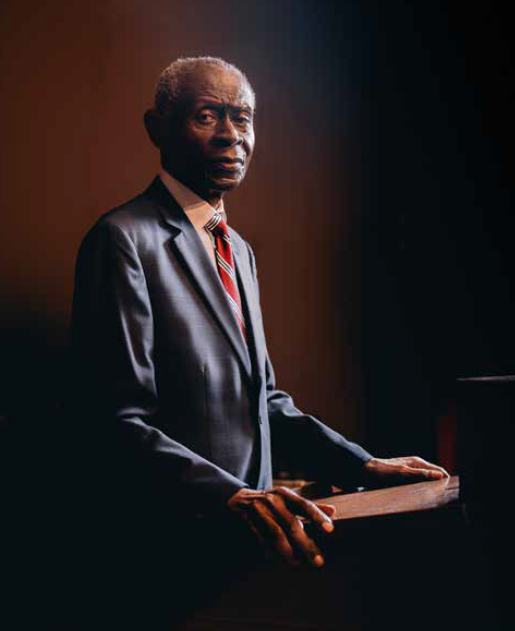
Lawrence Carter, Sr. (’68,’70,’79), the retiring dean of Morehouse College’s Martin Luther King, Jr. International Chapel, has a message for the academy and the church in troubled times
As told to Andrew Kimble (’19)
When I think about how the church must be in these tumultuous times, I return to small, decisive moments that made me who I am. There were factors, influences, motivations—specific experiences and a procession of personalities I marched with—that were preparing me before I was even consciously aware.
One of the earliest moments involved my grandmother. After I finished college, after I received my first Boston University degree, after I was ordained in 1968, and after I was married in 1969, I took my wife to Columbus, Ohio. We sat in my mother’s living room watching Alex Haley’s Roots. My mother and my aunt began to talk about family roots. My mother said, “When you were maybe five days old, we took you to church. At the end of the service, without any warning, my maternal grandmother took you in her arms and walked up and stood in front of the congregation. She started praying while holding you, and she prayed for God to make you a preacher.” I was born on Tuesday, September 23, 1941, at 5:25 p.m.; that Sunday my infant ears were closest to my grandmother’s lips. Hearing my mother recount that so profoundly shook me. I walked out on the front porch and down Oakley Avenue for blocks trying to fathom the power of prayer. The meaning of that public blessing: the church names futures. That prayer was a calling that stayed with me and later shaped everything I would do.
I loved the church. From the first grade to the ninth, I wanted to be a principal; my hero was Charles Blackburn, the principal of Garfield Elementary. But in the ninth grade something inside me changed. It was like a potter breaking a small vase and starting over with more clay: something bigger was growing in me. By the 10th grade I was trying to discern whether I was hearing a call. I began to pray seriously at 15. My strongest prayer was, “Lord, help me to send hundreds of young men and women into the ministry.” That was my desire: not fame, but formation—preparing people for a life of service.
My formation came from many teachers. In Columbus the Afro-Baptist pastors were giants—H. Beecher Hicks, Sr., of Mount Olivet Baptist Church, James Wesley Parrish of Shiloh Baptist Church, Jacob Julian Ashburn of Oakley Baptist Church, Charles F. Jenkins of Second Baptist, E.A. Parham of Trinity Baptist Church, and Phale D. Hale of Union Grove Baptist Church. They gathered the city for simultaneous annual revivals, bringing in five of the best preachers to preach at noon each day of the week at Shiloh Baptist. These occasions showed me that the pulpit is a place of moral imagination, and that ministry requires intellect, discipline, and eloquence; it shapes public conscience and cultivates civic formation.
I also learned from the humiliations and injustices I experienced. I remember being cheated after setting pins at a bowling alley, and being crushed at 13 when a proprietor refused my pay. I remember Dawson, Ga., where white people passing meant stepping off the sidewalk; I remember the “white man’s” water fountain, and my grandmother grabbing my shoulder and saying, “Don’t ever drink from the white man’s water fountain again.” Everything in me rebelled. It was then I knew I was different, set aside; that was the beginning of my realizing I would be a prophetic leader, “born to rebel.” At nine, at a minstrel show, I stared across a rope dividing black and white audiences and vowed, “When I become an adult, I’m going to tear that rope down.” Those early resistances became the moral fuel for a professional lifetime of reconciliation.
There were singular encounters that altered my course. In the 10th grade Joseph Gentry took me across town to Union Grove Baptist Church so I could hear Martin Luther King, Jr. (GRS’55, Hon.’59) preach. I’ve never been able to tell anybody what he preached, but afterwards, I found Dr. King sitting behind me watching me explore the pastor’s library. He asked, “Have you considered college? Have you considered Morehouse?” I said, “Yes!” I had been talked out of it by neighbors; he urged me to reconsider. I walked out a different person. Later, at E. C. Glass High School in Lynchburg, Va., I heard him again—4,000 people packed into an auditorium— and four times he lifted us out of our seats, screaming, “Yes!” It was oratory at its very best. These encounters taught me what prophetic ministry looks like: disciplined intellect married to moral courage and an ability to lift people toward action.
The church today must be a school of formation that marries heart and mind. We must prepare people to enter public life with disciplined compassion and moral imagination.

Boston University gave me other tools. I had five years of clinical training in pastoral psychology and counseling. That clinical formation taught me to see trauma, stress, and human brokenness with clarity. When people join the church and their baptisms “don’t take,” you can often trace that to unaddressed trauma and weak defenses. The ministry cannot be only oratory; it must be care. That is why I have labored to send hundreds of men and women into the ministry—not simply to preach but to build communities capable of bearing moral leadership.
Teaching chapel assistants across decades taught me another hard lesson: generations change. Society changes. Culture changes. Communication styles change. The current generation does not always share the values of the chapel assistants of my first 15 years. One student said, “I don’t need scholarship; I have the Spirit.” That troubled me. We are told to love the Lord with all heart, soul, and mind. If we forget the mind, we risk a truncated faith.
So how did I try to form them? With determination and vision. I knew where I had to get them, but I also knew they would not follow simply because I told them to. I had to become the thing I wanted them to be: model it, demonstrate it, actualize it. I had to depict it aesthetically and bring it to life so they saw the advantages of broadness and openness and were not threatened by it. I had to find scriptural texts that supported it and preach them so it was real, with ancient roots. I created an atmosphere that would continue to teach when I was gone. I brought people across all barriers—prisoners, all denominations, atheists, agnostics, deists, theists, the outcasts, the gays, the lesbians, the transgender. I tried to recognize everybody’s humanity. That’s where my preaching has come from.
The church today must be a school of formation that marries heart and mind. We must prepare people to enter public life with disciplined compassion and moral imagination. We must teach scholarship and spirit together; model inclusion without sacrificing conviction; learn to disagree agreeably; and embrace the long labor of institution-building. We must treat worship as work on the self, not merely the display of faith. Following the religion of Jesus will take you down paths you didn’t even know were there. I once thought my ministry was a failure, because I had to feed the hungry, clothe the naked, and raise scholarship money. Now, everybody is telling me that I won. Winning doesn’t always look like what you think it should.
If our churches and colleges can recover formation— prayer that names futures, preaching that marries intellect and compassion, pastoral practice that attends to trauma, and a call to the ministry of reconciliation—then they can be a guiding hand in a troubled moment. My hope is that the church will continue to realize callings, to form leaders, and to be people who can walk into a broken world with a disciplined, compassionate, healing heart of love.