Boston University DMin Seeks to Build Transformational Leaders
In August, a group of 25 Doctor of Ministry students gathered on Boston University’s campus to discover transformational leadership and learn new ways to transform their own ministry context, whether it’s working to include marginalized people in ministry, caring for churches that have suffered trauma, or creating space in a church’s community culture to welcome a new group of neighbors.
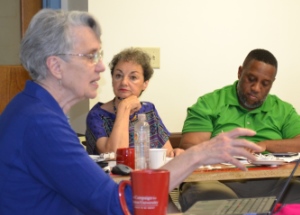 Mary Elizabeth Moore, dean of Boston University School of Theology, led the students through leadership theories, an analysis of leadership qualities, and core leadership functions. She referred back to the journal students kept, encouraging them to reflect on questions like, “Name the three leadership practices that you employ most often in your present community.” Woven throughout, students had the opportunity to talk through the insights they’d gained in their small group discussions and discuss their own thoughts on leadership, their unique style of leadership, and the cultural expectations around leadership styles.
“I think this class is doing a good job in that I’m far less sure about my answers to any of these questions than I was when I applied,” said one student. The students drew on examples from their own churches and contexts to think about their environment and the outcomes they wanted to accomplish.
As the class session drew to a close, Dean Moore left the students with some questions to ponder: What radical transformation might be needed in your community in the near future and later on? What actions would be authentic and ethical as you lead the community toward that future?
Boston University School of Theology has designed its Doctor of Ministry degree for leaders who have at least three years of ministry experience and are seeking a plan for transformational change. The degree is a three-year, low-residency degree program that combines online learning with six-day and nine-day intensive classes.
“In-class conversations regularly apply theological, transformative and leadership principles to the students’ own practice in their ministry settings,” said Dr. Eileen M. Daily, director of the program. The Doctor of Ministry intensives are a time of learning from Boston University’s leading faculty, with Sunday reserved for reading, writing, or Sabbath activities. The cohort have lively class discussions, share meals together, and immerse themselves in Boston by visiting churches and cultural sites that are relevant to the course. Students report that the discussions and learning help them to build a close-knit cohort that can support and learn from each other throughout the year.
“It was the core faculty who decided to launch this program and that decision came with a commitment to staff the program,” said Daily. Oversight is provided by a committee of core faculty members, and past teachers have included Dean Mary Elizabeth Moore teaching on Transformational Leadership and Dr. Walter E. Fluker teaching a course on Contextual Analysis.
The week after the class on transformational leadership, a second-year cohort met to discuss the directed study projects that are the culmination of the three-year degree. Each student gave a presentation on the idea and scope of their project and then their classmates lent analysis and input based on their own ministry experience.
The diversity of the program enriches the discussions. The program welcomes students from all faiths. Cohort members come from 16 states and across the United States, with 11 denominations and several nondenominational Christians. They work in a variety of contexts—as parish ministers, as hospital and military chaplains, as denominational leaders, as educators, as a multi-faith university chaplain, and as NGO leaders.
 Each student learns research skills and contextual analysis to dive deep into their directed study projects. “Students’ projects are part of the conversation with faculty and peers in each course from the beginning,” said Daily. One student is looking at integrating a one-on-one style of pastoral care, common in chaplaincy settings, with traditional parish life. Another student is creating a program to help a traditional United Methodist parish integrate parishioners with indigenous backgrounds. Another student is articulating a strategy for caring for parishes that have suffered injury or harm due to ministerial misconduct.
“Transformational leadership is a track that seems to offer the most flexibility for leaders in parishes, hospitals, NGOs and denominational organizations, and educational institutions,” said Daily. “As STH’s first major step into the distance learning world, we wanted to emphasize a track consistent with BU’s long-standing identity as being about prophetic witness in a changing world.”
You can find more information on the program here, including application requirements and deadlines.