
Program at a Glance
- Online and On Campus
- Full-Time or Part-Time Study
- 16 Units
- 8–12 Months to Completion
- 6 Full-Time Faculty Members
- No GRE/GMAT
- Tuition & Fees Range—Part-Time Study*: $11,290–$13,070
*Based on 2026–2027 Boston University tuition and fees.
Take the Next Step
Get essential information and guidance for applying.


Develop Valuable Crime Analysis Skills with a Graduate Certificate
Available on campus and online, the Graduate Certificate in Crime Analysis at Boston University’s Metropolitan College (MET) is an interdisciplinary program that develops your ability to use and analyze a variety of data sources to inform the investigations, strategies, and policy decisions of criminal justice organizations.
Crime analysis is crucial to a growing field within public safety and related domains in criminal justice, community-based organizations, and private firms. Policework is not just knocking on doors and interviewing witnesses anymore. Data-driven and intelligence-led approaches to crime have become the standard among contemporary criminal justice organizations. The proliferation of data generated by surveillance cameras, body cams, GPS, mobile devices, social media, email and text exchanges, wearable tech, sensors, and other sources has enhanced the potential to map hotspots, discern patterns and trends, gather evidence, solve crimes, and demonstrate results. Having the skills to analyze this data is critical for tactical, operational, and strategic efforts in law enforcement, and essential to research and policy development and reform.
BU MET’s Crime Analysis certificate prepares students to fill in-house crime analyst roles or similar positions, while strengthening the skills of those working in investigations, management, and operations to utilize analysis more effectively.
What Is My Career Outlook as a Graduate of This Program?
1,039,708
Total number of US Jobs
137,466
Annual job openings
+4%
Annual job openings
3%
Projected ten-year growth in jobs
(faster than average)
$79.2K
Median annual salary
Common job titles include:
- Crime/Intelligence Analyst
- Cybersecurity Investigator
- Special Agent
- Criminal Investigator
- Policy Coordinator
- Detective
Employers seek expertise in:
- Data analysis
- Performance management
- Investigation
- Digital forensics
Speak with our Admissions Team
Schedule a 1:1 call to speak with an advisor directly or attend an admissions event alongside other future students.
“Completing this program allowed me to move forward in my crime analysis career by expanding the range of positions that I could apply for in the field. While I did undertake this program with the intention of advancing my career, I also had the opportunity to learn skills that were applicable in my current position. After completing this program, I could perform more varied and elaborate analyses of the kind expected of traditional crime analysts.” Read more.
Caitlin Kloess (MET'22)
Crime Analyst, Denver Police Department
Graduate Certificate, Crime Analysis; Undergraduate Certificate, Criminal Justice
Why BU Should Be Your Top Choice for Criminal Justice Graduate Study
- Active Learning Environment: Benefit from criminal justice coursework that employs case studies, simulations using real data, and hands-on problem solving to develop practical skills you can immediately apply on the job.
- Engaged Faculty: Collaborate with faculty who have subject-matter expertise, research-based insight, and extensive field experience in law enforcement, corrections, cybercrime investigation and digital forensics, research and policy, forensic mental health, the judicial system, strategic management, and many other areas.
- Extensive Network: Study alongside classmates whose diversity of criminal justice experience inspires discussion and debate, along with the opportunity to form valuable, long-lasting connections in the field.
- 24:1 Average Class Ratio: Enjoy an exceptional student-to-instructor ratio, ensuring close interaction with faculty and access to support.
- Valuable Resources: Make use of Boston University’s extensive resources, including the Center for Career Development, Fitness & Recreation Center, IT Help Centers, Mugar Memorial Library, Frederick S. Pardee Center for the Study of the Longer-Range Future, Initiative on Cities, Howard Thurman Center for Common Ground, George Sherman Union, and many others.
- Flexible Options: Study at the pace that works for you, evenings on campus or fully online. Courses begin fall, spring, and summer; online courses have two starts per term.
- Track Record: Learn from the best—BU MET has offered criminal justice education since 1973, introducing its master’s degree in criminal justice in 1980, which became BU’s first fully online program in 2002.
Rankings & Accreditations

#5 in 2026, and top 6 since 2015 MET's criminal justice graduate certificates share curriculum with MET's online master's degree in criminal justice, which is ranked #5 in the nation by U.S. News & World Report.

#8, Best Online Master's in Criminal Justice Programs for Veterans MET’s criminal justice graduate certificates share curriculum with MET's online master's degree in criminal justice, which is ranked #8 in the nation for veterans and active-duty service members by U.S. News & World Report.
Prepare for the Future of Criminal Justice
The Crime Analysis graduate certificate is part of BU MET’s portfolio of criminal justice programs, which includes the Master of Science in Criminal Justice (MSCJ) with concentrations in Crime Analysis, Cybercrime Investigation & Cybersecurity, and Strategic Management, along with additional four-course graduate certificates in Criminal Justice, Cybercrime Investigation & Cybersecurity, and Strategic Management in Criminal Justice.
Housed in the Department of Applied Social Sciences at MET, Boston University’s criminal justice programs prepare you to tackle contemporary challenges in the field, providing training in critical specialization areas and emphasizing practical, insightful, and adaptable knowledge that can be immediately applied on the job while informing your career growth for years to come.
Online or on campus, BU MET students of criminal justice come from all walks of life and comprise an intricate network of organizations. Whether you are pursuing or enhancing a criminal justice career, planning for a doctoral program, or considering a future in teaching, BU’s criminal justice programs will give you the foundation to navigate difficult issues, improve your practice, and open new possibilities for your future.
Graduate with Expertise in Crime Analysis
Metropolitan College’s Graduate Certificate in Crime Analysis will equip you to:
- Acquire, clean, integrate, and manage complex public safety datasets (e.g., incident, calls-for-service) for analytical use.
- Apply statistical, spatial, and predictive analytical techniques—including mapping, GIS, and emerging data science tools—to identify crime patterns, trends, risk factors, and actionable insights.
- Produce professional analytical products (e.g., intelligence bulletins, tactical briefings, dashboards, and executive reports) that directly inform investigations, deployment strategies, and policy decisions.
- Evaluate and apply ethical, legal, and governance standards in the collection, analysis, and dissemination of crime and intelligence data within democratic public safety systems.
Certificate-to-Degree Pathway
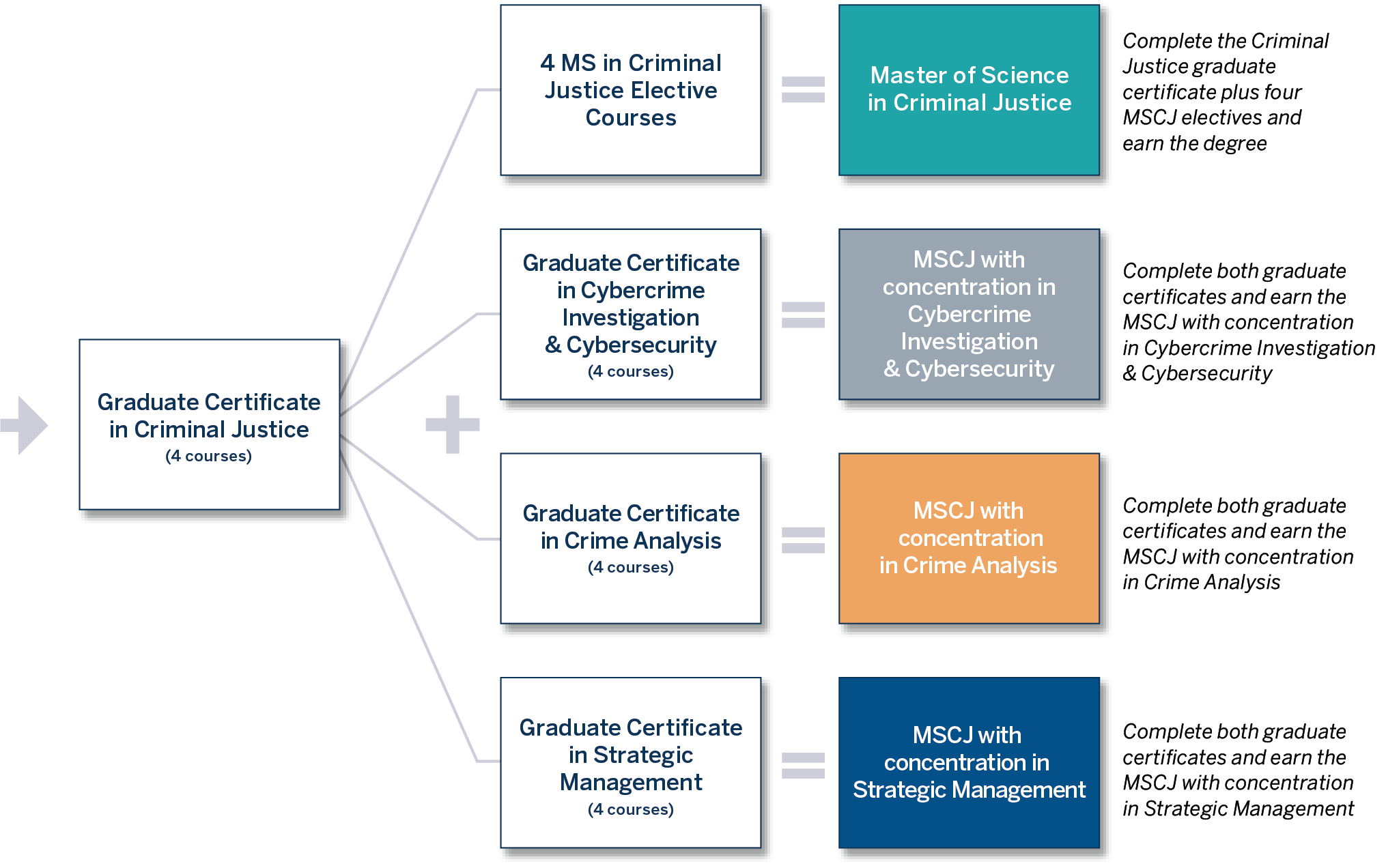
You can earn the master’s in Criminal Justice with a concentration in Crime Analysis by completing the Graduate Certificate in Criminal Justice and the Graduate Certificate in Crime Analysis. Students currently enrolled in a graduate certificate who are interested in transitioning into a master’s degree should contact their academic advisor to declare their interest in this pathway. A new master’s degree application is not required. Connect with a graduate admissions advisor at metadmissions@bu.edu to learn more about this option.
Crime Analysis Graduate Certificate Curriculum
A total of four courses (16 units) is required, as follows:
MET CJ 591 Applied Analytical Methods
MET CJ 612 Crime and Intelligence Analysis
MET UA 598 Foundations of GIS and Spatial Analysis
And one course from the following:
MET CJ 640 Performance Management Analytics
MET CJ 705 Threat Assessment
MET CJ 840 Applied Crime Analysis Project
MET CS 521 Information Structures with Python
MET CS 555 Foundations of Machine Learning
MET CS 577 Data Science with Python
MET CS 699 Data Mining
Any request for addition or substitution of elective courses requires approval from the department.
Criminal Justice Faculty

-

Abby Ballou
Visiting Assistant Professor, Criminal Justice Director, Prison Education Program
-

Kyung-shick Choi
Professor of the Practice, Criminal Justice Director, Cybercrime & Cybersecurity
-

Danielle Rousseau
Assistant Professor, Criminal Justice
-

James M. Silver
Visiting Associate Professor, Criminal Justice
-

April Gile Thomas
Associate Professor of the Practice, Criminal Justice
View All Faculty
How Much Does This Program Cost?
BU MET programs offer the flexibility of part-time study, either on campus or online. Tuition, fees, and total program cost are determined by enrollment status. Course enrollment in this certificate program is 1–2 courses (4–8 units) in a semester, and tuition is charged the part-time per-unit rate.
International students studying in on-campus programs are required to enroll full-time and should consult MET Admissions to ensure full-time enrollment is possible for a graduate certificate program based on current course availability. International students who enroll full-time will pay the full-time tuition rate as denoted on the tuition and fees page.
Crime Analysis Graduate Certificate (Online and On Campus)
| Enrollment Status | Part Time |
| Courses per Semester | 2 courses (8 units) |
| Time to Degree | 2 semesters (8 months) |
| Tuition* | $585–$1,030 per unit** |
| Fees per Semester* | $75 |
| Total Certificate Cost* | $11,290– $13,070 |
*Based on 2026–2027 Boston University tuition and fee rates.
**Cost per unit is determined by course number (100–599 = $585/unit, 600–999 = $1,030/unit).
Questions? Please contact us to hear from an Admissions Advisor who can help you determine the best enrollment pathway. For information regarding financial aid, visit BU MET’s Financial Aid page.
What to Read Next: MET Criminal Justice Knowledge Center
- Criminal Justice Student Stories
- Why Get a Master's Degree in Criminal Justice at BU MET?
- What Do My Career Options Look Like with a BU Master's in Criminal Justice?
- Are There Different Criminal Justice Graduate Programs or Specializations at BU?
- White Hat Hackers Team Up in International Cybercriminology Conference


