A Writer Discovers a Passion for Data at SPH.

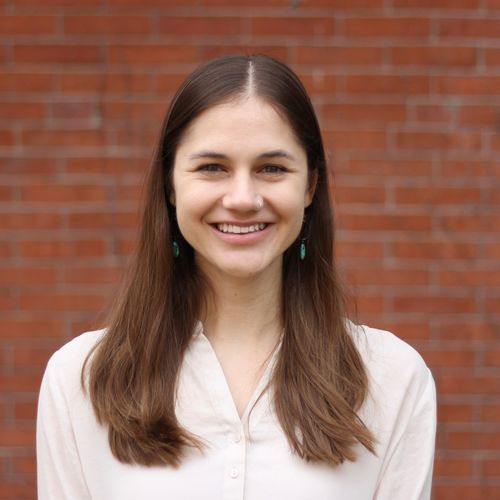
Rowena Lindsey on Talbot Green. Photo: Megan Jones
A Writer Discovers a Passion for Data at SPH
Rowena Lindsay, a part-time MPH student and full-time web strategist for MIT Lincoln Laboratory, came to SPH planning to strengthen her skills in health communications and completed a Public Health Post writing fellowship—then she unexpectedly developed a passion for epidemiology and biostatistics.
When Rowena Lindsay first enrolled at the School of Public Health, she had a plan. After studying journalism in undergrad and working several years in science communications at MIT Lincoln Laboratory—writing scripts, editing videos, and designing web content—she wanted to gain more experience in health communications more specifically. Pursuing an MPH seemed like the natural next step for someone who had been writing since childhood and spent most of her career to date translating complex scientific research for broader audiences.
But something unexpected happened during her first semester of coursework.
“I went into this program [for the] health communications and promotion certificate,” says Lindsay, “and I actually ended up switching to epidemiology and biostatistics [certificate], which was a real left turn for me.”
She began veering left in Quantitative Methods for Public Health (PH 717), a course she was originally apprehensive about, but somewhere between learning foundational statistical concepts and analyzing health datasets, something clicked. By the time Lindsay completed a second introductory course, Introduction to Statistical Applications in SAS (BS 723), with the same professor, Bill MacLeod, research associate professor of global health, she had made her decision. She would switch concentrations.
“That solidified my pivot into epi/biostats,” says Lindsay. “And then I took reproductive epidemiology—reproductive health is one of my areas of interest—with Lauren Wise, [professor of epidemiology,] and that was a really good class as well.”
As a part-time MPH student balancing full-time work at MIT Lincoln Laboratory as a web strategist, Lindsay also completed a year-long writing fellowship with Public Health Post (PHP). In a new Q&A, she shares what it takes to optimize the MPH experience as a working professional and the power of an advanced degree program to impart skills she may have otherwise found unattainable.
Q&A
With Rowena Lindsay—part-time MPH student, full-time web strategist for MIT Lincoln Laboratory, and prior Public Health Post writing fellow
SPH: Why did you choose to study at BUSPH, and did you know about Public Health Post (PHP) prior to enrolling?
Lindsay: There were several things that made me specifically want to go to BU, and I actually only ended up applying to BU. One of which was the concentrations and being able to really focus your studies in a specific way. But PHP was actually one of the things that I saw when I was researching the school, and that just seemed really perfect for me.
In undergrad at Northeastern [University], I had a co-op where I was doing a ton of writing about a lot of different subjects, and that was super helpful in focusing my career on science journalism and science communications. I saw PHP as something that could potentially do the same thing for this part of my career. [PHP] was part of why I applied to BU, and it ended up being a really great experience.
We write 30-something different articles, so there’s a lot of room to explore many different topics. I was able to write a lot about some of the areas that I’m particularly interested in—like reproductive health, environmental exposures, and rural healthcare delivery—but then I was also able to write some one-off things about subjects that are not necessarily my particular area of expertise. It’s interesting to get to dip your toe into it. Between all the pieces I wrote and all the pieces the other fellows were writing, you just learn a ton. And all the feedback from Jen Beard and Monica Wang, an editor at the time I was in PHP, was really valuable and not something you necessarily get in the professional world, so definitely appreciated that. It made me a stronger writer, and more confident in my ability to interpret and translate public health research for a broader audience.
SPH: How did you first come to be interested in public health?
Lindsay: Throughout undergrad, I had some journalism-related jobs, and through those, I came to focus specifically on science journalism and science communications. Now, I work at MIT Lincoln Laboratory, where I had a co-op in undergrad, and I’ve done a variety of roles for them. I worked on their internal newsletter, writing news articles, and then I spent several years working on the multimedia team, [doing] scriptwriting and video production. And now, I still work full-time there on the UI/UX team, [where] I do a lot of writing for websites. All of that was mostly focused on communicating the research that the lab is working on. I didn’t have a lot of opportunities to work on health-related projects, but whenever I did, I found that those were the ones that I was most interested in. This was a couple years ago when I was deciding to come back to school, [and] I was also dealing with some of my own health problems—interacting with the health system more, thinking more about the process by which new health knowledge is generated—so as soon as I had the idea to get an MPH, I decided that that’s what I would do.
SPH: You completed your fellowship with PHP, but you are still working full time while pursuing your MPH part time. How do you manage that balance, and what would you want prospective students who are considering a similar arrangement to know?
Lindsay: It’s definitely been challenging to balance everything. I’m a pretty organized person, so that definitely helps—I use a lot of color coding in my schedule. But I’m really happy to be going about it this way. I think, especially since I didn’t have a really solid goal of what I wanted to do with the degree when I went into it, I haven’t really minded taking my time with making my way through the program. There’s a lot of ways in which [being part time] makes my schedule less flexible, but I’ve also felt like I’ve been able to take a lot of the classes I wanted, with the professors I wanted, just because I have more time to spread things out. I’m really grateful to have work experience already, and it’s how I afford to pay for the program, is to work at the same time.
SPH: You originally planned to pursue a certificate in health communications and promotion, but during your first year in the MPH program, you switched to epidemiology and biostatistics. Could you elaborate on what changed, and what you hope to do with the skills you gain?
Lindsay: I’ve never been good at math, and I was absolutely dreading the quantitative methods core class. Then, I just ended up really loving it, which is still kind of shocking to me, even years later. But it made me realize that even if something doesn’t come naturally to me, like, say, writing generally does, I can still learn to be good at it. So I changed my concentration to epi/biostats, and that’s changed my career goals a little bit. I still want to be working in communications—I think the dream job would probably be some kind of data journalism role, with a focus on public health.