Qualify for Crime Analysis Jobs with a Master’s in Criminal Justice
The Master of Science in Criminal Justice concentration in Crime Analysis at Boston University’s Metropolitan College (MET) develops your expertise in using and analyzing a variety of data sources to inform the investigations, strategies, and policy decisions of criminal justice organizations. This set of skills is crucial to a growing field within law enforcement and related domains in criminal justice, since policework is not just knocking on doors and interviewing witnesses anymore. The proliferation of data generated by surveillance cameras, body cams, GPS, mobile devices, social media, email and text exchanges, wearable tech, sensors, and other sources has enhanced the potential to map hotspots, discern patterns and trends, gather evidence, solve crimes, and demonstrate results. Having the skills to analyze this data is critical for tactical, operational, and strategic efforts in law enforcement, and essential to research and policy development and reform.
The Crime Analysis concentration of BU MET’s MS in Criminal Justice prepares you to fill in-house crime analyst roles or similar positions, while strengthening the overall skillset of individuals who are involved in investigations, management, and operations.
“As someone who had no experience in the criminal justice field going into this program, I left it feeling very prepared and it definitely paid off. I have been told in several job interviews that my resume is impressive, and that is largely thanks to having Boston University on there. The name carries weight and gives you an edge over other candidates. On top of that, the skills and knowledge you gain really do prepare you for a job in the field.” Read more.
Bella Zak (MET'22)
Contractor, Crime Gun Intelligence Center of Chicago, Bureau of Alcohol, Tobacco, Firearms and Explosives MS, Criminal Justice, concentration in Crime Analysis
Why BU’s Criminal Justice Master’s Has Been Top 6 since 2015
Active Learning Environment: Benefit from a criminal justice master’s that employs case studies, simulations using real data, and hands-on problem solving to develop practical skills you can immediately apply on the job.
Engaged Faculty: Collaborate with faculty who have subject-matter expertise, research-based insight, and extensive field experience in law enforcement, corrections, cybercrime investigation and digital forensics, research and policy, forensic mental health, the judicial system, strategic management, and many other areas.
Extensive Network: Study alongside classmates whose diversity of criminal justice experience inspires discussion and debate, along with the opportunity to form valuable, long-lasting connections in the field.
24:1 Average Class Ratio: Enjoy an exceptional student-to-instructor ratio, ensuring close interaction with faculty and access to support.
Flexible Options: Study at the pace that works for you, evenings on campus or fully online. Courses begin fall, spring, and summer; online courses have two starts per term.
Track Record: Learn from the best—BU MET has offered criminal justice education since 1973, introducing the master’s degree in criminal justice in 1980, which became BU’s first fully online program in 2002.
Merit Scholarships: All graduate students are automatically considered for merit scholarships during the application process and nominated based on eligibility. Learn more.
Rankings & Accreditations
#5 in 2026, and top 6 since 2015
MET’s online master’s degree in criminal justice is ranked #5 in the nation by U.S. News & World Report.
#8, Best Online Master's in Criminal Justice Programs for Veterans
MET’s online master’s degree in criminal justice is ranked #8 in the nation for veterans and active-duty service members by U.S. News & World Report.
Prepare for the Future of Criminal Justice
The Crime Analysis concentration is part of BU MET’s MS in Criminal Justice (MSCJ) degree program, focusing on the data-driven and intelligence-led approaches to crime that are rapidly becoming the standard among contemporary criminal justice organizations.
The master’s in Criminal Justice at BU MET is designed for professionals who want to enter or advance in the field of criminal justice—or simply gain a deeper understanding of this fascinating discipline and how it intersects with careers in mental health, public health, journalism, and law. Emphasizing practical, insightful, and adaptable knowledge, BU MET’s criminal justice courses develop practical skills that can be immediately applied on the job while informing your career growth for years to come.
Graduate with Expertise in Crime Analysis
Metropolitan College’s Criminal Justice master’s degree concentration in Crime Analysis will equip you to:
Acquire, clean, integrate, and manage complex public safety datasets (e.g., incident, calls-for-service) for analytical use.
Apply statistical, spatial, and predictive analytical techniques—including mapping, GIS, and emerging data science tools—to identify crime patterns, trends, risk factors, and actionable insights.
Produce professional analytical products (e.g., intelligence bulletins, tactical briefings, dashboards, and executive reports) that directly inform investigations, deployment strategies, and policy decisions.
Evaluate and apply ethical, legal, and governance standards in the collection, analysis, and dissemination of crime and intelligence data within democratic public safety systems.
Certificate-to-Degree Pathway
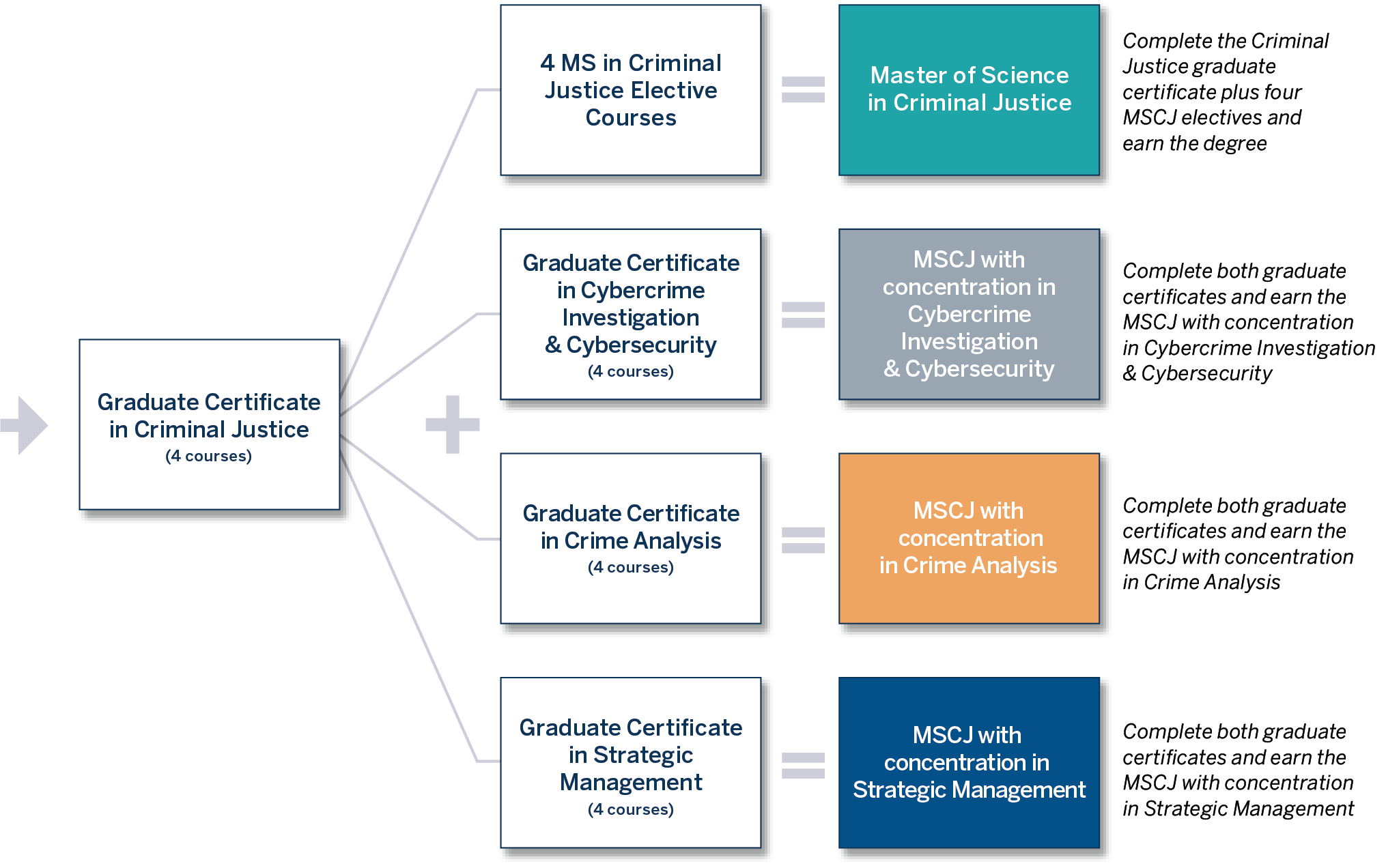
You can also earn the master’s in Criminal Justice with a concentration in Crime Analysis by completing the Graduate Certificate in Criminal Justice and the Graduate Certificate in Crime Analysis. Students currently enrolled in a graduate certificate who are interested in transitioning into a master’s degree should contact their academic advisor to declare their interest in this pathway. A new master’s degree application is not required. Connect with a graduate admissions advisor at metadmissions@bu.edu to learn more about this option.
Dual Concentration Option
Students in the MS in Criminal Justice program have the option to complete both the concentrations in Crime Analysis and Cybercrime Investigation & Cybersecurity by completing just two additional courses (for a total of ten courses/40 units). Along with the four required courses, candidates for the dual concentration would also complete the following:
MET CJ 610 Cybercrime
MET CJ 612 Crime and Intelligence Analysis
MET CJ 620 Cyberterrorism and Cyber Defense
MET CJ 710 Applied Digital Forensic Investigation
MET UA 598 Foundations of GIS and Spatial Analysis
Students must complete the core courses and Crime Analysis concentration requirements.
Core Courses
(Four courses/16 units)
MET CJ 570 Criminology and Crime Policy
Fall ‘26
Why do people commit crime, and how should those explanations shape public policy and practice? Explore crime through a range of criminological perspectives and examine how different ways of understanding crime lead to different responses from the justice system and society. You will study major theories from across the social sciences and consider what they suggest about the causes of crime, the development of law, and the design of effective policies and programs. Along the way, you will connect theory and research to contemporary crime problems and evaluate how well current justice practices reflect the evidence. By the end of the course, you will be better prepared to use criminological theory and research to assess competing ideas about crime and to inform decisions about law, policy, and practice. [ 4 cr. ]
Section
Type
Instructor
Location
Days
Times
A1
IND
Thomas
CAS 208
T
6:00 pm – 8:45 pm
O1
IND
Thomas
ARR
12:00 am – 12:00 am
MET CJ 571 Criminal Justice Administration and Ethics
Fall ‘26
How should justice organizations be led and managed within the legal and ethical constraints that govern their work? Explore the practical challenges of administering policing, court, and correctional institutions in ways that comply with law, policy, and professional standards. You will examine how justice organizations operate and how leadership, organizational culture, and management practices shape decision-making. The course introduces key ideas from organizational theory and applies them to real-world justice settings, including employee motivation, professional socialization, stress and burnout, and organizational deviance. Through case analysis and discussion, you will examine how laws, policies, and legal and professional obligations guide professional judgment and shape how justice leaders translate policy into practice. [ 4 cr. ]
Section
Type
Instructor
Location
Days
Times
A1
IND
Cadigan
EPC 208
R
6:00 pm – 8:45 pm
O1
IND
Silver
ARR
12:00 am – 12:00 am
MET CJ 590 Research and Evaluation Methods
Fall ‘26
How do justice leaders know whether a policy or program is actually working? In many criminal justice and community organizations, professionals are expected to use research and data to guide decisions, evaluate programs, and improve outcomes. Develop practical research and evaluation skills used in justice administration and related fields. You will learn how to move through the research and evaluation process—from developing questions to collecting, analyzing, and communicating evidence. The course emphasizes applied research settings, particularly the evaluation of justice policies and programs. You will examine common research designs and the strengths and limitations of different approaches. Topics include sampling, survey design, interviews, participant observation, case studies, and process evaluations. By the end of the course, you will be better prepared to interpret research and use evaluation methods to assess and improve real-world programs and policies. [ 4 cr. ]
Section
Type
Instructor
Location
Days
Times
A1
IND
Ballou
SHA 202
W
6:00 pm – 8:45 pm
O2
IND
Ballou
ARR
12:00 am – 12:00 am
MET CJ 591 Applied Analytical Methods
Fall ‘26
Evidence-based and data-informed approaches are now central to modern criminal justice practice. How can data help you understand crime problems, evaluate programs, and support better policy decisions? Develop practical skills for analyzing and interpreting quantitative data used in justice policy and administration. You will learn how to frame research questions, summarize patterns in data, and draw meaningful conclusions from statistical evidence. The course introduces key analytical tools—including descriptive statistics, hypothesis testing, and measures of association—and demonstrates how they are used to analyze crime and justice data. Working with real datasets and justice-system contexts, you will build experience conducting analyses and communicating findings clearly to diverse audiences. By the end of the course, you will be able to interpret statistical evidence and “tell the story” behind the numbers. [ 4 cr. ]
Section
Type
Instructor
Location
Days
Times
O2
IND
Holt
ARR
12:00 am – 12:00 am
Concentration Requirements
(Four courses/16 units)
MET CJ 612 Crime and Intelligence Analysis
Fall ‘26
How do crime analysts turn complex data into insights that guide investigations and crime prevention strategies? Explore the analytical techniques used by contemporary law enforcement and public safety organizations to identify crime patterns, assess emerging problems, and inform operational decisions. You will examine the principles and practices of crime and intelligence analysis, including how analysts collect, interpret, and communicate information that supports investigative, tactical, and strategic decision-making. The course also considers the role of analysts within justice organizations and the legal and policy frameworks that shape their work. Through applied exercises and case-based simulations using real-world data sources, you will develop practical analytical skills used to address common crime problems and support effective public safety strategies. [ 4 cr. ]
Section
Type
Instructor
Location
Days
Times
A1
IND
Cronin
PSY B55
M
6:00 pm – 8:45 pm
O1
IND
Cronin
ARR
12:00 am – 12:00 am
MET UA 598 Foundations of GIS and Spatial Analysis
Fall ‘26
How can maps and spatial data reveal patterns in cities and communities that aren’t visible at street level? In this project-based course, you learn how Geographic Information Systems (GIS) help planners and urban professionals analyze places, understand patterns, and make better decisions. You’ll build practical skills in spatial thinking and spatial analysis while working with real geographic data. Through hands-on projects, you’ll learn how to collect, organize, and analyze spatial information, create maps that communicate clear insights, and evaluate the strengths and limits of different data sources. Along the way, you’ll explore how GIS is used to address real urban challenges—from understanding neighborhood change to informing planning and policy decisions. By the end of the course, you’ll be able to use GIS tools to analyze places, visualize patterns, and communicate spatial insights that support sustainable and more equitable communities. [ 4 cr. ]
Section
Type
Instructor
Location
Days
Times
O2
IND
Sungu-Eryilmaz
ARR
12:00 am – 12:00 am
Plus one course from the following:
MET CJ 620 Cyberterrorism and Cyber Defense
Fall ‘26
How can cyber threats targeting critical infrastructure be identified, analyzed, and prevented? In this course, you will examine the evolving nature of cyberterrorism and the risks posed to national security, public safety, and critical systems. Drawing on cyber intelligence methods and real-world case studies, the course explores how malicious actors conduct information attacks, target infrastructure systems, and exploit digital technologies to advance extremist or criminal objectives. Working in a laboratory environment, you will analyze cyber incidents, examine attack strategies, and develop defensive and policy responses. By the end of the course, you will understand how cyber intelligence, digital investigation, and security strategies are used to detect, assess, and counter cyber-enabled threats to critical infrastructure. [ 4 cr. ]
Section
Type
Instructor
Location
Days
Times
O2
IND
Choi
ARR
12:00 am – 12:00 am
MET CJ 640 Performance Management Analytics
How can justice organizations use data to strengthen performance, accountability, and public trust? Explore how analytical tools support modern management and decision-making across policing, courts, corrections, and community-based organizations. You will examine contemporary performance management approaches and learn how data can be used to assess effectiveness, fairness, transparency, and responsiveness within justice systems. Working with real-world data sources, you will develop skills in identifying meaningful performance measures, organizing and analyzing datasets, and interpreting findings in organizational contexts. By the end of the course, you will be prepared to translate data into clear analytical products—such as reports and dashboards—that inform management decisions and support accountability to both agency leadership and community stakeholders. [ 4 cr. ]
MET CJ 705 Threat Assessment
Fall ‘26
How can potential acts of violence be identified and prevented before they occur? Explore the principles and practices of behavioral threat assessment, a structured approach used to identify, evaluate, and manage individuals who may pose a risk of targeted violence. Drawing on insights from criminology, psychology, psychiatry, and law enforcement practice, you will examine how threat assessment teams analyze behavioral indicators, contextual factors, and warning signs associated with potential acts of violence. Through case studies and research on school shootings, targeted violence, domestic violence, and lone-actor terrorism, the course explores how professionals assess risk and develop prevention strategies. The course reflects contemporary practices used by multidisciplinary threat assessment teams working to prevent targeted violence in schools, workplaces, and communities. [ 4 cr. ]
Section
Type
Instructor
Location
Days
Times
O1
IND
Silver
ARR
12:00 am – 12:00 am
MET CJ 840 Applied Crime Analysis Project
Students in the Crime Analysis (CA) concentration or certificate program are encouraged to engaged in a supervised project as part of their degree. The project is supervised by an instructor, typically the concentration area coordinator. It can be used to fulfill a 4-credit elective course within the concentration or certificate. Project-based and experiential learning activities are central to graduate professional education and to our own program's learning outcomes. The project gives students an opportunity to enhance and synthesize skills learned in other courses, apply skills to real-world problems and settings, and make connections into the professional field. Projects in the CA concentration or certificate will focus applied research and analytical methodologies and/or organizational processes connected to analysis within criminal justice or related agencies. [ 4 cr. ]
MET CS 521 Information Structures with Python
Fall ‘26
HUB
Prerequisite: Programming experience in any language. Or Instructor's consent. Explore the object-oriented approach to software design and development using Python. You will engage in a detailed discussion of programming concepts starting with the fundamentals of data types, control structures methods, classes, arrays and strings, and proceed to more advanced topics such as inheritance and polymorphism, creating user interfaces, exceptions and streams. Upon completion of this course, you will be able to apply software engineering principles to design and implement Python applications that can be used with analytics and big data. Effective Fall 2021, this course fulfills a single unit in each of the following BU Hub areas: Creativity/Innovation, Critical Thinking, Quantitative Reasoning 2. [ 4 cr. ]
Prerequisites: MET CS 544 or MET CS 550 or consent of instructor. You will learn the foundations of statistical machine learning, regression, and classification, and explore the key components of statistical models, including how to construct, interpret, and evaluate them. Topics include data description and visualization, statistical inference, one- and two-sample tests for means and proportions, simple and multiple linear regression, multinomial and logistic regression, analysis of variance (ANOVA), and regression diagnostics. For each topic, you will examine the methodology, underlying assumptions, interpretation of results, and model assessment. The course includes a programming component using R or Python, providing hands-on experience that reinforces theoretical concepts. Methods are presented through real-world examples to help you understand when and how to apply different statistical techniques effectively. [ 4 cr. ]
Section
Type
Instructor
Location
Days
Times
A1
IND
Alizadeh-Shabdiz
SHA 202
R
6:00 pm – 8:45 pm
O2
IND
Alizadeh-Shabdiz
ARR
12:00 am – 12:00 am
MET CS 577 Data Science with Python
Fall ‘26
Prerequisite: (MET CS 521) or equivalent or instructor's consent. Students will learn major Python tools and techniques for data analysis. There are weekly assignments and mini projects on topics covered in class. These assignments will help build necessary statistical, visualization and other data science skills for effective use of data science in a variety of applications including finance, text processing, time series analysis and recommendation systems. In addition, students will choose a topic for a final project and present it on the last day of class. [ 4 cr. ]
Section
Type
Instructor
Location
Days
Times
A2
IND
Mohan
PHO 202
R
6:00 pm – 8:45 pm
A4
IND
Pinsky
STH 113
T
9:00 am – 11:45 am
O2
IND
Mohan
ARR
12:00 am – 12:00 am
MET CS 699 Data Mining
Fall ‘26
Prerequisites: MET CS 521, MET LB 103 and MET LB 104; and either MET CS 579 or MET CS 669; or consent of instructor. - Study basic concepts and techniques of data mining. Topics include data preparation, classification, performance evaluation, association rule mining, regression and clustering. You will learn underlying theories of data mining algorithms in the class and practice those algorithms through assignments and a semester-long class project using R. After finishing this course, you will be able to independently perform data mining tasks to solve real-world problems. [ 4 cr. ]
Section
Type
Instructor
Location
Days
Times
A1
IND
Lee
SOC B63
W
6:00 pm – 8:45 pm
O2
IND
Lee
ARR
12:00 am – 12:00 am
MET UA 642 Geospatial Intelligence for Urban Analysis
How can spatial data reveal patterns in transportation, crime, environmental conditions, and economic activity across a city? In this course, you learn how advanced GIS and spatial analysis techniques help planners and urban professionals understand complex urban issues. The course is organized in three parts. First, analyzing the city, where you apply advanced spatial analysis methods—such as point pattern analysis, spatial autocorrelation, geographically weighted regression (GWR), and network analysis—to uncover patterns and relationships in urban data. Second, sensing the city, where you learn how spatial data is created through digitizing, field-based data collection with tools like ArcGIS Survey123, and emerging technologies such as LiDAR. Third, visualizing the city, where you transform analysis into clear insights using StoryMaps or interactive dashboards. Through hands-on projects, you will investigate real urban challenges and learn how to communicate spatial insights to support planning, policy analysis, and public understanding. By the end of the course, you’ll be able to collect, analyze, and visualize spatial data to inform evidence-based urban decision-making. [ 4 cr. ]
And one general elective chosen with an academic advisor. General electives can be found within the MS in Criminal Justice curriculum.
Any request for addition or substitution of elective courses requires approval from the department.
Charlene Bonner PsyD, Massachusetts School of Professional Psychology; MEd, Bridgewater State College; BA, Saint Anselm College
Robert Cadigan PhD, MA, Boston University; BA, University of Massachusetts Amherst
Clifford Davis MS, Boston University; BS, University of Massachusetts Boston
Linda Holt MA, Tufts University; BA, University of Massachusetts at Amherst
Melaine Malcolm MEd, BA, Boston College
James Matesanz MEd, Boston College; BA, St. Anselm College
How Much Does This Program Cost?
BU MET programs offer the flexibility of part-time or full-time study, either on campus or online. Tuition, fees, and total program cost are determined by enrollment status. If you enroll in 1–2 courses (4–8 units) in a semester, you are charged the part-time per-unit rate. If you enroll in 3–4 courses (12–16 units) in a semester, you are charged the full-time semester rate.
MS in Criminal Justice, Crime Analysis Concentration (Online and On Campus)
Enrollment Status
Part Time
Full Time
Courses per Semester
2 courses (8 units)
4 courses (16 units)
3 courses (12 units)
Time to Degree
4 semesters (16 months)
2 semesters (8–12 months)***
3 semesters (12–16 months)***
Tuition*
$585–$1,030 per unit**
$36,512 per semester
$36,512 per semester
Fees per Semester*
$75
$524
$524
Total Degree Cost*
$22,580– $24,360
$74,072
$82,387
*Based on 2026–2027 Boston University tuition and fee rates. **Cost per unit is determined by course number (100–599 = $585/unit, 600–999 = $1,030/unit). ***Summer semester enrollment is not required for international students to maintain F-1 visa status. Enrollment in summer semester coursework will expedite completion of program and reduce total program cost.
International students seeking an F-1 visa for on-campus study must enroll full time and demonstrate availability of funds to cover the Estimated Cost of Graduate Study; those who wish to study online may enroll part-time but are not eligible for a visa. Learn more about International Student Tuition & Fees.
Questions? Please contact us to hear from an Admissions Advisor who can help you determine the best enrollment pathway. For information regarding financial aid, visit BU MET’s Financial Aid page.
What to Read Next: MET Criminal Justice Knowledge Center