
Learn to Develop Effective Web Applications
Available online and on campus, the Master of Science in Computer Information Systems concentration in Web Application Development at Boston University’s Metropolitan College (MET) is designed to immerse you in the fast-paced world of technological innovation—preparing you for IT leadership and artificial intelligence-integrated positions in all sectors.
Program at a Glance
- Top-Ranked Online Program since 2014
- Online, On Campus, and Blended
- Part-Time or Full-Time Study
- STEM Designated
- 32 Units
- 8–16 Months to Completion
- 19 Core Faculty
- No GRE/GMAT
- Tuition & Fees—Part-Time Study*: $31,480
*Based on 2026–2027 Boston University tuition and fees. Merit scholarship may reduce cost.
Take the Next Step
Get essential information and guidance for applying.


Advance Your Career with a Master’s in Computer Information Systems
The BU MET Computer Information Systems master’s degree concentration in Web Application Development introduces the fundamental concepts of web applications, providing comprehensive coverage of both client-side and server-side development of apps, as well as rich internet application development. The Web Application Development concentration will prepare you to create real-world web application projects that also involve interacting with databases such as Oracle, MySQL, and NoSQL databases like MongoDB.
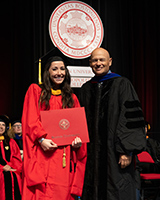
“While I still want to focus on web application development, I love how this program provided me with a thorough understanding of business fundamentals, as it puts me in a great position to easily transition to the business side of the technology field if I wish to do so.” Read more.
Chantal Barrett (MET'23)
Software Engineer, Dell
MS, Computer Information Systems; Concentration, Web Application Development
Speak with our Admissions Team
Schedule a 1:1 call to speak with an advisor directly or attend an admissions event alongside other future students.
Why BU’s Computer Information Systems Degree is a Top-Ranked Program
- Active Learning Environment: BU MET’s Computer Information Systems courses introduce case studies and real-world projects that ensure you gain in-depth, practical experience with the latest technologies.
- Career Counseling: MET’s Career Development office and BU’s Center for Career Development offer a variety of job-hunting resources, including one-on-one career counseling by appointment for both online and on-campus students.
- Engaged Faculty: In BU MET’s Computer Information Systems master’s program, you benefit from working closely with highly qualified faculty and industry leaders who have expertise in programming languages, databases, computer application systems, desktop and mobile applications, software development, and IT project management.
- AI-Integrated: Many courses prepare you to leverage artificial intelligence for the analysis, development, and integration of modern information systems.
- Extensive Network: Study information systems alongside peers with solid business experience, learn from faculty who have valuable IT contacts across several sectors, and benefit from an alumni community with strong professional connections.
- STEM Designated: Eligible graduates on student visas have access to an Optional Practical Training (OPT) of 12 months and an extension for up to 24 additional months.
- 24:1 Average Class Ratio: Enjoy an exceptional student-to-instructor ratio, ensuring close interaction with faculty and access to support.
- Valuable Resources: Make use of Boston University’s extensive resources, including the Center for Career Development, Educational Resource Center, Fitness & Recreation Center, IT Help Centers, Mugar Memorial Library, Howard Thurman Center for Common Ground, George Sherman Union, Rafik B. Hariri Institute for Computing and Computational Science & Engineering, and many others.
- Flexible Options: Study at the pace that works for you, evenings on campus or fully online. Courses begin fall, spring, and summer; online courses have two starts per term.
- Track Record: Learn from the best—BU MET’s Department of Computer Science was established in 1979 and is the longest-running computer science department at BU. Over the course of its existence, the department has played an important role in the emergence of IT at the University and throughout the region.
- Merit Scholarships: All graduate students are automatically considered for merit scholarships during the application process and nominated based on eligibility. Learn more.
Rankings & Accreditations

#12, Best Online Master's in Computer Information Technology Programs MET’s online master’s degrees in computer information technology are ranked #12 in the nation by U.S. News & World Report.
Master the Tools to Excel in Computer Information Systems
The Web Application Development concentration is part of BU MET’s MS in Computer Information Systems (MSCIS) degree program. You will learn the latest topics in JavaScript, CSS, HTML5, Vue.JS, Angular PHP, and Node.js, while becoming familiar with cutting-edge technologies for building desktop and mobile web applications.
With eight concentrations, the Computer Information Systems master’s encompasses a number of fast-growing and well-paid segments of the IT job market, providing the foundation for work as an application analyst, computer and information systems manager, data analyst, data scientist, cybersecurity analyst, IT consultant, network and computer systems administrator, computer systems analyst, database administrator, and many other integral positions in an organization.
Graduate with Expertise
In addition to the learning outcomes derived from Metropolitan College’s Computer Information Systems master’s degree program, the concentration in Web Application Development will equip you with the ability to:
- Develop and deploy full-stack web applications using client-side and server-side technologies (including responsive front-end frameworks and back-end services), building secure, scalable, and maintainable systems.
- Apply advanced programming principles, agile methodologies, and mobile and secure software development techniques to create user-centered applications.
- Work in team-based environments and adapt to evolving web development practices.
Certificate-to-Degree Pathway
You can also earn the master’s in Computer Information Systems with a concentration in Web Application Development by completing the BU MET Graduate Certificate in Information Technology plus either Information Structures with Java (MET CS 520) or Information Structures with Python (MET CS 521), and the Web Application Development degree concentration requirements. Students currently enrolled in a graduate certificate who are interested in transitioning into a master’s degree should contact their academic advisor to declare their interest in this pathway. A new master’s degree application is not required. Connect with a graduate admissions advisor at metadmissions@bu.edu to learn more about this option.
Master’s in Computer Information Systems Curriculum
Web Application Development Concentration
A total of 32 units is required.
Students must complete the core courses and Web Application Development concentration requirements.
Preparatory Labs
All students are enrolled in the following free, online, non-unit preparatory labs designed to strengthen their academic foundation and serve as a key resource for the degree program. Requirements for completion are assessed during the application process.
- MET LB 102 Foundations of Computer Information Systems
- MET LB 103 Core Mathematical Concepts
- MET LB 104 Foundations of Probability
Core Courses
(Four courses/16 units)
One of the following:
MET CS 520 Information Structures with Java
MET CS 521 Information Structures with Python
MET CS 625 Business Data Communication and Networks
MET CS 669 Database Design and Implementation for Business
MET CS 682 Information Systems Analysis and Design
Students who have completed courses on core curriculum subjects as part of their undergraduate degree program may request permission from the Department of Computer Science to replace the corresponding core courses with graduate-level computer information systems electives. Please refer to the MET CS Academic Policies Manual for further details.
Concentration Requirements
(Four courses/16 units)
MET CS 601 Frontend Web Development
MET CS 602 Server-Side Web Development
And two courses from the following (some courses may not be available in the online format):
MET CS 622 Advanced Programming Techniques
MET CS 634 Agile Software Development with Intelligent Systems
MET CS 683 Mobile Application Development with Android
MET CS 763 Secure Software Development
Master’s Thesis Option
(8 units)
Students have the option to complete a master’s thesis in addition to the program’s eight course (32 unit) requirements. The thesis option is to be completed within twelve months and is available to Master of Science in Computer Information Systems candidates who have completed at least four courses toward their degree and have a GPA of 3.7 or higher. Students are responsible for finding a thesis advisor and a principal reader within the department. The advisor must be a full-time faculty member; the principal reader may be part-time faculty with a PhD (unless waived by the department).
Computer Science Faculty
-

Guanglan Zhang
Associate Professor, Computer Science Coordinator, Health Informatics Programs Chair, Computer Science
-

Shengzhi Zhang
Associate Professor Associate Chair, Computer Science Coordinator, Web Application Development
-

Scot Arena
Master Lecturer, Computer Science Coordinator, Computer Networks
-

Farshid Alizadeh-Shabdiz
Professor of the Practice, Computer Science
-

Lou Chitkushev
Professor, Computer Science Senior Associate Dean, Academic Affairs Director, Health Informatics & Health Sciences Head, Digital Forensics Research Laboratory
View All Faculty













How Much Does This Program Cost?
BU MET programs offer the flexibility of part-time or full-time study, either on campus or online. Tuition, fees, and total program cost are determined by enrollment status. If you enroll in 1–2 courses (4–8 units) in a semester, you are charged the part-time per-unit rate. If you enroll in 3–4 courses (12–16 units) in a semester, you are charged the full-time semester rate.
MS in Computer Information Systems, Web Application Development Concentration (Online and On Campus)
| Enrollment Status | Part Time | Full Time | |
| Courses per Semester | 2 courses (8 units) |
4 courses (16 units) |
3 courses (12 units) |
| Time to Degree | 4 semesters (16 months) |
2 semesters (8–12 months)*** |
3 semesters (12–16 months)*** |
| Tuition* | $585–$1,030 per unit** |
$36,512 per semester |
$36,512 per semester |
| Fees per Semester* | $75 | $524 | $524 |
| Total Degree Cost* | $31,480 | $74,072 | $82,387 |
*Based on 2026–2027 Boston University tuition and fee rates.
**Cost per unit is determined by course number (100–599 = $585/unit, 600–999 = $1,030/unit).
***Summer semester enrollment is not required for international students to maintain F-1 visa status. Enrollment in summer semester coursework will expedite completion of program and reduce total program cost.
International students seeking an F-1 visa for on-campus study must enroll full time and demonstrate availability of funds to cover the Estimated Cost of Graduate Study; those who wish to study online may enroll part-time but are not eligible for a visa. Learn more about International Student Tuition & Fees.
Questions? Please contact us to hear from an Admissions Advisor who can help you determine the best enrollment pathway. For information regarding financial aid, visit BU MET’s Financial Aid page.


