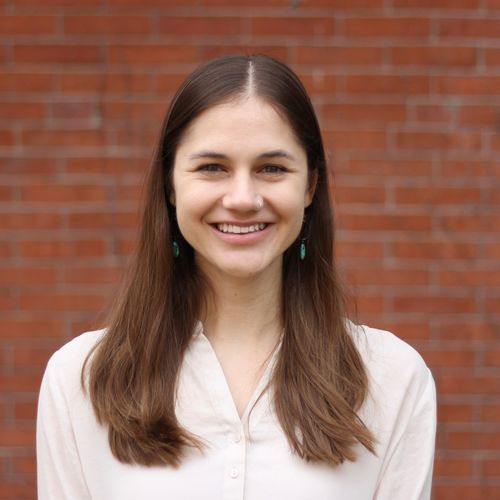
Certificate Spotlight: CAPDIE with Becca Spaulding.

Becca Spaulding. Photo courtesy of Becca Spaulding.
Certificate Spotlight: CAPDIE with Becca Spaulding
Becca Spaulding came to the School of Public Health eager to learn how she could better support people experiencing homelessness, leading her to select SPH’s certificate in community assessment, program design, implementation and evaluation (CAPDIE) for her on-campus MPH studies.
Becca Spaulding always had a general sense that she wanted her work to make a positive difference in the world.
In high school, she was particularly drawn to the social sciences, which led her to study psychology, gender studies, and music at Saint Anselm College. During her senior year of undergrad, while completing an internship with the New Hampshire Department of Health and Human Services, she helped collect data on housing resources in the state, sparking a new interest in research related to homelessness. Spaulding would later further develop her passion for research and advocacy as an MPH student and Maternal and Child Health fellow at the School of Public Health, but first, she attempted to contribute to social change through lens of economic development, undertaking a year of service with AmeriCorps.
After graduating from college, Spaulding served with City Year, an educational nonprofit that partners young adult mentors with schools in need of additional classroom support. She was assigned to a public school in Manchester, N.H., not far from where she grew up. Though she found the opportunity to support students one-on-one rewarding, particularly in the immediate aftermath of the COVID-19 pandemic, she soon came to suspect she might be better suited to a field where could intervene at the systems level rather than at the individual level. Upon the completion of her service, Spaulding accepted a position as a program coordinator at JSI, a global public health consulting organization. The new role allowed her to contribute to a variety of projects related to LGBTQIA+ youth, opioid use disorder and recovery, homelessness, and social isolation. Her suspicions confirmed and eager to learn more about the use of research to advance policy, she set her sights on a career in public health.
Spaulding spoke with SPH about finding the on-campus MPH program at SPH and building her academic home in the community assessment, program design, implementation and evaluation (CAPDIE) certificate program over the past year and a half.
Q&A
With Becca Spaulding, on-campus MPH student
SPH: What first sparked your interest in public health and homelessness?
Spaulding: The fall semester of my senior year of college, in 2020, there was this protest that I attended. I was in a class on social welfare at the time and writing a paper that I was assigned on youth homelessness when I got a text from the New Hampshire Youth Movement, saying, hey, there’s going to be this sweep, this eviction of an encampment, a very conspicuous one that I had walked by, several times to and from my apartment. This was mid-COVID—[shelters] had limited beds, it was November, it was really cold—and I read this, thought about the people in that encampment and the paper that I was writing and thought: If there was ever a sign, I should be going to this, [this is it.] So I showed up bright and early at 7 am, and there was a lot going on. A lot of people showed up to support the people in the encampment, and there was this one woman who I remember hearing say, “I didn’t think this many people cared.” Something about that changed my brain chemistry. Something about the five days I ultimately spent going back and forth between school and that protest—I haven’t been able to look back since.
SPH: Why did you choose BUSPH for your MPH?
Spaulding: After City Year, I worked out of the New Hampshire office of the JSI Research and Training Institute. [JSI] being a public health consulting firm where I officially made my debut in the public health space and where I figured out that [public health] is the angle we can take to make a positive difference. So I looked at public health programs that had some sort of connection with City Year, because I knew there were some tuition benefits there, and BU stood out. I learned more about BU and the type of program and values it has, and I was just really drawn to that. [In my career,] I’d really love to look into how we can better support people experiencing chronic homelessness as they transition into housing, so when I saw there was a class about homelessness, I really found myself drawn [to SPH]. In addition to the social justice aspect, when I heard someone talk about the Activist Lab and say, we want to do the research that changes policy, that sounded exactly like the goal I set in undergrad, so that’s how I found myself in public health and I found myself at BU.
SPH: What have been your favorite courses or projects that you have done as part of your CAPDIE certificate?
Spaulding: I’ve been reflecting a lot on my [determinants and strategies papers] since I’ve been grading all of those as a TA for Jacob Bor‘s Individual, Community, and Population Health course. My interventions project was really hard, but I did learn a lot. We were trying to design an intervention to reduce hepatitis C transmission among people experiencing homelessness in Boston. But I think I can firmly say that, in terms of things I learned and how much I enjoyed it in the process, my framing memo and oral testimony in my Strategies for Public Health Advocacy class with Craig Andrade were my favorite.
SPH: What’s next for you after you complete your MPH this spring?
Spaulding: I’m still figuring out if I’m done with grad school, so in order to put myself in a good position for potential future applications, I am rounding out my education here by taking Social Epidemiology and then I have two credits left on top of that, so I’m hoping to take GIS. It’s in the first half of the semester, which I learned is better for me—I took a two-credit class the fall semester as well, Community-Based Participatory Research with Madeleine Scammell, but it started halfway through the semester, so I went from having two classes to three—plus the class I was TA’ing for—which I don’t recommend, though the class itself was great and ultimately, I’m happy I took it. With only having to take 6 credits [this semester], that should open up some time for me to do my ILE, finish my practicum, and hopefully get a part-time job.
SPH: There is often a lot of misinformation and stigma surrounding homelessness. If you could share one message about homelessness, what would it be?
Spaulding: It’s really just about suspending your judgment in a lot of ways. You have no idea what’s going on with someone. You don’t know how they got there. You don’t know their life. For example, despite the stereotypes, they may or may not have an issue with substances, but even if they do that doesn’t mean that they deserve the situation that they’re in. Suspend your judgment. That’s [my] message. And maybe, if you ever get the chance to speak to someone in that situation, do it. I think a lot of our problems could be solved if we all went outside and just talked to each other more, because things are so polarizing on the internet. I think things would be better if we could talk to people from all walks of life more.