Earn Your Online MPH from Top Ranked Boston University without Leaving Home
Boston University’s online public health master’s is offered fully online by the nationally ranked #9 School of Public Health. The MPH program features a flexible, skills-based curriculum designed to prepare working professionals like you to solve real-world public health challenges without putting their careers on hold.
Application Deadlines
Fall 2026:
Round 2 Deadline: April 1, 2026
Round 3 Deadline: May 15, 2026
Final Deadline: July 1, 2026
Spring 2027:
Final Deadline: December 1, 2026
Request More Information
MPH Program Benefits
$25,000 USD
Total tuition cost to earn your MPH degree online from Boston University, regardless of how long it takes to complete the program.
Fully Online Courses
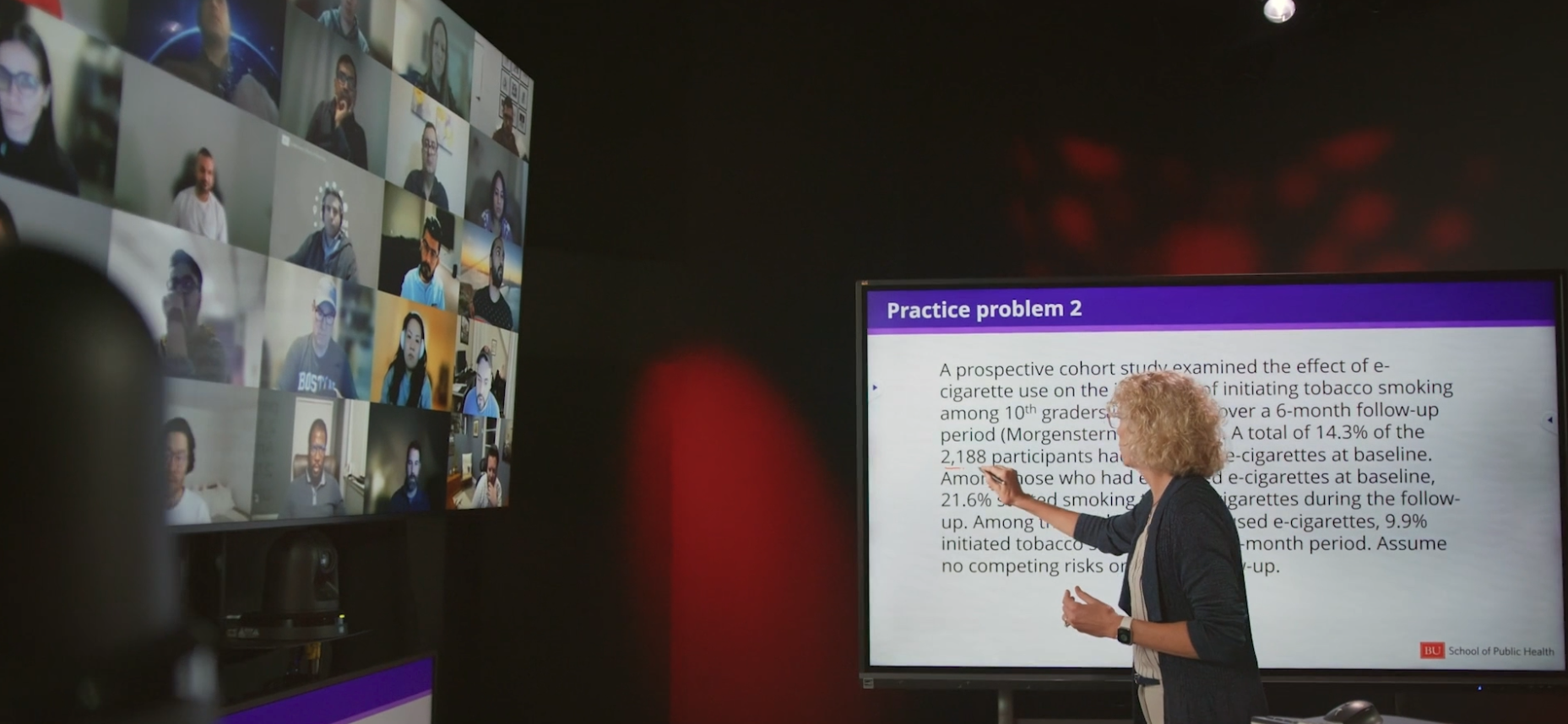
Working professionals can continue their full-time careers without disruption – no in-person courses, orientation, seminars, or meetings. Join weekly live sessions led by our faculty.
Virtual Engagement and Networking
Weekly integrated opportunities to connect live with your peers. Virtual coffee hours with school leadership and experts.
24 Months to 5 Year Timeline
The 42-credit program can be completed on the timeline that works for you. Our MPH online provides flexibility along with structure to help you navigate your busy schedule.
Learn from Leading BUSPH Faculty
Each Online MPH module is designed and led directly by Boston University School of Public Health faculty. Coursework is evidence-based, focused on sustainable solutions and practices that improve the health of populations.
Apply Now
Curriculum
Students complete six, online modules with weekly deadlines in addition to a 0-credit orientation module taken prior to the official start of the semester. These six modules are taken one at a time and must be completed in sequence—a student must successfully complete a module before taking the next module.
0. Online MPH Launch (0 cr)
Students are introduced to the program's learning platforms, tools, and resources to support their success in an online learning environment. Students learn the foundations of public health, including public health history, its core functions and disciplines and biological and social factors that affect health.
1. Data, Determinants, and Decision-Making for Health Equity (8 cr)
In this module, students learn about public health approaches for health and health equity, including social determinants of health. Students learn fundamental quantitative skills to analyze, synthesize, and apply data to inform decisions, and improve population health outcomes. Students are also introduced to different data collection methods for qualitative and quantitative analysis, population health needs assessments, techniques for budget and resource management, and strategies for effective leadership including managing conflict.
2. Policy, Programs and Public Health Communication (8 cr)
In this module, students learn about policymaking, and culturally and context appropriate communication and strategies to improve health in diverse populations. Students learn to design theory and evidence-based policies, programs, and interventions. The module also covers ethics, local and global politics in policymaking, and how to assess health care and regulatory systems.
Note: Module 2 includes graded, synchronous group-work component.
3. Applied Methods in Population Health Science (8 cr)
In this module, students develop both quantitative and qualitative research design and analysis skills to identify and address sources of health inequities. Students develop skills in epidemiological methods, exposure assessment, and health impact assessment to apply to current challenges in climate and environmental health. The module includes techniques for data management, data visualization and translation, coding and thematic analyses.
4. Public Health Policy, Advocacy, and Community Organizing (8 cr)
In this module, students learn strategies to address public health challenges affecting their communities. Students learn to translate knowledge into practice by using effective communication and education strategies to integrate different perspectives, audiences, and sectors. Students develop skills in stakeholder engagement, public health advocacy, resource-mapping, coalition building, community health organizing, and policy evaluation.
5. Applied Public Health Practice (8 cr)
In this practice-based module, students learn to apply research public health skills in real-world settings to improve health outcomes of individuals, communities, and populations. Students gain real-world experiences in areas such as: community health needs assessments, intervention design, implementation, and cost estimation, and monitoring and evaluation of programs for impact and implementation fidelity. The required practicum component is included directly within this module.
Note: Module 5’s practicum includes synchronous group-work and students will be expected to meet live with their team.
6. Integrative Seminar (2 cr)
In this final capstone module, students demonstrate the skills and knowledge they gained throughout the program in the form of a high-quality written product. Students address the ways that structural bias and social inequities undermine health, and they design strategies to communicate evidence-based findings to diverse audiences.
Meet our Master of Public Health Faculty
Outcomes
Upon the completion of the master’s in public health online students will have gained the knowledge and skills to:
- Design a public health intervention based on a community health needs assessment that brings together multiple data sources and community input to identify health inequities and their root causes
- Utilize evidence of health impacts associated with climate change and the environment to improve health and reduce inequities
- Develop a monitoring and evaluation plan to improve or scale a public health intervention, program, service, or policy
- Create an evidence-based strategy for community organizing and advocacy to create more equitable health systems or policies related to a public health issue
- Design a communication strategy that translates evidence-based findings for policy, advocacy or public health practice that are tailored to diverse audiences including the general public and the media
The Online MPH program addresses all Council on Education for Public Health (CEPH) competencies including:
Evidence-based Approaches to Public Health
- Apply epidemiological methods to settings and situations in public health practice.
- Select quantitative and qualitative data collection methods appropriate for a given public health context.
- Analyze quantitative and qualitative data using biostatistics, informatics, computer-based programming and software, as appropriate.
- Interpret results of data analysis for public health research, policy or practice.
Public Health & Healthcare Systems
- Compare the organization, structure and function of health care, public health and regulatory systems across national and international settings.
- Discuss the means by which structural bias, social inequities and racism undermine health and create challenges to achieving health equity at organizational, community and systemic levels.
Planning & Management to Promote Health
- Assess population needs, assets and capacities that affect communities’ health.
- Apply awareness of cultural values and practices to the design, implementation, or critique of public health policies or programs.
- Design a population-based policy, program, project or intervention.
- Explain basic principles and tools of budget and resource management.
- Select methods to evaluate public health programs.
Policy in Public Health
- Discuss the policy-making process, including the roles of ethics and evidence.
- Propose strategies to identify stakeholders and build coalitions and partnerships for influencing public health outcomes.
- Advocate for political, social or economic policies and programs that will improve health in diverse populations.
- Evaluate policies for their impact on public health and health equity.
Leadership
- Apply leadership and/or management principles to address relevant issues.
- Apply negotiation and mediation skills to address organizational or community challenges.
Communication
- Select communication strategies for different audiences and sectors.
- Communicate audience-appropriate (i.e. non-academic, non-peer audience) public health content, both in writing and through oral presentation.
- Describe the importance of cultural competence in communicating public health content.
Interprofessional and/or Intersectoral Practice
- Integrate perspectives from other sectors and/or professions to promote and advance population health.
Systems Thinking
- Apply systems thinking tools to visually represent a public health issue in a format other than standard narrative.
Frequently Asked Questions
Does the online public health master’s require work experience?
No, but we recommend at least two years of work experience as the master's degree in public health is designed for working professionals.
What is the current class profile of the online MPH degree?
Online master’s degree in public health students are employed by many different industries and fields. Recent students have included employees from federal and local governments, NGOs, community health organizations, healthcare providers, nurses, physicians, hospital administrations, and pharmaceutical companies. Our students are united by their commitment to improving health for all while advancing in their professional careers.
Does the Online MPH include a practicum?
Yes, and we bring the practicum to you. As a CEPH-accredited program, the project-based practicum is a requirement, but it is included within Module 5—which means you will not need to identify your own practicum.
Is financial aid available for the Master of Public Health online?
The master’s degree in public health online is an accessibly priced degree program. Online MPH students are not eligible for institutional scholarships; however,
domestic students may qualify for Federal Unsubsidized Loans. Visit our Office of Student Financial Services to learn more.What is a module and how are they structured?
- A module is the equivalent of two graduate-level courses at the same time within one semester.
- Each module requires commitment and planning to meet weekly assigned deliverables.
- You can expect to spend about 20 hours per week on readings, assessments, practice problems, watching videos, and/or group projects.
How many modules can I take at one time during the MPH program online?
Since this is a part-time program designed for the working professional, students may only take 1 module per semester.
Can I take periodic breaks during the semester?
- No. Content is released weekly, and you are expected to meet weekly deadlines. We cannot release material ahead of a predetermined schedule.
- While the live sessions are optional, the deliverables and assignments are not.
- Please be prepared to work through your content on a week-to-week basis during the semester.
What is Module 0?
Module 0 is a preparatory module that prepares students for the online master’s degree in public health. The content includes a history of public health, learning strategies and a quantitative primer. Module 0 must be completed before the start of your first semester.
How should I plan to structure my week in the MPH program online?
The online MPH degree requires at least 20 hours of work per week. New content is released every week, and there are weekly assessment deadlines. These assessments can take the form of quizzes, papers, or group work. There are also weekly Faculty Live sessions and Learning Facilitator office hours. Attendance at live sessions and office hours is optional but highly recommended. Session recordings are available and students who cannot attend are expected to watch the recordings.
Will I need to attend any live group meetings?
While attendance at weekly Faculty Live sessions are optional, Module 2 and Module 5 include synchronous group-work meetings that are linked to graded assignments/practicum and therefore live participation may be required for certain deliverables.
What kind of learning support is available if I have questions?
What type of network and community activities are available?
Are the online public health master’s faculty and staff from Boston University?
Yes. The coursework and weekly live sessions are developed and delivered by recognizable BUSPH faculty members. The Student Success team and Learning Facilitators are also full-time BUSPH staff members.
Admissions
MPH Program Online Application Requirements
- Bachelor’s degree from an accredited institution
- Recommended 2 years of full-time work experience
- GRE is NOT required and standardized test scores will NOT be considered as part of your application
- International students are required to submit English language proficiency exam
- Two letters of recommendation
- CV or resume
- Short essay admissions questions
- Students apply through SOPHAS platform
Application Deadlines
Fall 2026:
Round 2 Deadline: April 1, 2026
Round 3 Deadline: May 15, 2026
Final Deadline: July 1, 2026
Apply Now