Inside BU’s Real-Time Disease Surveillance Operation for the 2026 FIFA World Cup.
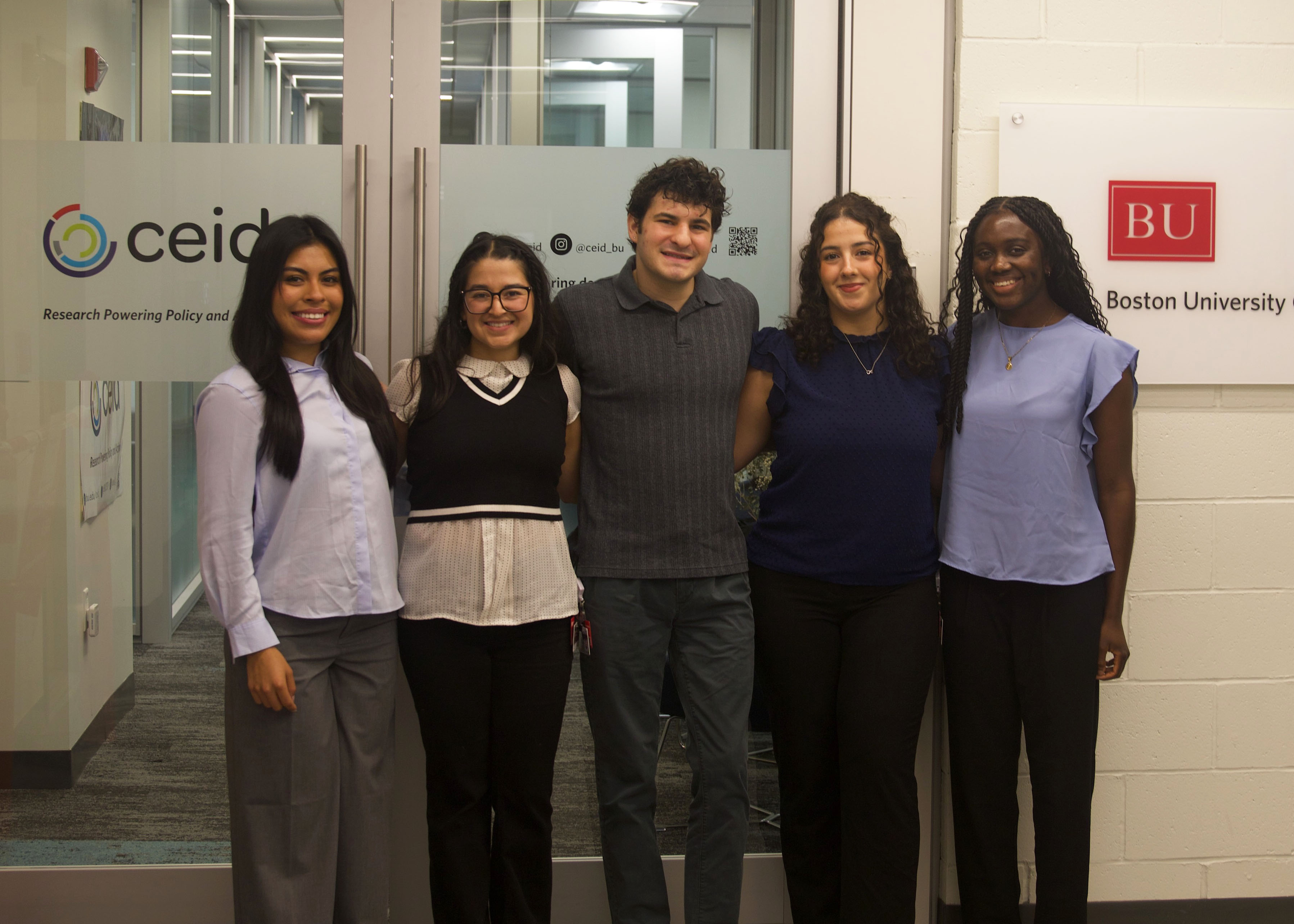
The SPH-sponsored FIFA World Cup practicum students on their first day at the CEID office (from left: Julianna Reyes, Alma Nieto, MacClement Guthrie, Melissa Mezieche, and Deirdre Otoo). Photo: Megan Jones
Inside BU’s Real-Time Disease Surveillance Operation for the 2026 FIFA World Cup
Melissa Mezieche, MacClement Guthrie, Julianna Reyes, Alma Nieto, and Deirdre Otoo reflect on their summer practica at BU’s Center on Emerging Infectious Diseases where they helped monitor disease outbreaks throughout the tournament.
Spain’s upset victory over Argentina, the defending champions, dominated headlines as the FIFA World Cup concluded this summer to much fanfare. But for five MPH students on SPH-sponsored practica with Boston University’s Center on Emerging Infectious Diseases (CEID), success was marked not in dramatic match results, but the absence of a major infectious disease outbreak threatening millions of fans across three countries.
Melissa Mezieche, MacClement Guthrie, Julianna Reyes, Alma Nieto, and Deirdre Otoo started their practicums at BU’s CEID in May 2026. Throughout the summer, they collaborated with CEID faculty and staff to support the Center’s Biothreats Emergence, Analysis and Communications Network (BEACON) program, tracking infectious disease signals and contributing to daily briefings for public health departments across North America. By July 31, when the students’ practicums concluded, the team had monitored and reported on cyclosporiasis outbreaks across the United States with a suspected link to lettuce, an influenza outbreak at Lackland Air Force Base (Joint Base San Antonio) following the end of vaccine mandates for service members, a cluster of Legionnaires’ disease cases in New York City and positive cultures of Legionella bacteria in the cooling towers of area buildings, new measles cases in all three host countries, and the health challenges posed by poor air quality and extreme heat. They had also helped stand watch over potential global threats, such as the Bundibugyo virus outbreak in the Democratic Republic of Congo and Uganda, that ultimately did not materialize during the tournament despite early concerns of a spread.
Reflecting on their eight weeks of real-time surveillance work, the students shared that the experience transformed not only their understanding of epidemiology, but their sense of what it means to be a public health professional.
Teamwork: Detecting Signals
The daily rhythm of surveillance required each student to work both quickly and meticulously, through layers of data, to detect signals of diseases. Mezieche, an Epidemiology Excellence Fellow at SPH, developed tools to help herself stay on top of emerging signals. “I created a measles count tracker in [Google] Sheets, including a national tab where I would update the latest national updates from the [Centers for Disease Control and Prevention] or the Johns Hopkins tracker and an additional tab to track all state-related dashboards because states’ measles case counts were usually updated more often,” she says.
As the weeks progressed, an organic division of labor emerged based on the students’ unique skills and interests. Guthrie, a former CDC associate program fellow with the Minneapolis Health Department, noted that “as our coverage progressed and we got into our groove, some of us would cover certain ‘beats’—to borrow a term from journalism—so that we could gain familiarity with the sources and timeline of any given outbreak.”

Nieto, a former chemist at CDC who grew up in Mexico, emphasized the group’s camaraderie. “Working with the other fellows was very memorable,” she says. “I learned so much from them. And we are now friends, too. I had such a wonderful time watching the games with them. And we bonded over health signals. For example, [Mezieche] became the ‘Measles Reporter’, [Guthrie] loved reporting rabies cases, [Otoo] became an expert on West Nile, [Reyes] was a social media expert, and I was the Mexico reporter. It all just became a wonderful experience to learn and also make great connections.”
Mezieche observed, “Over time, we developed a deeper understanding of the patterns and developments within the diseases we monitored most closely. This dynamic strengthened our teamwork, as we came to rely on each other’s expertise in specific areas.”
Mentorship: Validating Signals
After identifying signals of potential importance each morning, the students would gather for a 9:30 am editorial meeting with CEID faculty and staff where they presented their findings and discussed how to proceed with the day’s coverage. Nahid Bhadelia, a BU infectious diseases expert and the founding director of both CEID and BEACON, and Britta Lassmann, BEACON editor-in-chief, provided guidance and feedback to the students while Emily Goldsmith, BEACON program manager, kept the team on track to meet their daily deadlines. The students all agree it was a privilege to work with such experienced professionals.
“Beyond their intelligence, whether it was their ability to translate complex epidemiological concepts into something clear and actionable, or their eye for catching signals I may have missed, and their excellent leadership styles, what stood out to me the most was how approachable they were despite how demanding their own workloads were,” says Reyes. “If I flagged a signal I wasn’t exactly sure how to interpret, or wasn’t confident in how to phrase a report, I never hesitated to ask, because I knew I’d get a thoughtful answer rather than feeling like I was a burden. That kind of environment pushed me to ask more questions, and ultimately get more out of the practicum than I think I would have otherwise. This was the kind of mentorship I hope to pass along myself someday.”
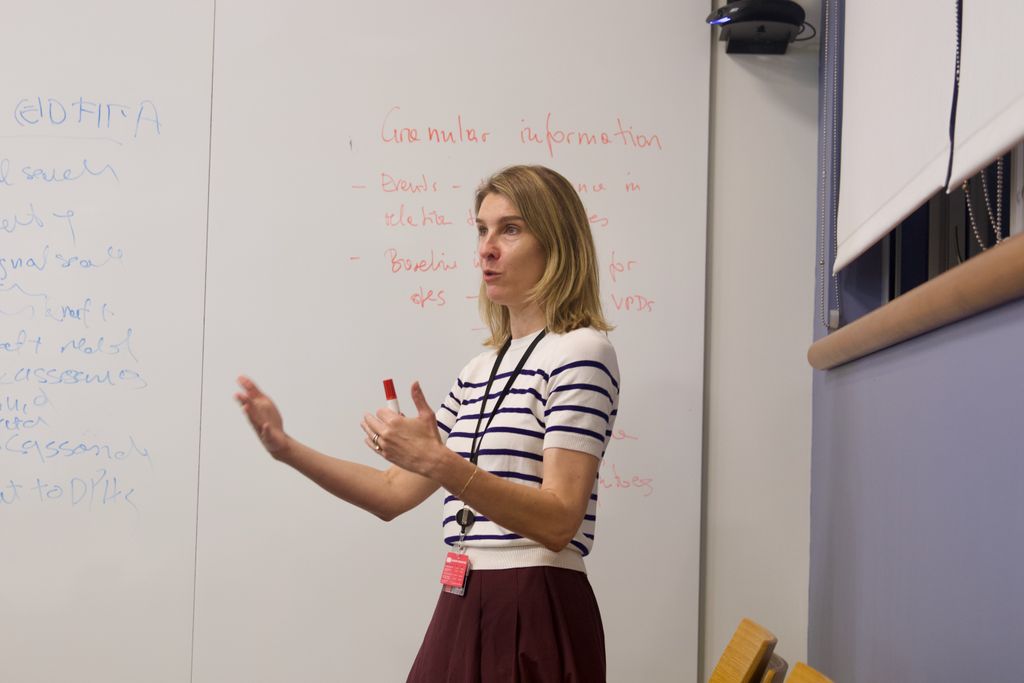
A major portion of the students’ work each afternoon involved corroborating a signal with other sources to confirm its veracity and then contextualizing it based on geography and history, says Guthrie. He recalls asking himself, for example: Are these cases above the baseline of past years? Is this mosquito-borne disease detection earlier in the season than in past years? Is this a rabies infection in an unusual species for the area?
“The value add that we present to our public health partners is in both the aggregation of these signals and the contextualization—both what’s going on, and why does it matter,” Guthrie says.
According to Goldsmith, with the help of the students, the team was able to deliver as promised. “The students did an excellent job and quickly adapted to the daily workflow of signal searching, presentation, vetting, verification, and report drafting,” she says. “The daily reporting was fast paced and wouldn’t have been possible without their contributions.”
Jessica Ibiebele, a postdoctoral fellow at CEID who also worked closely with the students, echoes Goldsmith’s account. “The students’ contributions were essential to the development of our daily surveillance reports. They demonstrated great adaptability in navigating complex information from numerous data streams,” she says.
On the Beat: Monitoring Signals
Early in the summer, Mezieche recalls encountering a signal that expanded her perspective of what constitutes public health surveillance. A Kroger powdered milk recall, flagged for potential Salmonella contamination, caught her attention.
“As I investigated further, I discovered the powdered milk was used as an ingredient in various frozen food products, broadening the potential public health impact of the recall,” she says. “I realized that public health surveillance extends far beyond tracking disease outbreaks—things such as food recalls and contamination events can also have significant public health implications. During mass gatherings like the FIFA World Cup, for example, visitors may purchase and consume food products in the United States, increasing the potential impact of such events.”
For Reyes, the stakes of the team’s work crystallized when she identified a measles exposure in a traveler passing through Los Angeles International Airport (LAX) on July 8, 2026. By July 13, there were 52 measles cases reported across California, including several ultimately linked back to LAX. Given that multiple World Cup matches and team base camps were being hosted in Los Angeles, Reyes recalls feeling the weight of responsibility as she continued to closely monitor the situation. Like with Mezieche’s measles count tracker, Reyes and her peers later developed a list of all airport-related exposures to make it easier for public health departments receiving their daily reports to determine their relevance and evaluate the risk to their jurisdictions.

Reyes was surprised at how challenging it could be, at times, to verify signals through a reputable source. While covering West Nile virus signals, she found that each county’s public health authorities handled reporting differently—some issued press releases, but many did not. Since much of her information came through social media, posts would often cite health officials, but she still struggled to track down official press releases, she says.
“Two skills I walked away with were media literacy and concise report writing” she says of her practicum. “When verifying signals, I was constantly evaluating sources, learning to distinguish an official [Department of Public Health] release from a media report, etc. Over time, I also got much faster at writing up reports, cutting straight to what mattered.”
Communication: Documenting Signals
The students ended each day by concisely documenting the information they had gathered on their signals in a handful of sentences. Like Reyes, many of the students credit this exercise in sharpening their writing and communication skills. Guthrie noticed a collective improvement in the team’s output over the course of the summer.
“Not many other practicums have quite that level of pressure, with most students working on large, months-long, slow-moving projects. The experience we had of publishing a reliable and polished product every single day was pretty unique,” he says. “Looking back at the work we produced in our first and last weeks of coverage, the differences in clarity and conciseness are clear. We know our public health partner agencies are all very busy, and our challenge [was] to publish reports that get straight to the point and tell the reader exactly what one needs to know.”

Mezieche says she also gained a deeper understanding of public health data, including how to navigate public dashboards, interpret wastewater data, and apply these tools in a real-world public health setting. She now has greater confidence in sharing and presenting her work. “The supportive environment at CEID/BEACON, where fellows’ perspectives were valued and respected, encouraged me to participate more actively in public health discussions and made me feel like I was truly contributing to the team,” she says.
The Future
As the students plan their fall coursework with either newfound clarity or greater conviction, they encourage their peers to take calculated risks in their own practicum searches.
“As I think about graduation, I am more open to career paths that involve infectious disease surveillance and emergency preparedness than I was before this internship. The experience showed me how meaningful it is to translate complex public health information into actionable insights and reinforced my desire to contribute to evidence-based public health practice.” says Mezieche.
Guthrie looks forward to taking Microbes and Methods: Selected Topics in Outbreak Investigation (EP800) in the fall. “I’m happy to say it hasn’t changed my trajectory so much as vindicated the path that I’m already on,” he says. “I’m really looking forward to going deeper into the mechanics of how health departments investigate and respond to outbreaks of infectious disease, and I think the practicum this summer set me up well to continue to grow and learn in that field. My goal after graduation is to work in a state or local health department, and this summer’s experience reinforced that for me.”
Reyes recommends that her peers not shy away from applying to practicums they may deem themselves unfit for. “When I applied for this role,” she says, “I didn’t have a background in public health surveillance, but the skills that ended up mattering the most, like being detail-oriented [and] persistent about tracking down sources, weren’t things I’d built in the classroom, but rather were developed on the job. If I’d only applied to roles that matched my exact background, I would have missed out on an experience that taught me far more than I expected.”