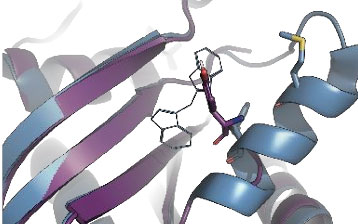
How does medicine know where to go once you take it? Generally, that information is encoded directly in the medicine, and sometimes it’s relatively easy, like a pain reliever curing your headache. But the more complex the malady, the more complex the “directions” need to be. And when the medicine needs to target a specific part of a specific protein, it can be a difficult task. On top of that, the protein is constantly flexing in space, so a specific pocket on the surface of a protein that could bind the medicine may be hidden, or unavailable one second and available the next.
New research by Diane Joseph-McCarthy, Professor of the Practice (BME, Chemistry, MSE) published in Communications Biology, titled “The influence of ligands on AlphaFold3 prediction of cryptic pockets,” uses AI to model the locations and positions of the peripatetic proteins. Contributing to the work were Professor Sandor Vajda (BME, Chemistry), graduate student Maria Lazou ‘27 (BME) and undergraduate Felix Tuchscherer ‘27 (CS, Biology).
“Cryptic pockets are binding sites in proteins that are formed or exposed upon a change in the overall structure of the protein,” said McCarthy. “Experimental structures provide a snapshot of a protein but do not capture their motion. Proteins are dynamic, and their structure is constantly moving from one stable state to another.”
Sometimes, one of these motions creates or exposes a cryptic pocket, a place for a medicine to “dock” with a protein and deliver healing effects. McCarthy and her team explored the use of AlphaFold3, which can predict the 3D structure of a protein based solely on its amino acid sequence, to generate ensembles of protein structure snapshots. The data generated are designed to predict where and when these pockets might appear.
“These models reveal small molecules likely to bind to those sites, which ultimately may advance the development of new medicines for difficult to access targets, think certain types of cancers, Alzheimer’s disease, and cardiovascular disease,” said McCarthy.
This convergent research sits at the nexus of AI, machine learning, physics-based modeling, and structural biology.