
How BU ENG, a research powerhouse, is partnering with the Commonwealth it calls home
By Patrick L. Kennedy
University research is one of America’s greatest engines of progress. The discoveries made on BU’s campus and others’ have produced new medicines, cleaner energy, stronger materials, and digital tools that billions of people depend on every day. Federal agencies like the National Institutes of Health (NIH) and National Science Foundation (NSF) have long been partners in that enterprise. At the same time, research universities maximize their impact by partnering locally, developing collaborations with regional government and industry that nurture an innovation ecosystem.
Boston University—Boston’s university, as College of Engineering (ENG) Dean Elise Morgan likes to say—is already deeply woven into the fabric of the region, and ENG is further developing partnerships with the Commonwealth of Massachusetts, a natural ally that has clearly and consistently demonstrated a deep commitment to science, health, and innovation. Together, ENG and the Commonwealth are tackling societal problems, exemplifying how universities can contribute to the regions they call home.
Whether in the life sciences, clean energy, or cloud computing, the researchers in the following pages are collaborating across disciplines and the region to produce the innovations that promise a better future for Massachusetts and the world. Their work is a reminder of why investing in research—and in the students who will carry that research training forward—matters so much.
Building a life sciences workforce
Himagowri Prasad (ENG’26) came to Boston for the biomaterials.
“I chose BU because of the amazing faculty research here in biomaterials,” says Prasad, a senior who has completed internships with the US Navy and NASA. “There are so many applications for biomaterials, not just biomedical. There’s synthetic nylon, leather, bio-based inks.”
Prasad’s goal is to become a research professor with her own biomaterials lab, mentoring future students and continuing to tackle real-world problems. If she does this in Massachusetts, she’ll join a robust biotech sector; by one accounting, biotech in the Bay State boasts 115,000 jobs and contributes more than $42 billion to the economy.
But that doesn’t happen by magic. State leaders have made a point of investing in the sector over the years, through agencies such as the Massachusetts Life Sciences Center (MLSC). Recently, MLSC awarded BU a $750,000 Workforce Development Capital Grant to develop a new internship preparation program designed to connect students like Prasad to future job opportunities.

The resulting program is Biomedical Research to Industry Development, Growth, Engineering, and Scale-up to Internships—a.k.a. BRIDGES to Internships. Professor Joyce Wong (BME, MSE) is its architect and project lead. “It’s all about building the life sciences workforce, which is the mission of MLSC—and it’s our mission, too,” says Wong.
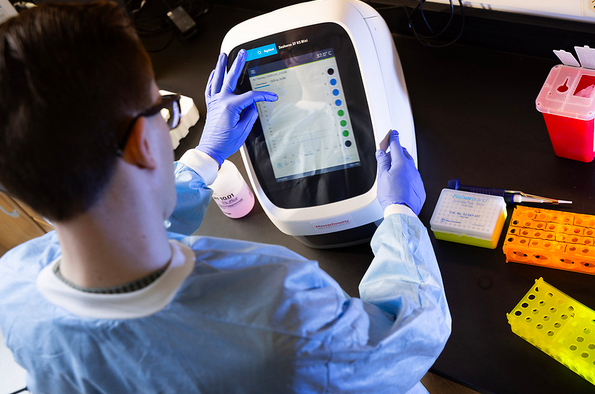
With the MLSC funds, the College of Engineering is outfitting its Bio-Interface and Technology (BIT) Core Facility with an advanced microscope, flow cytometer, plate reader, and other cutting-edge equipment. The hands-on training that students gain with these top-flight tools will fortify what they’re learning in their biomechanics, biomaterials, and nanotechnology coursework. Ultimately, it will give them the up-to-date skills and experience they’ll need to land internships and then, professional roles in fields such as biomedical engineering, drug delivery, and tissue engineering.
To ensure that the program meets student needs, Wong worked closely with Prasad and other officers of the BU student chapter of the Society for Biomaterials (SFB). Prasad is founder and president of the chapter; her own research, conducted with Assistant Professor Timothy O’Shea (BME, MSE) on soft matter for drug delivery to the central nervous system, is a prime example of the work BRIDGES to Internships is designed to amplify.

“To ensure that our ENG students go on to make impactful contributions to the workforce in rapidly evolving biomaterials-related fields after graduation, we must provide immersive training in cutting edge technologies for characterizing materials,” says O’Shea. “Integrating the new equipment funded through the BRIDGES program, including the new FTIR spectrometer and microscope, will allow us to provide skills development opportunities beyond the classroom.
“I am particularly excited about integrating training on the new equipment into my undergraduate introductory materials science course (BE425) and as part of ENG Senior Design projects run through my lab,” O’Shea adds. “Student peer-driven workshops offered by our ENG student clubs, such as the BU SFB chapter, that also include training and mentorship from our exceptional graduate students, will also give our undergraduate ENG students unique capacity building opportunities and a competitive edge as they navigate a challenging labor market.”
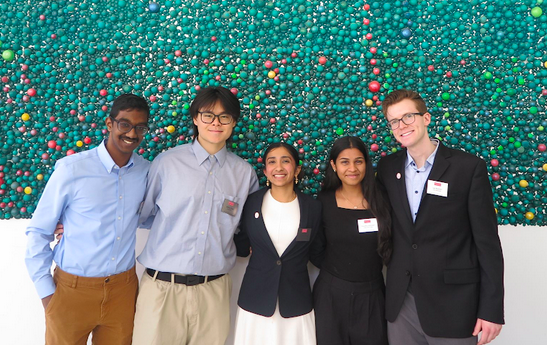
The SFB leaders surveyed their membership—which includes chemistry, physics, and other majors from the BU College of Arts & Sciences as well as ENG students—to find out what technical skills students most wanted to learn in SFB workshops.
Meanwhile, Wong sought input from industry partners to ensure that the program reflects current demands in life sciences labs. “When we proposed BRIDGES to Internships to MLSC, we had letters of support from industry, saying, ‘Yes, we’d hire this phenotype of this person who has this training,’” says Wong.
Wong is also collaborating with other faculty to align BRIDGES to Internships programming with the ENG curriculum and with the ENG Career Development Office. Colleagues in this effort include Senior Lecturer Xin Brown (BME), director of the BIT facility, and Professor of the Practice Diane Joseph-McCarthy (BME, MSE), executive director of the Bioengineering Technology & Entrepreneurship Center (BTEC). The program also leverages the Design, Automation, Manufacturing, and Processes (DAMP) Lab for scale-up.
“It’s so important to invest in our students and connect them to industry,” says Wong. “And they’ll go on to solve challenges in medical devices, drug development, cancer, women’s health, and more. So ultimately, society benefits.”
Rectifying disparities in care
The MLSC also recently awarded Wong and BU colleagues a pilot grant for a project driving women’s health innovation, part of a program addressing historic underinvestment in women’s health and the consequent gap in women’s health outcomes.
The project is a fallopian-tube-on-a-chip model aimed at understanding the mechanisms by which sexually transmitted infections (STIs) induce tubal scarring, which can lead to tubal infertility, more common in women of color. Ultimately, the work might result in therapies that would maintain tissue integrity during antibiotic treatment of an STI, preserving tubal function and reducing the need for in vitro fertilization (IVF), which is costly and has a modest success rate.
Wong’s colleagues on this grant are Professor Robin Ingalls (infectious diseases, virology, immunology, and microbiology) and Associate Professor Wendy Kuohung (obstetrics and gynecology, reproductive endocrinology) of the BU Chobanian & Avedisian School of Medicine, along with Associate Professor Michael Smith (BME, MSE).
“Massachusetts has always been at the forefront of social justice since Revolutionary War times,” says Kuohung. “With this project, we’re aiming to rectify disparities in care, but it could also save billions of dollars in healthcare costs.”
The US is still the world leader in biomedical research, says Kuohung. “One way to maintain that leadership is for states to step in to provide research funding. And the biomedical research output per capita in Massachusetts is second to none.”
State investment in women’s health research at BU was recently supplemented by federal funding. In fall 2025, the NIH awarded BU its second Building Interdisciplinary Research Careers in Women’s Health grant, which funds institutions developing early-career faculty conducting interdisciplinary women’s health research. The award reflects both BU’s established strength in this area and the recognition that closing long-standing gaps in women’s health outcomes requires sustained, career-level investment in the researchers who will close them.
As it happens, the MLSC grant for BRIDGES to Internships, although focused on life sciences workforce development, intersects with women’s health innovation as well. Among the new equipment is a Seahorse metabolic analyzer, a cutting-edge tool central to a training module that Assistant Professor Brianne Connizzo (BME, ME) is developing to explore sex-based differences in diseases such as cardiovascular and autoimmune disorders. Connizzo is also developing a new ENG course in women’s health engineering, which will provide the background material for the module.
The Seahorse’s use extends well beyond women’s health research; it and the rest of the new equipment are broadly applicable to a range of research areas, says Connizzo. “The Seahorse allows you to measure, in real time, metabolic changes in cells—so, what types of nutrients they’re processing, how efficient they are. You can use it for any cell type or for small tissue explants.”
It’s crucial for a teaching lab like the BIT facility to keep up with the dramatic pace of change in the biotech industry, Connizzo says. “Biomedical engineering is still such a young field, and to be able to expose our students to the latest technologies that start-ups are rolling out every day is pretty world-class.”
Helping communities transition to clean energy
Another vital area for regional collaboration is clean energy. In late 2024, the Massachusetts Department of Energy Resources announced $5.7 million in funds over three years for the Clean Energy and Environment Legacy Transition (CELT), a partnership with BU and UMass Lowell aimed at advancing an equitable energy transition, empowering communities, and training the next generation of climate leaders.
From BU, data analysis work for CELT is being led by Associate Professor Emily Ryan (ME, MSE) along with Professor Cutler Cleveland (Earth and Environment) of the College of Arts & Sciences and Professor Patricia Fabian (Environmental Health) of the School of Public Health. The three are associate directors of BU’s Institute for Global Sustainability.
The team has developed the CELT Energy Transition Atlas, a user-friendly, interactive mapping tool offering energy data to support municipal decision-making. “The goal is to make data more accessible and actionable by the stakeholders,” says Ryan, who was recently named the Duan Family Faculty Fellow. The platform visualizes key clean energy indicators helping cities and towns think through the details of electric vehicle infrastructure, solar panel and heat pump installations, and more.

Beyond providing data tools, Ryan and colleagues at BU and UMass Lowell also send student fellows directly to cities and towns to work with municipal leaders on clean energy projects, for example, studying the feasibility of electrifying city buildings or vehicle fleets.
“There’s a huge interest across the state in replacing fuel oil and natural gas,” says Ryan. “This year we placed 26 fellows—at no cost to these communities that might not have the funds to support the staff—to look at the different clean energy technologies and what the hurdles are that they have to overcome.”
For Ryan and her students alike, it’s about connecting technical knowledge with policy. “I’m usually doing fundamental electro-chemistry,” says Ryan, whose work includes modeling the complex physical processes in next-generation lithium-metal batteries. “But I decided to get involved in [CELT] because I think it’s really important to think about how we can have an impact in our communities.
“We’re lucky to live in Massachusetts, where the governor and administration understand the importance of green energy transitions,” she adds, “but they’re also limited in their capacity. By partnering directly with large universities like BU and UMass Lowell, you get a much bigger workforce that can help you advance these transitions.”
Sitting at sea level, BU has a particular responsibility to be part of the solution. “We’re very susceptible to climate change,” says Ryan. “We need that resiliency. Massachusetts is already at the forefront, but we need to keep pushing, and taking advantage of all the academic institutions and expertise the state has.”
Cloud computing to advance research
BU is a founding member of one of the most powerful regional computing consortia in the country, the Massachusetts Green High Performance Computing Center (MGHPCC). With a supercomputing facility located in Holyoke, Mass., the MGHPCC serves the research-related, high-performance computing needs of BU, Harvard, MIT, Northeastern University, the UMass system, and Yale University. ENG Dean Emeritus Kenneth Lutchen, BU’s vice president and associate provost for research, is a director. Other affiliated faculty include Professor Martin Herbordt (ECE) and Professor David Coker (Chemistry, MSE).

The MGHPCC provides the foundation for the New England Research Cloud (NERC), a production cloud operated by BU, Harvard, the Red Hat Collaboratory, and the Mass Open Cloud (MOC) Alliance and directed by Professor Orran Krieger (ECE), with some funding from the Massachusetts Technology Collaborative. The NERC boasts state-of-the-art graphics processing unit (GPU) hardware and serves as a resource for researchers across higher education who need to process massive data sets in a variety of disciplines.
“Research has had an enormous impact on the world in terms of innovation—and so has open-source computing,” says Krieger. “My passion is to have innovation happen in an open way. We won’t get what we can out of AI if it’s just three companies that are able to innovate.”
BU and the MOC Alliance recently convened a symposium devoted to AI for drug discovery, bringing together clinicians, researchers, pharma and tech executives, and others to discuss ways to leverage AI to accelerate the drug discovery process, which currently takes up to 15 years.
For example, Distinguished Professor of Engineering Yannis Paschalidis (ECE, BME, SE), the director of the Rafik B. Hariri Institute for Computing and Computational Science & Engineering, is training a large language model in protein language, and programming it to predict how antibodies and antigens might bind. The goal is to develop antibodies that can target specific pathways of disease.
“Collaboration among multiple disciplines is critical forprogress,” Paschalidis noted at the symposium. “People who have a lot of expertise in the algorithmic world don’t necessarily understand the domain in which they are trying to make contributions. Having domain knowledge is quite important.”

Indeed, closer collaboration is key to the entire research enterprise, says Wong. “We have to be creative in how we can support each other through these lean times.” She suggests reaching out to stakeholders beyond the academia-technology sphere as well.
“More of us should get involved and contact our elected officials and spread the word that more money should go to train students in these fields,” Wong says. “People are used to seeing products on Shark Tank, but behind the scenes, universities are where all the basic science and the innovation and the nitty-gritty work take place. That’s why we need to invest in engineering.”
Banner photo by Michael Spencer
This article originally appeared in ENGineer magazine