
The College of Engineering Celebrates the Class of 2026
By Patrick L. Kennedy
With processions to the swelling strains of “Pomp and Circumstance,” inspiring orations, and the cheers and tears of supportive families in the stands, the Boston University College of Engineering (ENG) formally conferred the credentials of a Societal Engineer onto graduates of the Class of 2026. More than 540 bachelor’s recipients and many of this year’s 120 doctoral and 330 master’s graduates were celebrated in two separate ceremonies in the days leading up to the University’s Commencement on Sunday.
“The work you do—in industry, in research, in academia, or in a startup that doesn’t yet exist—can reverberate far beyond any single laboratory or conference room,” said ENG Dean Elise F. Morgan, the Maysarah K. Sukkar Professor of Engineering Design & Innovation, in her speech to graduate candidates. “That is the promise of engineering. And it is the responsibility that comes with your degree.”
Inflection point
Boston University President Emeritus Robert A. Brown delivered the address at the graduate convocation and doctor of philosophy hooding ceremony on Thursday, May 14, in the Case Center Gymnasium. A professor of engineering and a professor of computing and data sciences, Brown led BU from 2005 to 2023. He is a fellow of the National Academy of Inventors, and his book Fighting Fires and Building Flywheels: How We Sustain America’s Research Universities is forthcoming from MIT Press.
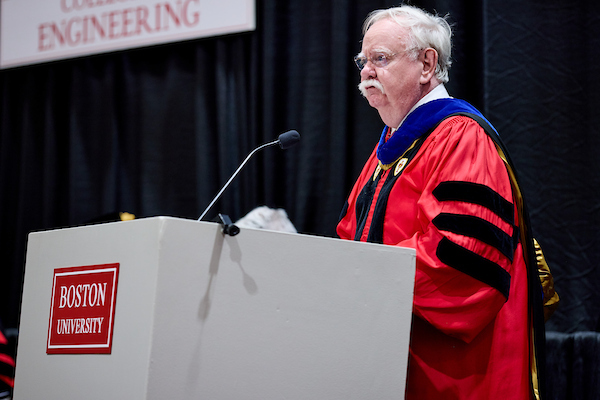
“You are graduating at an inflection point in the world’s history—I can say ‘inflection point’ because I am talking to engineers,” said Brown. “It seems trite to say that technology is changing our world at a rate never seen before in the history of man. Hasn’t this always been true? . . . This time feels different, more pervasive, and much more complex.”
And yet, Brown expressed confidence that this year’s graduates can make a difference. “I dream that you can be successful because of the technology,” he said. “This is the world that you must make a better place, and you can. You understand the science and technologies transforming society. You know how to work on complex problems and the value of teaming with people from different backgrounds and perspectives to create solutions.
“My call is for you to use your intelligence and imagination to address society’s biggest challenges—and we have plenty of them: affordable quality healthcare, food security, protection of our planet, and peace between the people and nations of the world,” Brown continued. “Whether you develop sensors and software to help farmers grow better crops, or invent devices that help the elderly live more independent lives, you can combine your love of science and engineering with sensitivity to the needs of others. If you do, you will have enormous impact and a rewarding career.”
What you leave here with
In her remarks, Morgan praised the persistence of the red-robed graduates. “I suspect each of you carries a private catalog of difficult moments from your time here,” she said. “Moments when nothing worked, when the data made no sense, when the elegant solution you had envisioned simply refused to materialize. Every failed prototype, every stubborn line of buggy code that consumed your nights—each of those was not a detour from your education. It was your education. Persistence in the face of failure is the defining trait of the engineer.”

That trait will serve the newly minted professionals well “at a time of incredible complexity,” Morgan said. “At this moment of uncertainty and disruption, I stand here with genuine, evidence-based hope because of you, and because of what you carry with you as you leave here,” including “hard-won resilience,” a sense of purpose, and the ability to work with colleagues from all over the globe.
“And you leave here with adaptability,” Morgan said. “The engineering instinct that when the design fails, you don’t abandon the goal; you rethink the approach.”
Engineer the s—t out of it.
The sidewalks around Agganis Arena were clogged with festive foot traffic on Saturday, May 16, as thousands of parents, siblings, grandparents, and other supporters arrived for the ENG bachelor’s degree ceremony. Once inside, the soon-to-be graduates heard four life lessons from commencement speaker Brian Dunkin (ENG’85), vice president for medical affairs and chief medical officer for the endoscopy division at Boston Scientific. These four lessons were based on Dunkin’s zigzagging career as a biomedical engineer, an advanced laparoscopic surgeon, and a leader in medicine, academia, and the medical device industry.
First, “Career decisions are rarely a one-way street,” Dunkin said. “When faced with what appears to be a high-stakes career decision, make the best decision you can with the information at hand, and have no regrets. You can always pivot, and, at the very least, you’ll have a life experience to learn from and a line to add to your resume.”

Second, “In life, try to have a magnifying effect.” When Dunkin had the opportunity to train new surgeons in the growing field of laparoscopic surgery, he saw how the work of one person could ripple across countless others’ lives. That’s why he later took a job at Boston Scientific; because he could see its potential for a magnifying effect. “My division manufactures medical devices that touch 27 patients a minute in 133 countries around the world.”
Third, adapting a line from the STEM-heavy novel and film The Martian, “Sometimes you just have to engineer the s—t out of it.” That’s how Dunkin felt when he was recruited to build a surgical endoscopy training program at the University of Miami. “I had never designed or built a clinical space before, but I broke the problem down into smaller elements as if no one had ever done it, and then solved each one.”
Finally, Dunkin related a harrowing, not-for-the-squeamish story of a surgery beset by complications. Dunkin went the extra mile with the patient, who eventually recovered. The lesson? “Bad times have their own timeline before they become good,” said Dunkin. “Try to endure with grace, diligence, and patience.”
Problems that don’t come with instructions
Pippi Pi (ENG’26) delivered the baccalaureate address on Saturday. A computer engineering major, Pi served as the secretary and software lead for the BU Mars Rover Club, overseeing aspects of the development of an autonomous vehicle capable of navigating Martian terrain. She is moving to Redmond, Washington, to join Microsoft as a machine learning engineer, and she plans to launch her own startup someday.

“In your family, you are now officially known as ‘The Nerd,’” Pi said to the knowing laughter of her classmates. “The one who gets the honorable duty of fixing every computer, printer, and Wi-Fi router in the house, no matter how many times you explain, ‘I’m not that kind of engineer.’”
“What this degree proves isn’t that you have all the answers,” said Pi. “It proves that you now possess the tools and the grit to face problems that don’t come with instructions. It proves you know how to sit in uncertainty and still move forward.”
In the next decade or two, Pi said, she expects some of her classmates to design life-saving medical devices, city-saving infrastructure, and more. Some will move into fields other than engineering, and “some of us may end up in roles that don’t even have a title yet.”
Wherever they came from and wherever they’re going, Pi said the members of the BU ENG Class of 2026 will always have a few important things in common: “What defines us together is the spirit of curiosity, our tenacity in the face of failure, and our shared mission to make a lasting impact.”
Special distinctions
Not for the first time, multiple students tied for valedictorian status this year. Mechanical engineering (ME) majors Dylan List, William Maharry, and Akemi Zollinger each had a perfect 4.0 average.
Morgan also announced that the senior class selected Assistant Professor Sean Lubner (ME, MSE) as the recipient of the 2026 College of Engineering Teaching Excellence Award. In addition, Biomedical Engineering (BME) Lecturer Andy Fan, Associate Professor Lei Tian (ECE, BME), and Assistant Professor Andrew Sabelhaus (ME, SE) earned departmental awards for teaching excellence.
Professor Kamal Sen (BME) received the award for Teaching Excellence in the Core Curriculum, while Assistant Professor Stormy Attaway (ME) earned the Faculty Service Award.
Dissertation awards
Carolyn Marar won the 2026 PhD Societal Impact Award for her dissertation, “Microwaves for Bi-modal Neuromodulation: Mechanisms and Translation.” Distinguished Professor Ji-Xin Cheng (ECE, BME, MSE) served as her advisor. Jeffrey Lim earned the Master’s Societal Impact Award for “Towards Open-Source Platforms for Researching Proprietary Cloud Service.” Ariane Garrett earned the PhD Entrepreneurial Award for a technique she developed called speckle contrast optical spectroscopy for cuffless blood pressure estimation.

The following doctoral students earned awards for outstanding dissertations.
Emma Stowe, “Aging and Senescence Dysregulate Tendon Adaptation to Mechanical Load.” Advisor: Assistant Professor Brianne Connizzo (BME, ME).
Pujan Paudel, “Data-driven Approaches for Improving the Identification of Misleading Content Online.” Advisor: Associate Professor Gianluca Stringhini (ECE).
Daniel Shahar, “High-Dimensional Orbital Angular Momentum Entanglement in Optical Fibers.” Advisor: Distinguished Professor of Engineering Siddharth Ramachandran (ECE, Physics, MSE).
Monan Ma, “Fundamentals of Nonlinear Nanomechanical Resonators: Actuation, Scaling, and Fluctuation-Driven Dynamics.” Advisor: Professsor Kamil Ekinci (ME, MSE).
Wenlu Wang, “Electrodeposition of Polymer Networks as Conformal Ultrathin Coatings.”Advisor: Assistant Professor Jörg Werner (ME, MSE).
Yingqing Chen, “Safety-Critical Control and Optimization of Traffic Systems.” Advisor: Distinguished Professor Christos Cassandras (ECE, SE).