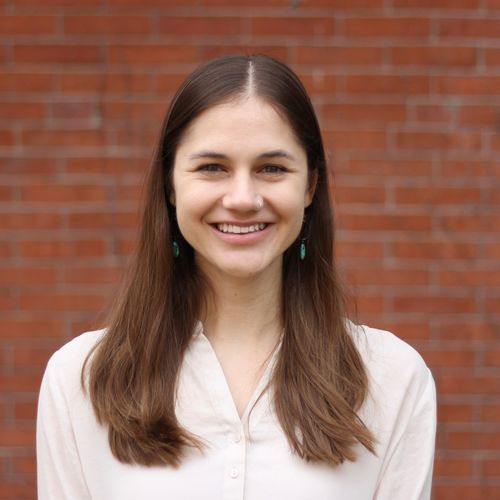
Career Readiness: A Q&A with SPH’s Practicum Program Director.

Ryan Wisniewski. Photo: Megan Jones
Career Readiness: A Q&A with SPH’s Practicum Program Director
Ryan Wisniewski (Wheelock’22) discusses his own career path, his approach to advising students at the School of Public Health, and his vision for the future of higher education.
Going back to school to earn an advanced degree is a significant undertaking. Ryan Wisniewski understands—he has done it three times himself.
During the eight years and counting that Wisniewski has worked in the Career & Practicum Office (CPO) at the School of Public Health, he has completed a bachelor’s degree in human resources, a master’s degree in education, and soon he will add an Ed.D.
As the director of SPH’s practicum program, Wisniewski supports on-campus MPH students to find, secure, and successfully complete the required 240-hour applied practice experiences, which pair students with partner organizations to apply their education to real-world public health problems and further develop their professional skills. Each year, more than 300 students enroll in the MPH Health Practicum (PH976) course. It is Wisniewski’s responsibility to track their progress, review learning contracts with their employers, and examine the samples of their work submitted as part of their final assessments.
One of Wisniewski’s favorite parts of working at SPH is meeting one-on-one with students early in their tenure at the school and brainstorming strategies for finding a practicum that will springboard them into a job, he says. He often asks students to find a job posting that a post-graduation version of themselves would be eager to apply to, and then they work backwards from there to find an internship that could serve as a stepping stone.
For someone so at home in higher education, Wisniewski had a nontraditional student experience himself. Prior to joining SPH, he worked in human resources and recruiting at a VA hospital in the Boston area, where he landed after dropping out of cooking school. At the time, he was not sure what he wanted to do long term, but he was sure he wanted to stay in Boston.
“Living in the city taught me a lot about being an adult,” says Wisniewski. “I grew up poor. We never had money to travel. Both of my parents were on disability, so we used food pantries and [ate] donated food. We always lived in rentals—we never had a house.”
Besides travel, Wisniewski was eager to do something else his parents never had the opportunity to do: earn a college degree.
“My mom dropped out of high school. Only my dad has a high school diploma,” he says. Wisniewski thought he was destined for the same fate when he was forced to drop out of high school during a protracted illness. “I lost a scholarship, so I didn’t think I was going to go to college either.”
But Wisniewski steeled his resolve and started chipping away at his bachelor’s degree online, ultimately leveraging his HR connections to get his foot in the door at SPH. Working in higher education now feels like eating the forbidden fruit, he says. “It was something intangible for so long.”
Wisniewski shared insight into how he leverages lessons from his own struggles to smooth the launch of SPH students’ careers.
Q&A
With Ryan Wisniewski (Wheelock’22), practicum program director at SPH
SPH: You came to public health somewhat by chance, but you have now been at SPH for eight years and counting—what keeps you motivated to do this work?
Wisniewski: I am an empath, a full-blown feeler—somebody cries in front of me and I start crying—so working with students who have similar characteristics—I like to say that public health is one step below social work on the hugging scale—it is just so inspiring to be around students who are passionate and care about doing something that is going to make an impact.
In my previous job in HR at the VA hospital, we sometimes recruited MPH students, but that was the extent of my experience with public health. Since being at SPH, I feel like I have gotten an MPH without actually having gotten an MPH. I have learned so much about public health and health systems. I have also learned things from students about DEI and about the expanded LGBTQ spectrum. I am still learning daily about the different things our students can do and where public health intersects [with other fields]. I don’t think I’d be the same person if I hadn’t worked at SPH.
SPH: What are the most rewarding parts of your role? Do you have a memorable story you could share about a student whom you helped to secure a practicum?
Wisniewski: I can talk about a recent student who just graduated this past January. When I first started meeting with him, he was worried about his ability to get a practicum. He would say that he didn’t have a lot of experience, coming straight from undergrad, and that his undergrad [major] was not even public health. He was down on himself about what he could [contribute].
To keep him on track, we met really frequently, even if it was 10- or 15-minute check-ins, so he had accountability. I helped get him connected with this awesome program over at BMC called Street Cred, where he helped patients access financial resources, and they loved him! His supervisor was glowing about him—loved his work, his commitment, his dedication. Meeting with [the student] after his practicum was over, he was a completely different person. You could tell that just being in that practicum for a few months, he grew so much. He was more optimistic about his future.
That is really the most rewarding part—the program goes so fast, but the amount of growth a student can have over the course of a year is incredible. When I can make something like this happen and I can lift a student up because I see what they can’t see in themselves, it’s very rewarding—definitely fills my bucket.
SPH: Already having your master’s in education, what motivated you to go back for a doctorate?
Wisniewski: I always equate it to how I tackle running marathons. I never saw myself as a runner. When I finally ran a half marathon I was like, alright, that’s enough—13 miles is more than I ever thought I would run. Then, seven months later, I ran my first marathon. Being at BU, I was very motivated to take advantage of tuition remission, so I hopped right into [a Master of Education program] in my first year at SPH. I love learning, and higher education is such an interesting field—there is so much change that needs to happen. I have been in higher ed enough to understand the inequities it’s built on—the systems [and] processes carried over for decades. I saw this as an opportunity, while I am still relatively young and still have that spark, to make change. I feel confident that with a doctoral degree I can put myself in a position to do that, so I pulled the band-aid off and just [enrolled].
SPH: If you could wave a magic wand and solve one challenge in higher education, what would that be?
Wisniewski: I would focus on the one I am planning to do my dissertation on—career readiness. It is always in the news. People are concerned about return on investment. Part of why I was inspired to focus on it is because of the Career and Practicum Office and the relationship-based approach we take [to advising], in partnership with our faculty. It is not enough anymore to just [review] resumes and hope students get internships. We aim to integrate career readiness into everything the university does. At both undergrad and graduate levels, students should have opportunities to work on real-world projects or simulations rather than just listening to lectures. If we want better outcomes for the economy, better return on investment, and more equitable access, higher ed needs to follow SPH’s lead and truly prepare students for the field, including how to be good citizens and how to think for themselves.
Registration is now open for SPH’s Public Health Networking and Recruitment Fair in person at Hiebert Lounge from 4 – 6 :30 pm on March 25. On-campus MPH students, dual-degree candidates, and recent SPH graduates are invited to register on Handshake.