
Engineering researchers, entrepreneurs, and tech executives discuss the future of wearables and other forward-looking health technology
By Patrick L. Kennedy
For the future of medicine, the grand challenge is to shift modes from disease management to disease prevention, declared Noubar Afeyan last Thursday. “Our health care system is really a sick care system,” said Afeyan, CEO and Founder of Flagship Pioneering, in a conversation with Boston University President Melissa Gilliam. “Only two percent of our health care budget is for prevention. Can we imagine a world in which health span rather than life span is what we try to maximize?”
It was just one of many insights shared on September 17 and 18 as top BU leaders convened a gathering of at least 120 pharmaceutical executives, engineering researchers, entrepreneurs, faculty, students, alumni, and others from Boston and beyond. The occasion was the BU College of Engineering’s second annual Catalyst Summit.
Held high on the 17th floor of the Duan Family Center for Computing & Data Sciences, this year’s conference explored the topic “Decoding Everyday Health.” Attendees heard the inside stories of a range of innovative health solutions—from the vaccines that ended the pandemic, to the latest wearable monitoring devices on the market, to technologies still under development in labs across academia and industry.

“For many decades, health has been something we could monitor only in snapshots—a visit to the doctor, a blood test, a CAT scan,” said College of Engineering Dean Elise Morgan in opening remarks. “But our bodies are not working in snapshots. They are generating information continuously, and transmitting that information in signals like heart rate, blood pressure and blood flow, hormone levels, oxygen saturation, protein concentration, RNA synthesis, electrical potentials and more. What has changed is our growing ability to detect those signals continuously, interpret them correctly, and act on them before problems become crises.”
Making data actionable
“When we talk about everyday health, it’s easy to focus on the visible endpoints—the device on a wrist, the sensor in a hospital room,” said Morgan, who is also the Maysarah K. Sukkar Professor of Engineering Design and Innovation. “But there is much less visible work that makes those endpoints possible.” And often, that work begins with a researcher asking a fundamental question. As an example, Morgan pointed to the bionic pancreas invented by Edward Damiano, research professor of biomedical engineering.
“Professor Damiano’s research began with the question, ‘Could one design a closed-loop control system that monitors blood glucose continuously, interprets it in real time, and adjusts insulin dosages automatically, without requiring a human being to manage every step?‘”
The solution in this case, the iLet Bionic Pancreas, gives people with type 1 diabetes freedom, Morgan said. “Freedom to sleep through the night, freedom to travel, freedom to pay attention to their lives rather than their numbers.”
“No such thing as basic research”
Afeyan also oversees research that is driven by fundamental questions. His conversation with Gilliam—herself an interdisciplinary researcher in medicine, public health, and the humanities—kicked off the summit on Thursday night. Through Flagship Pioneering, his innovative life sciences venture firm, Afeyan co-founded Moderna, maker of one of the major vaccines against COVID-19. Flagship was also behind one of the earliest bio-sensing wearable devices, used by professional cyclists to monitor their heart rate during the 2003 Tour de France.
“We ask the ‘what-if’ questions,” said Afeyan of the researchers at Flagship’s portfolio of 100 companies. In the case of Moderna’s vaccines, he said, the question was: “What if you could inject a molecule into a person and use their body’s cells to manufacture proteins that would prevent or treat disease?” It turned out that messenger RNA (mRNA) was that molecule.
“We had to assemble a scientific team with as many engineers as scientists” on the way to making the vaccine a reality, Afeyan said.

“At Boston University, we have made convergent research a top priority,” said Gilliam. “Here, that means crossing disciplines to solve problems that transcend traditional academic boundaries. What does convergence mean to you?”
“I do think convergence, if you want to have an impact, is a necessity,” Afeyan said. “Think of the Boston Symphony Orchestra. The musicians are trained in their specialized instruments, but they have to play together to live up to their name. We’re all educated to become specialists in something and we want to be world-class at that and not deviate from it. But you’d be surprised, in an industrial career, how many things you can be world-class at just by keeping an open mind and learning new things.”
Determining with a quick show-of-hands poll that about half the audience was bilingual, Afeyan said, “I’d encourage you to be bilingual not just in your languages but in your disciplines as well. Be bilingual in computer science and biology and medicine. Why not?”
Addressing the importance of academia as an engine for scientific discovery, Gilliam asked, “How do you think about the relationship between research universities and industry at this particular moment?”
Afeyan decried the prevailing anti-science attitude that has led to drastic cuts in federal funding for basic research. But to defuse complaints about tax dollars going to satisfy scientists’ curiosity, Afeyan suggested a new framing: “There’s no such thing as basic research,” he said. “There’s enabling research, and applied research. No enabling science [means] no applied science. No applied science [means] no cures, no food, no lots of things that we take for granted. We should view all of this scientific activity as the fuel on which all innovation and therefore progress depends.”
A lot of science and a bit of luck
Of course, curiosity remains a critical component of scientific activity, along with perseverance, said Takeda President and CEO Julie Kim in the event’s keynote conversation. Her Q&A with BU Provost and Chief Academic Officer Colin Duckett held lessons for everyone from undergraduates to executives.

“Some of the biggest medicines on the market today were kind of mistakes,” Kim said. “Sometimes it is a little bit of luck [plus] a lot of deep science. It takes years and years of dedicated thinking to really come up with a discovery that makes a difference for patients.”
Because the failure rate in the pharmaceutical industry is so high, Kim said, drug companies need to be dogged in their pursuit of knowledge. “There’s an underlying curiosity that you need to have, and once you figure something out, you keep digging and keep digging.”
Takeda recently received FDA approval for the first medicine to treat the underlying cause of type 1 narcolepsy, but it was a long, never-certain journey to reach that milestone after the initial breakthrough discovery, Kim said. At two different points, major setbacks almost sunk the effort.
“You have to keep in mind who you’re doing this for: people with a variety of diseases that don’t have good treatment options,” Kim said. “That’s why you keep going.”
Adding healthy years
The summit also included a conversation between Shyamal Patel, Oura senior vice president of science, and Brian Dunkin (ENG’85), Boston Scientific chief medical officer for endoscopy; as well as a talk between Ed Baker, WHOOP chief product officer, and James Galagan, BioSens8 scientific founder and cocreator and a BU professor of biomedical engineering, microbiology, and electrical and computer engineering.
Patel oversees the Oura Ring, a smart ring used to track sleep, heart rate, and other health indicators. A potential update he expressed excitement about is the use of AI large language models to glean insights from all that data. “Models that learn the language of physiology and behavior might unlock, essentially, a lot of the hidden knowledge that exists in this data,” Patel said. “We can ask, ‘What is the likelihood that Brian will develop hypertension in 20 years?’ And we can simulate counterfactuals: ‘If you change your behaviors in these ways, what will the cumulative impact be?’
“What this means is, instead of thinking about our health retroactively—’What happened?’— with this approach, we’re increasingly thinking, ‘What could happen, and how can I get ahead of it?’”
That vision somewhat echoed Afeyan’s challenge to the health care world, as did Baker’s dream for WHOOP, which also makes a wearable health tracker. “What I get excited about is adding a billion healthy years to the planet,” Baker said. Empowered with sleep and other health data, he explained, WHOOP users might make needed lifestyle changes, adding to their health span. “If we can do that across 200 million members, I think that would make the world a better place.”
Awards for distinguished alumni
Damiano was on hand to present the BU ENG Distinguished Young Alumni Award to his former student and lab researcher Jamil Hakim (ENG’18,’19), chief technology officer and head of product at Ceredyn Biotechnology.

“What I find particularly rewarding,” Damiano said, “is seeing how the student I knew at BU has carried that same focus on translating engineering into meaningful clinical impact throughout his early career.”
Jenny Gruber (ENG’99), future habitation procurement lead for the NASA moon base program, presented the BU ENG Distinguished Alumni Award to Nicholas Doucette (ENG’09), vice president of strategic operations and co-founder of Ursa Major.
“Nick has built his career on the engineering and manufacturing challenges that make ambitious missions—and entirely new capabilities—possible,” said Gruber.
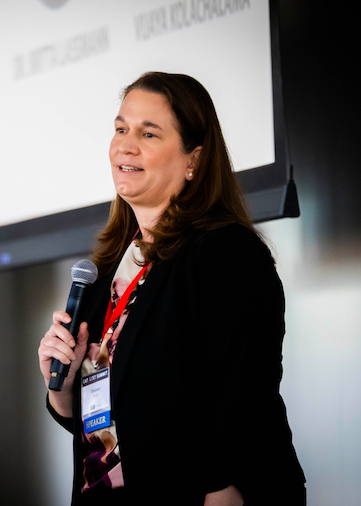
Other Catalyst Summit highlights were panel discussions and lightning talks featuring BU faculty and affiliates such as Professor and Chair of Biomedical Engineering Shannon Stott; Professor (BME, ECE) and Graduate Chair (BME) Darren Roblyer, developer of a novel device that uses light to monitor blood pressure; Rhoda Au, professor of anatomy & neurobiology, neurology, medicine, and epidemiology in the Chobanian & Avedisian School of Medicine; Associate Professor of Biomedical Engineering Alexander Green; AutoIVF VP of Research & Development Emre Ozkumur (ENG’09); M. Selim Ünlü, distinguished professor of electrical & computer engineering, biomedical engineering, physics, and materials science & engineering; former Roche VP and Global Head of Engineering & Facilities Carla Boragno, a member of the BU ENG Dean’s Leadership Advisory Board; Associate Professor of Medicine and Computer Science Vijaya Kolachalama; and Britta Lassmann, co-director and co-founder of BEACON.
The program also included an innovation showcase, featuring BU-bred biomedical technologies and labs such as DermaSensor, Bio Optical & Acoustic Spectroscopy, El Microbial Integration Group, BetaBionics, Nervara, Magnesis Robotics, NeuroSonix, Averra, and Rivus Optics.