BU Ignition Award Winners’ Innovations Could Reduce Knee Pain, Extend Lives of Cancer Patients, and Propel Underwater Robots
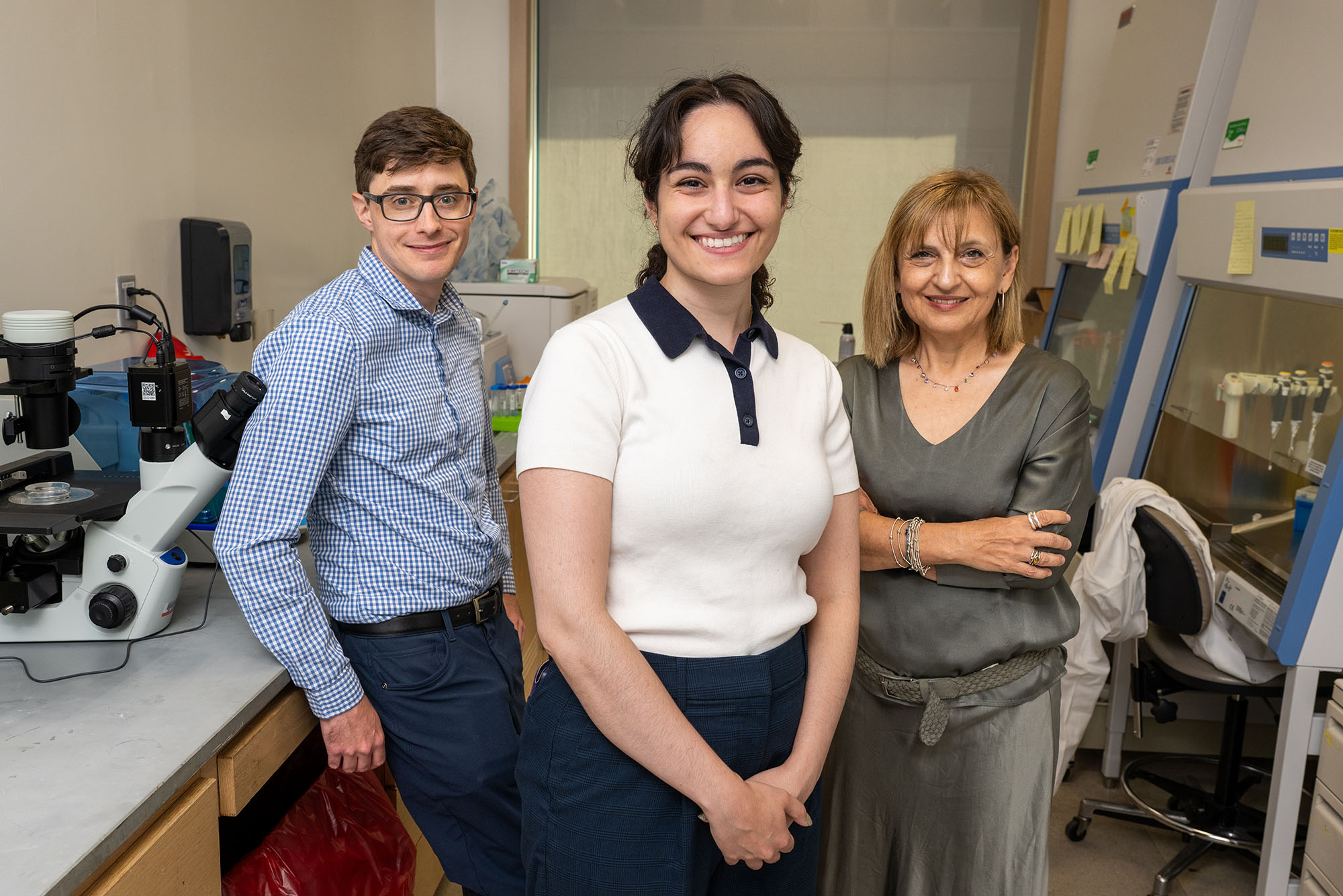
BU biomedical engineer Carolyn Marar (center) won an Ignition Award for her work with researchers Daniel Taub (left) and Venetia Zachariou (right) on a drug-free technology to tackle knee pain.
BU Ignition Award Winners’ Innovations Could Reduce Knee Pain, Extend Lives of Cancer Patients, and Propel Underwater Robots
Annual entrepreneurship awards given to research projects ready to make the leap from the lab to real-world impact
Recovery after a full knee replacement is a slow process—for some, it can take a few weeks before ditching the crutches and months before even thinking about stepping on a treadmill again.
While most patients make a full recovery, a handful struggle to shake the pain after surgery. Sometimes, they may even have to go back under the knife to solve the problem.
Boston University biomedical engineer Carolyn Marar (ENG’23,’25) is working on a less invasive, drug-free solution—a tiny, injectable implant that could wirelessly dial down the volume from selected nerves, reducing knee pain. She’s already tested the device in cell cultures and has founded a company, Nervara, to help push it along the path to clinical use.
Her mission has gained fresh impetus through a 2026 BU Ignition Award. The annual awards recognize research projects that are ready to step beyond the lab, providing financial and expert support to help innovative technologies move toward commercialization and real-world impact. Other winners this year include teams aiming to improve defense against drones, develop near-silent underwater propulsion technology, repair tooth enamel, stop the progression of kidney disease, and extend life for people with aggressive pancreatic cancer. The awards, which include up to $75,000 in funding, are run by BU Technology Development’s entrepreneurship division, which also offers a smaller prize for early-stage projects.
“I’m most energized by how these teams are forming, with researchers reaching beyond their labs to combine technical and entrepreneurial expertise to give an early discovery its best chance to reach the market,” says Melinda S. Shockley, BU’s executive director of faculty entrepreneurship. “The Ignition Awards show how BU’s researchers are building solutions to some of the hardest problems in health, defense, and sustainability.”
Marar is currently working with Venetia Zachariou and Daniel Taub, BU Chobanian & Avedisian School of Medicine experts on chronic pain, to begin the next phase of testing. Her knee pain device, which is made of a biodegradable, conductive polymer, looks like a small piece of pencil lead. It’s inert, but the magic happens when microwaves—high frequency electromagnetic waves rather than ovens—are directed at it.

“My PhD thesis work was on microwave neuromodulation and I studied how microwaves can inhibit nerves, neurons—any excitable tissue,” says Marar, a research scientist in Zachariou’s and Taub’s labs. “The implant just acts as a focusing mechanism for the microwaves, enhancing them at the target spot, so only that nerve gets affected.”
One of the next challenges is figuring out the best way of delivering those microwaves to the site of the pain, whether via a knee brace for ongoing therapy or a small device for relief from occasional flare-ups. After years of concentrating on the fundamental research, Marar says the expert support the Ignition Award provides—each team is paired with a dedicated advisory committee—is helping her determine how best to take her idea from the lab to the market, tackling issues like how to make the technology consumer friendly, attracting investors, and securing regulatory approval.
“I love exploring new science, but also finding ways to translate it,” she says. “Having a team of people with that entrepreneurship experience who can tell me, this is what matters, this is how you figure it out, and this is how you communicate it to investors, has been really helpful.”
A major goal of the awards is developing these projects to increase their chances of reaching consumers and clinics, says Shockley.
“Innovation lives in every corner of BU, driven by talented people who take early discoveries and imagine them all the way to real-world impact.”
The other 2026 Ignition Award winners are:
Optical Technology to Reduce Military Drone Threats
New technology is being developed “to reduce cost and improve performance of deformable mirror systems,” which the team says, “would improve civilian and military safety by enabling affordable, scalable directed-energy [high beams of energy] defenses against low-cost drone threats.” Project leads: Thomas Bifano, BU Photonics Center director and a College of Engineering professor of mechanical engineering, and David Bishop, an ENG professor of electrical and computer engineering.
New Drug for Chronic Kidney Disease
Chronic kidney disease (CKD) is often a complication of diabetes and high blood pressure—and can lead to kidney failure. There’s no cure. BU researchers are working on a peptide drug that will prevent the loss of specialized kidney cells called podocytes and, they say, stop CKD “progression, reduce morbidity and mortality, and decrease the burden of high dialysis costs on our society.” Project leads: Steven C. Borkan, an associate professor of medicine, and Laurence H. Beck, an associate professor of nephrology, both of BU’s medical school.
Synthetic Enamel for Sensitive Teeth
Once tooth enamel is gone, there’s no way to get it back—and that can leave you sensitive to cold and sweet drinks and food. BU researchers are developing a synthetic enamel technology that they say will be an “efficient, noninvasive treatment for tooth sensitivity” and may also help reduce the need for root canals and extractions. Project lead: Yuwei Fan, a Henry M. Goldman School of Dental Medicine research associate professor of restorative sciences and biomaterials.
Life-Extending Chemotherapeutic for Aggressive Cancer
Pancreatic ductal adenocarcinoma (PDAC) is an aggressive cancer with a five-year survival rate of less than five percent. A BU team is working on a novel chemotherapeutic for a type of PDAC associated with a mutation in the BRCA2 gene that could extend patients’ lives. Project lead: John A. Porco, Jr., BU College of Arts & Sciences Samour Family Professor of Organic Chemistry and director of the University’s Center for Molecular Discovery.
Silent Underwater Propulsion Technology
BU engineers are developing a bioinspired jet propulsion technology that could power underwater robots and vehicles. (It may also have applications in fluid pumps.) The team says it could be particularly beneficial on acoustic-sensitive missions, from defense to aquaculture, making “underwater operations quieter, longer-endurance, and lower-maintenance.” Project lead: Tommaso Ranzani, an ENG assistant professor of mechanical engineering.
Early-Stage Winners
The winners of the awards for emerging ideas are projects exploring tissue evaluation (Michael Albro, an ENG associate professor of mechanical engineering), autonomous science instruments (Keith Brown, an ENG professor of mechanical engineering), the reduction of HIV-associated inflammation (Daniel Cifuentes, a medical school associate professor of biochemistry and virology, immunology, and microbiology), and in-soil sensors (Miguel Jimenez, an ENG assistant professor of biomedical engineering).
According to the researchers behind the underwater propulsion technology, the Ignition Award landed at just the right moment.
“It’s transformative for our team,” says Ranzani, who credits PhD student Pranav Sultania (ENG’21,’27) with driving the project. “We had the core technology validated through Office of Naval Research funding and more than 30 customer discovery interviews showing genuine market demand, but we didn’t yet have the resources or structured pathway to bridge from a research-grade prototype to a field-ready product that could compete head-to-head with incumbent solutions.”
The timing is also fortuitous for Marar’s pain implant project, says Zachariou, Edward Avedisian Professor and chair of pharmacology, physiology, and biophysics. It comes as her department has been expanding, adding faculty and other researchers, to “establish innovative research programs in pain therapeutics,” she says. “This kind of collaboration between scientists from diverse scientific backgrounds allows us to test innovative tools that have promising therapeutic applications.”
And those would help fill an important gap in the market—and potentially bring pain relief to millions.
“Chronic pain is the leading cause of disability globally, and current pharmacotherapies are ineffective for a significant proportion of patients,” says Taub, a medical school assistant professor of pharmacology, physiology, and biophysics. “We have received considerable interest from both patients and clinicians regarding an effective, noninvasive, drug-free therapeutic approach.”
Winning an Ignition Award has expanded Marar’s ambitions—and helped her consider the technology’s future societal benefits. It could, she says, theoretically be used just about anywhere on the body. During her PhD research, she even studied its potential for epilepsy treatment, with implants used to inhibit seizures.
“The Ignition Award has helped me realize the extent of the impact my work can have,” says Marar. “It’s really inspiring to know that if I can get this to work, there are so many people who will benefit. It motivates me to keep going.”
The application cycle for 2027 Ignition Awards opens on October 1.