Keeping Care Close to Home: An Alum’s Approach to Rural Hospital Leadership.
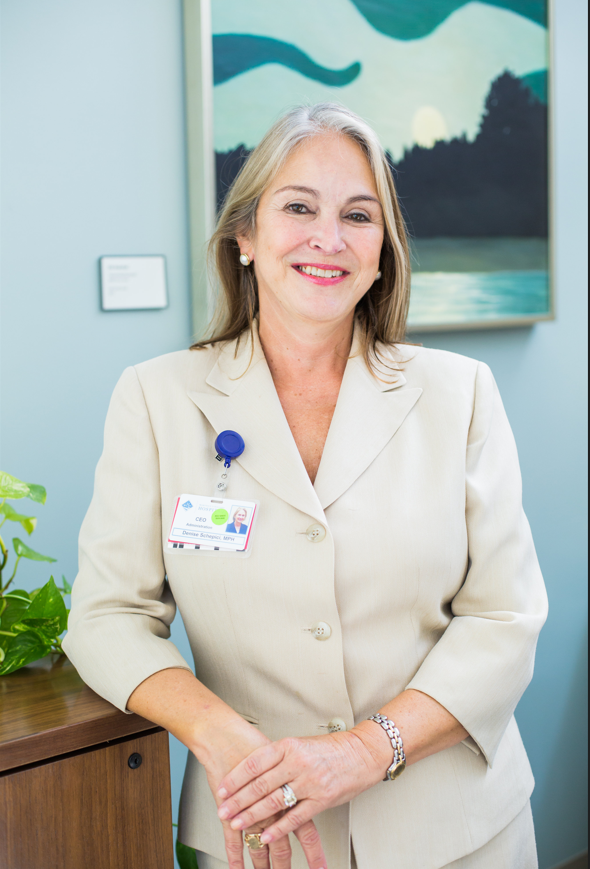
Denise Schepici. Photo courtesy of Denise Schepici.
Keeping Care Close to Home: An Alum’s Approach to Rural Hospital Leadership
Denise Schepici (SAR ’80, SPH ’92), who retired as president of Martha’s Vineyard Hospital in January 2026, reflects on a career that blended clinical experience and public health training to support the health of her Martha’s Vineyard neighbors.
Denise Schepici (SAR’80, SPH’92) retired as president of Martha’s Vineyard Hospital in January 2026 after eight years in the role and more than 45 years in healthcare overall. Now, she is ready to embrace island life with fewer responsibilities—something she has dreamed about since college.
“I came down with [a friend] for a weekend and just fell in love with the place. September and October are my favorite months. The water’s still warm, most of the crowds after Labor Day have gone home, the island starts to change colors—it’s just beautiful,” Schepici says. She briefly pursued pre-medical studies at Suffolk University before enrolling in BU Sargent College of Health & Rehabilitation Sciences to study cardiovascular technology. “I said, ‘Someday I’m going to live there.’ Sure enough, now I am. We built our house 26 years ago.”

Schepici’s husband, a retired schoolteacher, took up permanent residence on the island first, while Schepici wrapped up her second decade in hospital administration.
Ten years following the launch of her healthcare career as a cardiac catheterization laboratory technician at Salem Hospital (now North Shore Medical Center), Schepici moved into management—first as vice president of clinical services and later as chief administrative officer. Her strong clinical background helped well-positioned her for leadership, and eager to maintain her upward trajectory, she pursued a part-time MPH in healthcare management part time at SPH.
“I liked the flexibility of BU’s master’s in public health because you could do healthcare administration and take business courses,” says Schepici. “From statistics to health law […] I loved the program. It offered a lot of options.”
After earning her MPH, Schepici held various senior administrative roles at other hospitals across the region, including Tufts Medical Center and Metrowest Medical Center. In 2018 she joined her husband full time on Martha’s Vineyard intending to retire—until a headhunter approached her about leading the island hospital. “I never wanted to work on the island—it’s my happy place,” she recalls saying. “But he said they needed me, and I fell in love [the hospital].”
Schepici steered Martha’s Vineyard Hospital—the island’s only comprehensive care provider and largest employer—through the COVID-19 pandemic, ensuring it not only emerged intact but on track to expand its services. During her tenure the hospital expanded its stroke service, added an MRI coil for breast imaging, and established a new neurocognitive disorder and Alzheimer’s clinic. She also championed the transition of the island’s only nursing home in partnership with Navigator Homes in Edgartown, a skilled nursing and rehabilitation facility for Island seniors. At a farewell ceremony, staff praised her leadership and celebrated the legacy she leaves behind.
Now, Schepici encourages young people to consider careers in healthcare and public health. “I tell all my friends’ kids who are becoming college‑aged,” she says. “The BU School of Public Health really opened my eyes to more possibilities than I ever could have imagined.”
In a Q&A with SPH, Schepici reflected on her career and shared advice for aspiring healthcare leaders.
Q&A
With Denise Schepici (SAR’80, SPH’92)
SPH: Could you describe what it was like living on Martha’s Vineyard and working at Martha’s Vineyard Hospital? What are you most proud of accomplishing during your tenure?
Schepici: Martha’s Vineyard is a rural community seven miles out to sea, and Martha’s Vineyard Hospital is the only healthcare institution on the island. There are small private practices, but no complete set of services other than the hospital, so there’s a high reliance on the hospital. Some people misconstrue the island as only a place for the rich and famous. While that’s partially true, 20,500 people live here year-round—schoolteachers, firemen, fishermen, artists. It’s economically diverse. We have people who are housing insecure and food insecure, [as well as] people who are very wealthy who are generous and help the community.
One of the first things I did was a clinical assessment of all our programs because getting off the island to Boston for services is a hardship. We have an aging population—one in three people are over 65—so healthcare and chronic care are real concerns. I wanted to ensure we had high-quality care for islanders and seasonal residents alike. We were planning a building campaign to replace old buildings to accommodate clinical growth when COVID hit. That was the most challenging time I’ve had in healthcare. My staff—they hate when I say it—were absolute warriors. [With] compassion, expertise, ruggedness, we got through it.
SPH: How did your MPH training at SPH inform your leadership approach to the nonclinical challenges facing the hospital, such the need for affordable housing?
Schepici: When you’re in public health you learn about underlying causes of disease. When people are food insecure or housing insecure, health isn’t their top priority because they lack resources. That became acute here. Our tri-annual community health needs assessment made the community’s needs clear. We had to build programs to fill those gaps. Fortunately, Martha’s Vineyard Hospital was part of a big system—Partners, now Mass General Brigham—and we had resources at our fingertips. My job was to negotiate hurdles and bring resources to the forefront here on the Vineyard.
The community is remarkable—we have a huge food pantry and programs for the unhoused. There are still voids, but people are aware and do outreach. Some homeless people don’t want to go into shelters—they don’t trust healthcare and [may] have mental health or substance [use] problems. You have to meet them where they are. I couldn’t have done it without a public health understanding of these influences on disease.
I remember [taking] a class on seat belts and their impact on public health. Later, at Tufts, I ran the transplant programs, and we had to shut down one program because seatbelt campaigns were so successful there weren’t enough organs. A public health campaign saved lives but created a different problem, requiring consolidation of programs with a sister hospital. There are influences you learn that shape how you give care and organize programs. We’ve had a nice consortium on the island. We overlap rather than compete and help each other where our expertise lies.
SPH: What skills or knowledge do you believe future healthcare leaders should be focused on gaining through an MPH program?
Schepici: One big area is climate-related issues. I don’t think we’ve fully realized climate’s impact on our future food streams and health. If I were a young student today, I’d study that deeply. Related to climate is vector-borne disease. On Martha’s Vineyard, one out of 100 ER visits is tick related. We have high prevalence of Lyme disease in ticks because of the deer population, and now alpha gal caused by the Lone Star tick. Thirty years ago, I [had] never heard of the Lone Star tick; now people have alpha-gal disease and can’t eat meat and other mammalian products. Some are so sensitive they react to the smell of cooking meat. Why are ticks so prevalent? Temperature changes likely play a role. Environmental issues are concerning—water supply, chemical contamination—it’s not a natural world, especially here. The aquifer is sensitive. Well water contamination is a real risk. Whether in the city or rural areas, public health students should focus on the environment and what we can do to make a difference.