BtH: Town Hall on Refugees, Immigrants and Us
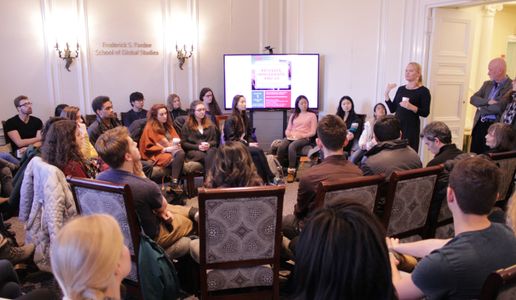
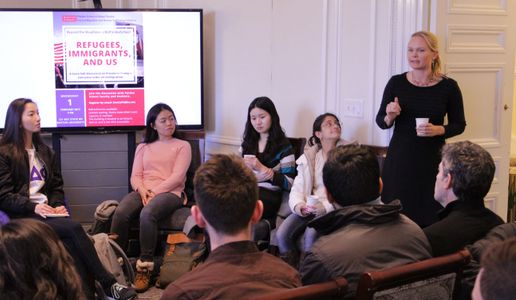
The Frederick S. Pardee School of Global Studies at Boston University and the Initiative on Forced Migration and Human Trafficking hosted a town hall discussion on United States President Donald Trump’s executive order on immigration on February 1, 2017 as part of the school’s Beyond the Headlines, or BtH, series.
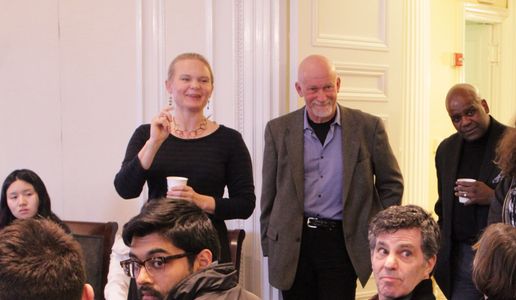
Students and faculty from across Boston University attended the town hall, entitled “Refugees, Immigrants, and Us,” to share their thoughts and concerns on the executive order. The discussion, which was moderated by Assistant Professor of International Relations Kaija Schilde, brought together expertise and scholarship on diplomacy, immigration law, security, intelligence and the broader field of global studies for a conversation on the global implications of President Trump’s executive order.
On hand to answer questions and facilitate discussion were Pardee School faculty members, including Amb. Robert Loftis, Professor of the Practice of International Relations who served in the State Department and Foreign Service from 1980 to 2012 where he held a wide variety of assignments including Ambassador to Lesotho from 2001-2004. Loftis stressed the importance of supplementing public protest and demonstration with direct contact with legislators on Capitol Hill.
“Going out to demonstrations is really a lot of fun, but to tell you the truth Donald Trump and Steve Bannon don’t care about your demonstrations, and in fact they would almost welcome them so they can basically ignore you,” Loftis said. “The one thing that you can do is to write to your congressman in your district a short, sweet, declarative note that says I am firmly opposed. Just focus on one subject, don’t bloat it with anything else, and say this is my vote — you cross me on this I’m voting against you, I’m supporting your opponent.”
Manjari Chatterjee Miller, Assistant Professor of International Relations, urged students to support a free press in the United States by not only reading the news, but by subscribing to newspapers and other media outlets who produce quality investigative journalism.
“Reading the news is really important, but it’s not just about reading the news, it’s about subscribing to newspapers,” Miller said. “I know everyone likes to click on the free links from the New York Times, everyone has done it, but a free press is essential. You want to subscribe to outlets that provide good investigative journalism, whether liberal or conservative, and as students you’ll get good discounts. A free press is the bedrock of a democracy.”
Dean of Students Kenneth Elmore attended the town hall, and discussed how students can get involved with organizations who have been at the forefront of the fight for causes including civil rights and gender equality for decades.
“I encourage you to really think about what exists, what works within the realm of what your interests might be and get involved with it,” Elmore said. “There are ways even if you’re not a citizen, even if you’re not registered to vote, that you can be actively engaged in something. Don’t think you have to reinvent this, maybe you can help these organizations that already exist, and engage with them as much as possible. Now is the time to double down on your synagogue, your mosque or your church and reengage with the civic organizations that mean a lot to you.”
Karen Pita Loor, Clinical Associate Professor of Law at the Boston University School of Law, was on hand to answer questions from several students on the legality of the executive order and who it specifically applies to.
“It essentially affects non-citizens across the board,” Loor said. “The people who have been detained at airports are from the seven countries affected by the executive order, and they are across the board non-citizens — there have been legal permanent residents detained at airports and people with legal visas have also been detained at airports. It’s applying across the board to non-citizens, which of course makes it very broad and very scary.”
Pardee School Adil Najam urged students and faculty to support and reach out to all groups who may be affected by the executive order on immigration or by future legislation.
“There are always people right next to you who need comfort as much as those who may be far away,” Najam said. “We cannot reduce this to one cause at a time. Today it may be Muslims who are under attack, but there are many others. Let us not pick this as one moment against another, if you stand for one of them you have to stand for all of the causes you believe are right.”