
Departments are required to undergo regular, thoughtful curriculum review to ensure programs and courses at MET remain up-to-date, rigorous, and relevant to student and industry needs. This ongoing review supports the introduction of new offerings, timely updates to existing curriculum, and the retirement of programs and courses that no longer align with our academic goals.
The Dean’s office is committed to supporting this review process. Below you will find the typical process workflows for each type of program or course change to guide your planning and submissions. For further guidance or to discuss a proposed change, please contact Kim Crosta at kimrich@bu.edu. We look forward to collaborating with you.
Creating or Changing a Program
For Departments that would like to engage in revisions to existing programs, changes in program modality, or proposals for new program. Your proposal will follow the process steps outlined below.

Dean’s Consult
An initial consultation is required to ensure the proposal appropriately reflects and is in line with the strategic direction of the college. You will receive guidance on the appropriate procedure for the request, including any necessary documentation and estimated timeline: Request a meeting.
Department Review & Approval
- Proposals must be approved by the Department Chair/Head as well as the faculty in the department. The Department should also examine what impact the changes will have on other programs within the Department or college and how they will address these issues.
- New programs and program revisions that include courses from other departments must also obtain faculty approval from the department that hosts the course, even if the home department previously approved the inclusion of the course in the last version of the curriculum.
- Any new courses that will be created with the proposal require approval as well. A syllabus and APC New Course Proposal Template must be provided for each new course.
- Courses that are being renumbered require an updated syllabus
Academic Policy Committee (APC) Review & Approval
Submit your proposal at least one week in advance of the next scheduled APC meeting. You must submit required eCAP documents, syllabi, and any other supporting documents via the proposal submission form to be scheduled for a proposal defense.
Dean’s Review & Approval
The Dean’s office will work with the faculty lead to ensure all required documentation is complete and polished. Once the documents are finalized, the Dean will review for final approval.
Electronic Curricular Review Process (eCAP) submission
The Dean’s office will submit approved documents through eCAP. The level of approval is based on the extent of the proposal. proposals are typically reviewed by the Office of the Provost, Global Programs (if applicable), the consultative body, the Undergraduate Academic Programs and Policies (UAPP) or the Graduate Academic Programs and Policies (GAPP) committees, and the University Council. After university approval, the Dean’s office works with the Office of the Registrar to finalize any programmatic details.
Launch
The Dean’s office will initiate the launch with the hosting department, marketing, and the admissions team to execute the proposal. Items that will be determined during the launch phase are the timing of the launch of the student application, website & marketing material updates, as well as staff, faculty, and student notifications, etc.
Establishing a New Non-Required Course

Department Review
Faculty submits a new course proposal for review and approval by the Department Chair/Head and faculty.
The proposal should include:
- APC New Course Proposal Form
- Budget proposal for course with special requirements such as international travel, extended laboratory requirements, online material development, etc.
- CV of the faculty developing and teaching the course if the faculty is external to MET
APC Review
The proposal should be submitted to the APC to be scheduled for an upcoming meeting. The Chair of the APC will invite the faculty proposing the course and/or a department representative to present the proposal.
Dean’s Office Review
The Dean or Senior Associate Dean for Academic Affairs reviews the proposal for final approval and sign-off. The Dean’s office sets up the course for inclusion in the course inventory.
Minor Updates to an Existing Course

Online Course Development & Significant Updates

Faculty who need to develop or update an online course are requested to submit an online proposal form after obtaining Chair/Program Head approval. BU Virtual has limited bandwidth each semester for developments and updates, and your adherence to the submission deadline is imperative for planning.
For each proposal, the Dean’s office will coordinate with BU Virtual to finalize the planned term launch. The final timeline of the course development will be confirmed upon the approval of the proposal. Classes must still be scheduled through the regular scheduling process.
| Proposal Submission Deadline | Target Launch Term |
| Nov 3, 2025 | Summer 2026 |
| Feb 2, 2026 | Fall 2026 |
| June 1, 2026 | Spring 2027 |
| Nov 2, 2026 | Summer 2027 |
HUB Proposals

BU Hub is Boston University’s innovative general education program for all undergraduate students. MET Undergraduate students follow the Hub Requirements for Transfer Students. Faculty members will work with their Departments to identify or create courses to be added to the BU Hub. Proposals are submitted through Courseleaf, which is the BU Hub General Education Proposal Management System.
Upcoming Deadlines:
November 15, 2024 for AY 2025-2026 (Fall, Fall/Spring and Summer Courses)
For full details regarding the approval process, please visit: the BU HUB Approval Process and Deadlines page.
Credit Assignment to Academic Courses
Boston University Policy on Credit Assignment to Academic Courses
The Boston University Policy on Credit Assignment to Academic Courses establishes guidelines for assigning the number of credits earned through fulfillment of requirements for academic courses. Reaffirming Boston University’s commitment to educational quality in terms that certify compliance with applicable government regulations and accreditation standards, the policy makes explicit the relationship between the credits assigned to an individual course and the expected work of a student completing that course.
The policy applies to all credit-bearing academic courses, regardless of course type, instructional format, mode of delivery, or length of the course.
Read the Full Policy Document with Tables
Effective Date. All new courses developed after June 1, 2015 should be in compliance with the policy. Full implementation for existing courses should be completed for the June 1, 2017 bulletin.
MET Task Force on Course Credit Assignment
In 2016, the MET Task Force on Course Credit Assignment (CCA) was established and charged with outlining the College’s procedures for implementation of the university-wide policy on course credit hours. The Task Force took into consideration the diversity of academic programs at MET and the variety of course delivery modes, and accomplished, among the others, the following specific tasks:
- Outlined general procedures, priority order and timeline for CCA policy implementation in all existing and newly developed MET course in each of the delivery formats;
- Identified faculty and administrators in each academic credit and program who would be in charge of implementation and supervision of the CCA policy;
- Estimated the resources and time needed for full MET compliance with CCA policy across the delivery formats;
- For each delivery format developed samples of the most common course activity distributions that satisfy the CAA policy that can be shared with the faculty;
- Proposed mechanisms and steps that the MET Academic Policy Committee should implement in the review process to assure full compliance with the CCA policy for all the newly approved courses;
- Suggested steps to be included in the online course development procedures that would assure implementation and compliance with the policy, including necessary updates to the course development contracts and facilitator contracts;
- Recommended a procedure for informing MET full-time and part-time faculty about the CCA policy and its requirements and the wording to be included in course syllabi that would state and explain the policy to students;
The members of the CCA Task Force were:
- Professor Robert Schudy, Director of the online MSCIS program
- Professor Mary Ellen Mastrorilli, Faculty Coordinator for the MCJ online program
- Professor Stephen Leybourne, Faculty Coordinator for the MSM online program
- Eric Friedman, Director of Distance Education
- Daniel Hillman, Assistant Director of Instructional Design
- Dean Tanya Zlateva
- Senior Associate Dean Lou Chitkushev
MET Course Time Analysis Table
The Task Force provided demos of the Time Analysis Table to the MET Faculty Council on March 25, 2016 and on May 6, 2016. The Time Analysis Table contains a course metric workbook that will help faculty examine their courses to see if they meet course credit hour requirements. The workbook can be used to:
- show how many contact hours a course currently contains,
- break down the amount of activity week by week, and
- let faculty members play with the number and kind of activities they could add before any course development takes place.
The first tab of the table, “Constants” contains constants that are used to calculate the course credit hours based on a set time ratio assignment for synchronous and asynchronous activities. The second tab marked “Demo” contains an example online course not currently meeting the policy hour requirements, but can be used to see how entering new activities increases the contact policy hours based on the approved ratios for synchronous and asynchronous activities. The third tab, “Your Course” is a blank workbook set up for an online course with seven weeks, but can be modified easily for a fifteen week on campus course.
The Time Analysis Table is also required to be submitted to the APC with new course proposals.
Proposal Workflow Quick Chart
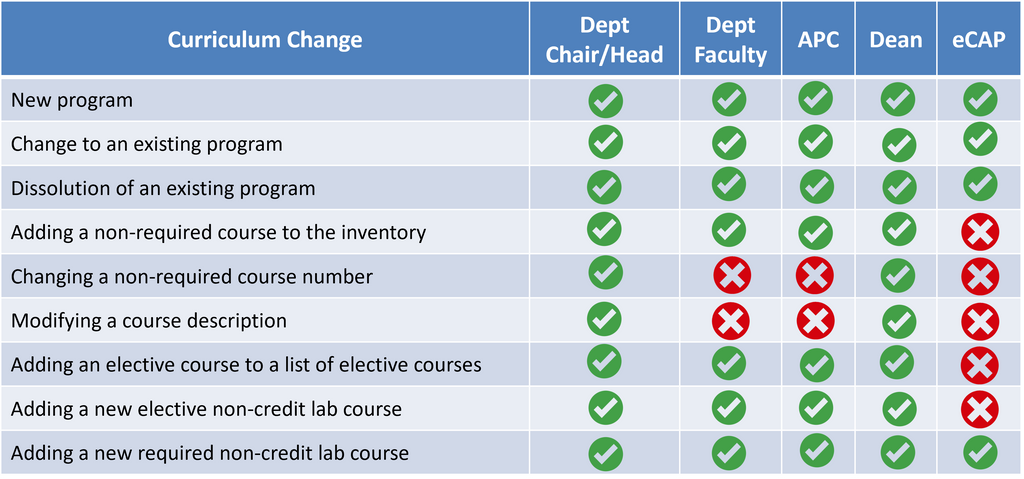
“Program” – includes degrees, majors, minors, unit-bearing and non-unit-bearing certificates.