
A Living Internet of Things
by A.J. Kleber
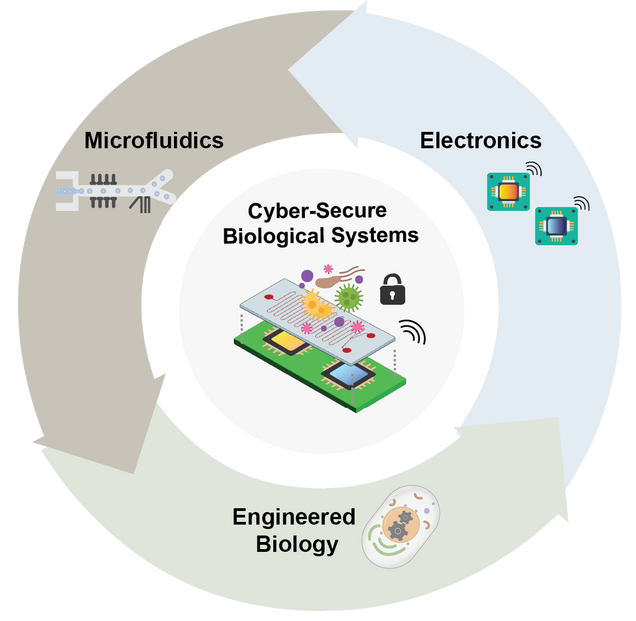
It’s part manifesto, part classification system: a pair of BU ECE faculty have published a review & vision paper in Nature Biotechnology aimed at introducing and describing what they’ve termed Cyber-Secure Biological Systems, or “a new class of living bioelectronic devices,” which they see as a key component for future research across multiple disciplines. They hope to encourage an organized collaborative effort to push the advancement of these devices and realize their many potential applications.
Convergent thinkers–and doers
Professors Rabia Yazicigil and Douglas Densmore each have considerable experience with interdisciplinary research collaborations, both separately and as an established team. A microelectronics specialist and an automation and fabrication pioneer, respectively, both have formed strong ties in biomedical and environmental domains. Professor Yazicigil has broken new ground with her work on miniaturized, ultra-low-power microchips for ingestible medical monitoring technology, while Professor Densmore has designed microfluidic platforms for studying engineered bacterial communities, and developed a computer-aided design (CAD) program for use in the design of new microorganisms. Together, they’ve collaborated on projects aimed at developing smart biosensors and better bioreactors for biomanufacturing.
 What are Cyber-Secure Biological Systems?
In their paper, “Improving engineered biological systems with electronics and microfluidics,” Densmore and Yazicigil discuss an emerging class of devices which integrate electronics, microfluidics, and engineered biological components (such as microbes) to accomplish a variety of tasks related to “biological environments.” Their purpose may be for observation and reporting, sensing changes and measuring impacts, or acting more directly on such environments, whether in the lab, or in the field. Per the authors, the integration of these different technologies provides a unique set of combined strengths which enhance functionality and provides ever-greater insight into the complex biological processes which underpin our world. These biological processes are likely the key to some of the most urgent problems our society, and indeed our species, now face.
The paper lays out the advantages and weaknesses of electronic, biological and microfluidic components, considers performance trade-offs and design options, and imagines a broad array of potential applications for everything from personalized healthcare to smart agriculture. The authors propose a system of standardized categorization based on 24 years of research across disciplines, grouped by combinations of components, level of integration and customization, and scale. They also highlight key challenges to address, and issue an open call for collaboration, contributions, and participation from colleagues from diverse fields, with an emphasis on practical design and experimentation.
An invitation to innovate
To facilitate this participation, Yazicigil and Densmore have launched a unique online resource: an interactive website designed to “dynamically visualize emerging trends,” which they term a Living Roadmap. The site features a curated collection of relevant research papers, a submission form for interested colleagues to add to the growing body of work, infographics and other resources; all designed to encourage future contributions and new insights.
They’re putting out the call: the hybrid technology of the future is coming, and it needs bright minds from a diverse set of backgrounds and disciplines to make it a reality. Will you answer?
 Professor Douglas Densmore is the director of the Cross-disciplinary Integration of Design Automation Research (CIDAR) group, with a research focus on developing tools for the specification, design, assembly, and testing of synthetic biological systems. He is an AIMBE Fellow, a Tegan Family Distinguished Faculty Fellow, a Senior Member of IEEE and ACM, and a 2013 NSF CAREER Award recipient, among other honors, and has co-founded three commercial synthetic biology-based companies in the Boston area. He is also the founder of STEM Pathways, an organization dedicated to student mentorship and outreach.
 Professor Rabia Yazicigil leads the Wireless Integrated Systems and Extreme Circuits (WISE-Circuits) Laboratory, with domain-spanning research including integrated circuits and chip design, biosensing architectures, wireless communications systems, and physical-layer security. She is the recent recipient of a $6M collaborative grant from the Northeast Microelectronics Coalition (NEMC) Hub to develop universal data decoding chips, and an NSF CAREER Award in support of her ongoing work on secure miniaturized bio-electronic sensors designed to monitor the human GI tract from the inside, in real time.