Hare Examines U.S. Diplomacy Toward Cuba and Venezuela
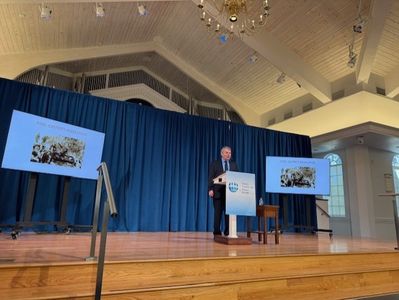
 Upon invitation, Paul Webster Hare, former British ambassador to Cuba and a master lecturer at the Pardee School of Global Studies, addressed the Naples Council on World Affairs (NCWA) in Florida in a lecture, titled Diplomacy and Negotiation: Cuba and Latin America. Since 1980, the NCWA has served their local communities by providing education and engagement on international affairs and critical global issues.
Hare was part of this year’s Distinguished Speaker Lecture Series, themed Our Enduring Global Crises, and was among nine other lectures spanning across November 2025 – April 2026. The lectures were attended by over 1,000 NCWA members and Floridian residents.
In his lecture, Hare examined the historical context of U.S. policy toward Venezuela and Cuba, highlighting key political and economic differences between the two countries. Venezuela has a long democratic tradition and a deep history of U.S. business engagement, and its democratic opposition remains comparatively strong, as reflected in the July 2024 elections.
By contrast, Cuba has not experienced multiparty democracy for more than six decades, and much of its political opposition has left. Despite this, there have been moments of attempted rapprochement, most notably during the Obama administration, that pointed toward renewed diplomatic engagement and potential economic opportunities for U.S. and Cuban American businesses.
Historically, Venezuela was a close U.S. ally, not only because of oil interests but also through broader commercial ties, educational exchanges, and a shared legacy of independence from colonial rule, symbolized by Simón Bolívar’s admiration for the American Revolution.
Cuba, too, achieved independence with U.S. support, yet between 1902 and 1959 it remained firmly within the United States’ sphere of influence despite its formal sovereignty. Upon reflection, Hare noted that “We may now be entering a new era where the U.S becomes the dominant neighbor influencing the economic and political development of what is still a one-party state.”
More information on the Naples Council on World Affairs lecture series can be found here.
Paul Webster Hare is a master lecturer at the Frederick S. Pardee School of Global Studies. He served as British Ambassador to Cuba from 2001 to 2004 and also represented the U.K. to the European Union in Brussels, New York, Portugal, and Venezuela as deputy head of mission. Hare has extensively written about Cuba for renowned news outlets including The Financial Times, The Atlantic, Newsweek, and The Huffington Post. He is also the co-editor of the Palgrave Handbook of Diplomatic Reform and Innovation, which analyzes current practices of diplomacy and proposes practical solutions to improve diplomatic outcomes.