
Honoring Student Achievements at the Close of the 2025-26 Academic Year
by A.J. Kleber
Looking back at another incredible academic year, Boston University’s department of electrical and computer engineering has many student achievements to celebrate; not least, the most recent crop of award-winning senior design projects, MS research, and Ph.D. dissertations.
As Pippi Pi (CE’26) emphasized in her College of Engineering commencement speech, BU students gain “the tools and grit” to face real-world problems, beyond “the textbook answer.” These recent accomplishments are a testament to this legacy of ingenuity and determination.
A federal vote of confidence
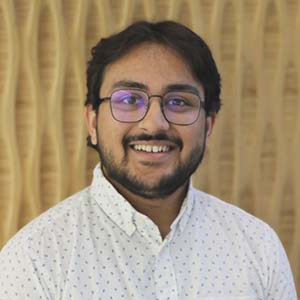
Ask any researcher: there’s nothing quite like the freedom funding can provide for innovation, allowing the work to follow interesting questions as they arise. ECE Ph.D. student Yash Patel, recipient of a 2026 NSF Graduate Research Fellowship, can attest to this. “This fellowship provides the flexibility to pursue high-risk, high-impact research,” he enthused in his post on LinkedIn announcing the achievement.
A member of Professor Rabia Yazicigil’s WISE-Circuits Lab, Patel’s research centers on the convergence of electronic micro-circuit design and synthetic biology, with applications for biosensing, wearable technology, and medicine. Last summer, his “impressive technical skills and strong collaboration efforts” won him the Massachusetts Life Sciences Center (MLSC)’s inaugural Susan Windham-Bannister Life Sciences Intern Award, in support of his internship at Cambridge-based digital health company BioSens8. He plans to put his new funding to use in pursuit of advancing CMOS sensing technologies.
The NSF Graduate Research Fellowship Program (GRFP), founded in 1952, is one of the nation’s most prestigious and competitive. The 2,500 2026 recipients, including Patel, were selected from a pool of nearly 14,000 applicants from across the United States. The express purpose of the GRFP is to develop new generations of talent and leadership in science, and to encourage groundbreaking research and economically significant innovation.
A chance to shine

Collaboration is a cornerstone of impactful research, and key to the development of promising early-career researchers. This is one of the benefits of programs like the MLCommons Rising Stars, which supports and connects early-career researchers in machine learning and systems engineering. The program is selective–in 2026, 39 applicants have been chosen from a pool of over 170–and provides its participants with a global community of peers and leadership in their fields, career development opportunities, and an in-person workshop where they can connect, learn, and present their work.
This year, ECE Ph.D. student Efe Şencan has been selected for one of the coveted Rising Stars spots. Working with Professor Ayșe Coskun, his research focuses on building ML methods to detect performance anomalies and bottlenecks, and provide telemetry-driven analytics for high-performance computing (HPC) systems, with the goal of improved reliability, efficiency, and troubleshooting. His work is an excellent fit for a cohort of Rising Stars who, according to the organization, collectively reflect the growing importance of research on machine learning systems in shaping the future of AI.
The building blocks of an open cloud

In its commitment to Creating the Societal Engineer, the College of Engineering isn’t just dedicated to turning out inventors who fully-realized application-focused projects like a high-tech braille system, impressive and important though such things are. A considerable amount of engineering work is highly technical and behind-the-scenes, where their ultimate benefits are not always easily noticeable to the lay user.
This year’s ENG Masters Societal Impact Award recognizes Jeffery Lim (ECE MS ‘26) for thesis work that falls into this category. The problem Lim’s work focused on is an inherently societal one: currently, cloud-based computing relies on proprietary architecture designs to offload data-hungry functions like networking, security and storage from client CPUs, enabling larger workloads at higher speeds. Companies like Amazon, which owns the Nitro SmartNIC architecture, do not make these products available for study by researchers, which restricts development and accessibility.
Mentored by Professor Martin Herbordt, Lim has developed and implemented an open-source FPGA-based network switch, Verilog Network Switch (VNS), built on an existing, but less advanced, open-source NIC, with several novel components. Evaluated against existing open-source alternatives, VNS performed similarly or better. In Lim’s own words, this achievement represents “the first open-source steps toward a Nitro-class SmartNIC research platform,” which could provide top-of-the-line, efficient cloud service to researchers without having to go through a corporate intermediary.
In pursuit of sustainable generation

Each year, the BU Institute for Global Sustainability (IGS) brings together an interdisciplinary cohort of graduate students under its Summer Fellows program, offering financial support, mentorship, and professional development resources for independent research projects focused on environmental sustainability. As a 2026 IGS Summer Fellow, ECE Ph.D. student Lizzy Yue will pursue a project titled “Power Optimization in Large Language Model Inference Serving;” an investigation aligned with her advisor Professor Ayșe Coskun’s work on energy-efficient high-performance computing and AI data centers, among other related topics. Yue expressed her appreciation in a LinkedIn post, stating that she is “grateful for this opportunity to pursue sustainability-related research along such an inspiring interdisciplinary cohort, and I look forward to learning from faculty mentors and fellow graduate students this summer.”
Two million minutes later …
Pippi Pi’s cheerfully celebratory commencement address was not without a note of challenge, directed to herself and her classmates, as she affirmed that they “know, now, how to sit in uncertainty and still move forward.” In, as she termed it, “this complex, ever-changing world in which technology is both exciting and scary,” they may well be called upon to save lives or “hold cities together,” through the training they’ve received and the ethos of convergence and Societal Engineering inculcated during their approximately two million minutes at BU.

Fortunately, as their field increasingly defines and supports the very society they live in, BU ECE students at every program level are learning–and indeed, already demonstrating–the skills and values they’ll need to step up.