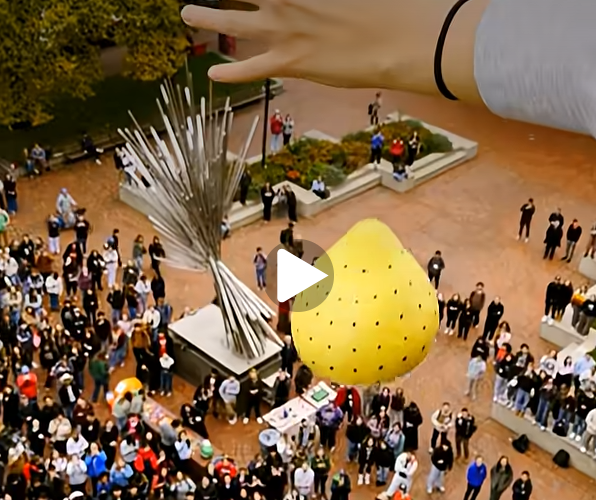
By tossing a pomelo off a roof, researchers demonstrate the fruit’s remarkable shock absorbency
It’s the world’s biggest citrus fruit, native to Southeast Asia. The grapefruit-like pomelo, officially Citrus maxima, is a popular festival food with a mild, slightly sweet taste. It also has a hefty peel that protects the delicate flesh inside—and that could help inspire more shock absorbent cell phone cases, packaging, and even naval ships.
At Boston University College of Engineering, researchers are studying the pomelo’s remarkable ability to fall from great heights—pomelo trees can grow up to 50 feet—without smashing into pieces. With a US Navy grant, they’re combining biology, materials science, and computational mechanics to engineer novel, lightweight materials that replicate this unique fruit’s energy absorption mechanisms, on a larger scale.
“I’ve always been intrigued by bioinspired engineering,” says project lead J. Gregory McDaniel, an ENG associate professor of mechanical engineering and of materials science and engineering. “Nature keeps building things and testing them all the time, right in front of our eyes.”