
New ECE Professor David Lake and the Quantum Architecture of the Future
by A.J. Kleber
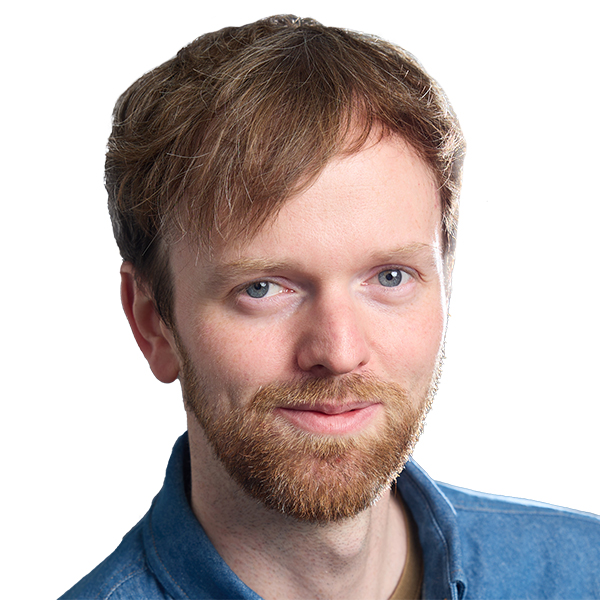 Many scientists and engineers are convinced: the future is quantum. Quantum computing and communications technologies are still largely theoretical, but dedicated efforts are underway to make them a tangible and scalable reality, chasing the promise of exponentially faster, provably secure, and almost impossibly advanced computing power. In the words of new BU ECE Assistant Professor David Lake, “quantum information technology promises to solve problems no classical computer can” – which, he affirms, will provide “immense societal benefit.” With this in mind, he has spent his burgeoning career working to bring that quantum future closer to realization.
Lake is focused on addressing a looming challenge: current quantum processors are approaching a limit to their quantum bit, or “qubit,” capacity. In order to reach the full potential of quantum computing, networking architectures must be developed that can support a much higher qubit load, analogous to modern data networks, the internet, and so on. Lake’s doctoral and postdoctoral work have taken various approaches to the development of quantum interconnects, exploring the replication and utilization of naturally-occurring defects in the crystal lattice that makes up diamonds, called “color centers,” and designing novel quantum devices for entangling optical and microwave photonic qubits, a building block for future architectures.
This enterprising researcher joins Boston University from the California Institute of Technology, where he held the roles of Postdoctoral Scholar and Staff Scientist, working on collaborative efforts with colleagues at the University of Chicago and the Jet Propulsion Laboratory. He completed his doctoral studies at the University of Calgary in 2020, under the auspices of a Natural Sciences and Engineering Research Council of Canada (NSERC) Doctoral Scholarship and an Alberta Innovates – Technology Futures Doctoral Scholarship.
At Boston University, he plans to put together a cutting-edge quantum research lab where, building on the techniques and expertise acquired during his previous studies and projects, he will continue to push towards the development of practical quantum interconnects. His blueprint for future research is based on his identification of Erbium dopants in Silicon as the nanomaterial from which to develop “a complete quantum information technology platform.” And of course, while he continues to break new ground in his lab, he’ll be working to educate and fire the imaginations of the next generation of his colleagues via his first BU class, EC 585: Quantum Engineering and Technology.