
Tenth annual Materials Day focuses on automation in materials discovery
Nearly 130 researchers gathered high on the 17th floor of Boston University’s Duan Family Center for Computing & Data Sciences last week to share and learn about the successes and challenges of leveraging automation for materials discovery. The occasion was Materials Day 2025, From Automation to Collaboration: The Future of Self-Driving Labs.
Sponsored by the Materials Science & Engineering (MSE) division of the Boston University College of Engineering along with BU’s Rafik B. Hariri Institute for Computing and Computational Science & Engineering, the day-long workshop featured nine faculty speakers from industry and institutions around the Boston area and beyond, as well as lightning talks by graduate students.
“Materials research here at BU integrates approaches from many different domains, across engineering and beyond,” said BU College of Engineering Dean Elise Morgan in opening remarks. “We think that convergent approach really helps address the complex challenges that aren’t solvable by single-discipline thinking alone. And we focus on the problems that matter the most to people.”
The theme of this, the tenth annual Materials Day, “fits perfectly with the college’s mission and also the moment we are living in,” Morgan added. “The potential of self-driving labs to democratize materials research and increase both the throughput and the sophistication of that research and its impact on society is clearly transformative at scale. And the emphasis of today’s program on creating a community and banding together to accelerate progress is a wise tactic when threats to research funding abound.”
Bright ideas
A self-driving lab (SDL) is one in which robotic devices perform a great number of experiments consistently, aided by machine learning, toward a goal chosen by human scientists. A prime example is the lab of Keith Brown (ME, MSE, physics), who organized and emceed Materials Day with the help of administrators Elizabeth Flagg and Lea Sabra of MSE and Maureen Stanton of the Hariri Institute.
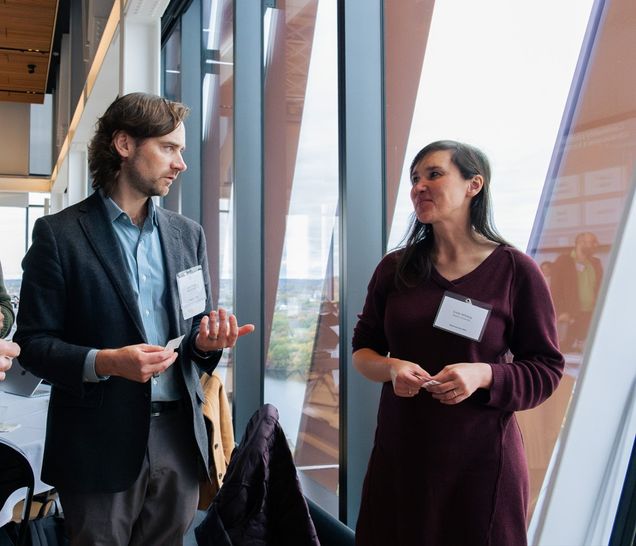
Brown’s KABLab used a system Brown calls the Bayesian experimental autonomous researcher (BEAR), combining additive manufacturing, robotics, and machine learning to do thousands of experiments until the team discovered the most efficient material ever for absorbing energy—ideal for applications such as crash helmets or packaging. The lab has since developed the BEAR DEN, a collection of automated systems that enables them to make fundamental advances in polymers.
Noting how Thomas Edison and his team at Menlo Park tested 6,000 materials before arriving at the filament that worked for the electric light bulb, Brown said, “The term ‘Edisonian’ has in some ways come to mean a brute-force approach that doesn’t leave room for thought. And we should be thoughtful. But we also need to do a lot of experiments. Automation helps us in this process.”
In addition to the relatively simple robots physically carrying out experiments, advances in machine learning mean that software can actually choose the experiments, guided by researchers. “The idea that you can take computers and use them to solve complicated problems is a core part of the vision of self-driving labs,” said Brown. “Let’s compute what we can to try to do better and smarter experiments.”
The Taco Bell model
For a scientist—and indeed for the research community and society generally—the most important benefit of an automated lab is its ability to faithfully replicate an experiment over and over and over again, said Professor Douglas Densmore (ECE, BME, MSE).
“You see robots, you see software—it’s all in the service of reproducibility,” Densmore said. “Higher throughput is great, lower cost is great, but it’s really reproducibility. It’s that if we were able to get this result, you could get the same result using a similarly configured lab. That’s my metric.”
Densmore runs the Design, Automation, Manufacturing and Processes (DAMP) Lab. During the pandemic, the heavily automated lab processed up to 6,000 COVID-19 tests a day. Now, it’s a resource for synthetic biology researchers seeking to create genetic materials. And, Densmore said, the lab’s efficiency is not unlike that of a fast-food franchise.
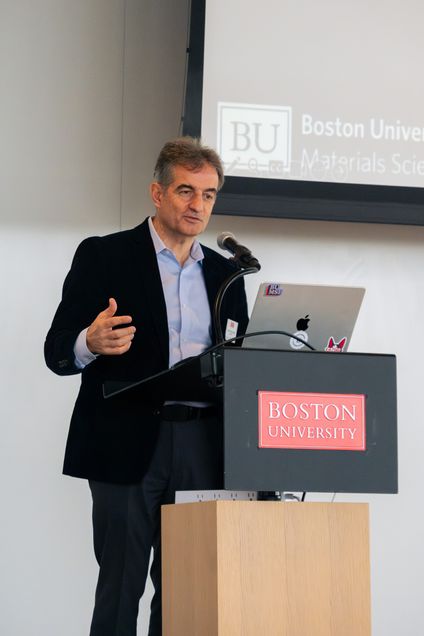
“People who work at Taco Bell go through a standardized training,” Densmore said. “They know they won’t be there forever. When someone leaves, Taco Bell doesn’t say, ‘Well, Joe left. We’re done.’ In our lab, we love our people, but when a student graduates or a postdoc leaves, we don’t say, ‘What are we gonna do?’ We have standardized processes in place.”
Parameters for polymers
Assistant Professor Joerg Werner (ME, MSE) spoke about how his research is well suited to SDLs. Werner studies polymer materials, which have applications in packaging, coatings, advanced electronics, batteries, and drug delivery.
“Polymers’ properties depend on how you process the material,” Werner said. “There are lots and lots of parameters that matter. So it’s a perfect case for automation.”
For example, Werner, along with collaborators such as doctoral student Zhaoyi Zheng (who delivered one of the day’s lightning talks), used Brown’s BEAR DEN to speed up the development of the Electrodeposition of Polymer Networks mechanism, a novel method for fabricating polymer thin films on conductive materials of any shape.
“We hope we can drive forward this kind of polymers materials discovery,” said Werner, “using electrodeposition to make the films, modular chemistry to modify them, and closed-loop experimentation.”
A range of topics
Other speakers, hailing from universities such as MIT, Cornell, and Carnegie Mellon, addressed Bayesian optimization, the challenges that atomic systems pose to machine learning, and workforce development, to name a few aspects of SDLs.
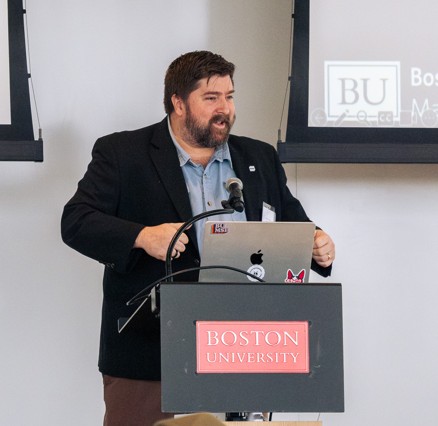
For example, Nadya Peek of the University of Washington discussed how DIY and makerspace approaches can help lower the barriers to automation. Tonio Buonnassisi of MIT explored how automation can reduce bottlenecks in characterization and shared his lab’s success in discovering novel perovskite-inspired materials. Malte Jung of Cornell sounded a cautionary note, pointing to research about how the automated lab environment might undermine teamwork among human researchers. (The full list of speakers is here.)
The lightning talks by students were an important component of the program. “It’s nice to have the opportunity to share our recent focus with the whole community,” said Jiashuo Wang, a doctoral student in the KABLab. “A few people reached out to me afterwards to talk about more details or share their experiences and thoughts in similar areas, which is very helpful for our continuing research and collaboration.”
The full picture
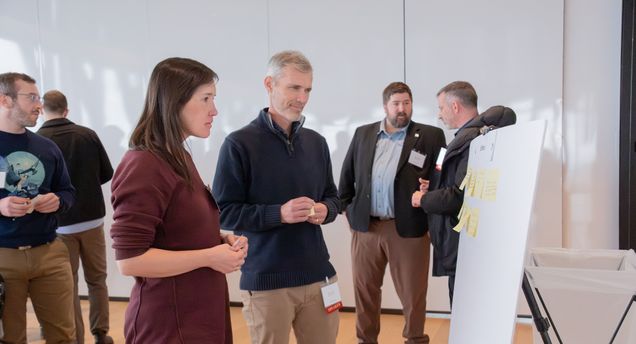
In a new feature of Materials Day, this year’s attendees engaged in a community ideation exercise. Throughout the workshop, the researchers were encouraged to jot down open questions, grand challenges, and other relevant thoughts on sticky notes and, during breaks, to stick the notes on poster boards devoted to various topics: hardware, software, modular chemistry, human-machine learning, community, and convergence. After lunch, all participants stood up and circulated throughout the room, congregating at the poster boards, reading and commenting on each other’s questions. The exercise sparked lively discussions and, perhaps, future collaborations.
As Buonassisi said, live gatherings of this nature provide the scientific community with something not found in a textbook. “You need to hear from other people,” he said. “Our oral history, this way of sharing is the best we’ve got right now. If you want the full picture, come to a workshop like this.”