
Program Notes
- No GRE required.
- Merit scholarships available, with no additional application required.
- Current BU undergrads & alumni: learn about the Double Terrier scholarship.
- International students: This program is eligible for the OPT STEM extension.
What is emerging media studies?
Emerging media studies is the science of understanding people in a digital world. It brings together communication, media psychology, behavioral research, analytics, and computational methods to investigate how people interact with technology, and how those interactions shape behavior, relationships, organizations, and society.
At BU, you’ll learn to go beyond observing what people do. You’ll ask why they do it, test those questions through research, analyze what you find, and turn evidence into insights that can inform products, policies, communication, and strategy.
That understanding requires diverse perspectives, which is why our cohorts welcome students from a wide range of academic and professional backgrounds. Whether you’re entering directly from college or pivoting from another industry, you’ll build the data literacy and research skills you need from the ground up, so you can investigate complex questions with confidence.
Why choose the MA in Emerging Media Studies?
Answer questions that matter: the year-long Collaboratory
Organizations don’t just need more data—they need people who know how to ask the right questions. Through the Master’s Collaboratory in Emerging Media, you’ll spend three semesters on a team helping clients—including regional tech startups, national nonprofits, and media organizations—understand audiences, interpret behavior, and answer questions that shape products, policies, and people’s experiences. You’ll graduate with a portfolio of applied research demonstrating your ability to design studies, analyze complex data, interpret human behavior, and communicate findings that influence real-world decisions.
Advanced research infrastructure
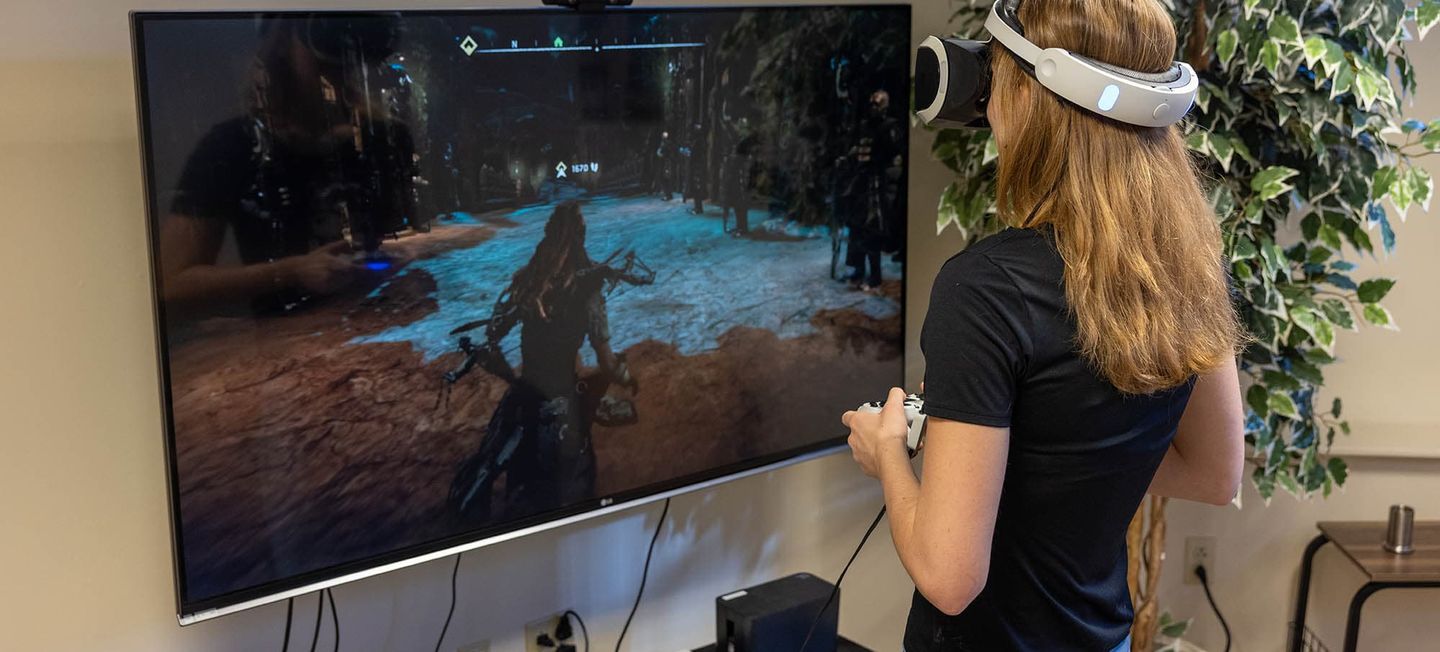
Behind every data point is a person. You’ll learn how to understand both. Conduct original behavioral and physiological research in the Communication Research Center (CRC), COM’s advanced data and media lab. Here, you’ll gain proficiency in biometric tracking, eye-movement analysis, and cognitive response tools, applying empirical social-science methods to questions involving AI, virtual reality, augmented reality, social media, and other emerging technologies.
Present original research
The program culminates in the #ScreentimeBU conference, our annual student-led research conference. You’ll present your team’s data visualizations and empirical insights to industry professionals, faculty, and academic peers—building an active network before graduation.
What can you do with an MA in Emerging Media Studies?
Become the person organizations turn to when they need to understand people. You’ll be prepared for careers in UX research, audience analytics, digital strategy, public policy, AI research, consumer insights, and social data science. You’ll find our graduates in industries that might surprise you—and a few that won’t.
Demand for professionals who can understand audiences and interpret data continues to grow. Market research analysts, one of the many paths our alumni pursue, are projected to grow 7% over the next decade—much faster than the U.S. average for all occupations.
Whether they work for technology companies, nonprofits, healthcare systems, government agencies, or research organizations, our alumni help people make sense of a digital world. By translating behavioral research and data into actionable insights, they improve products, shape policy, design better user experiences, and inform strategic decisions.
Because the MA in Emerging Media Studies is STEM-designated, you’ll graduate with highly sought-after technical and analytical skills. More than 90% of COM graduate students report finding employment or continuing their education within six months of graduation. International students are also eligible for the 36-month Optional Practical Training (OPT) extension to work in the United States after graduation.
Common career pathways
MA in Emerging Media Studies graduates pursue roles across sectors — many of which didn’t exist ten years ago:
- User Experience (UX) Research: UX Researcher, Usability Specialist, Design Strategist
- Data + Audience Analytics: Social Data Analyst, Media Insights Manager, Data Visualization Specialist
- Digital Strategy + Public Policy: Platform Governance Advisor, Digital Marketing Specialist, Technology Policy Researcher
- Academic Research: Research Associate, Research Analyst, Doctoral Study in Communication or Social Data Science
I knew that I was entering a workforce where I would be surrounded by rapidly changing technology and media. I was looking for guidance on how to learn as much as I could before becoming a subject matter expert in my career.
Samantha Middleton, Alumna and Director of Project Management at Digitas Health
Where our graduates work
Graduates of the MA in Emerging Media Studies work anywhere organizations need to understand people, technology, and data.
- Technology + platform networks: Google, Meta, TikTok, Amazon, Apple, IBM, HubSpot, ODK Media, Sky Solutions AI
- Financial + professional services: Fidelity, Accenture Song, China Merchants Bank, Gartner, Linkgraph SEO Services, Nielsen, Ipsos, Sky Solutions
- Media, consumer brands + healthcare: Netflix, HBO, National Public Radio (NPR), Blue Bottle Coffee, Target, National Institutes of Health (NIH)
- Research + global institutions: United Nations Development Programme (UNDP), MIT Media Lab, and premier tier-one research universities in the US and abroad
Curriculum: What you’ll learn in this emerging media master’s program
You’ll build expertise in behavioral research, media psychology, computational social science, network analysis, and data analytics—then apply those methods to questions involving technology, communication, and society.
Explore our courses and curriculum.
Research + technical toolkits
You’ll learn to ask better questions before you ever start analyzing data. Through data-driven coursework, you’ll build proficiency in the research methods, analytical software, and technical tools required to mine raw data and translate it into insights that improve products, policies, and organizational decision-making.
- Social network analysis + Big Data: Gephi, NodeXL, UCINET
- User experience (UX) + biometric research: iMotions biometric tracking platform (eye-tracking, facial expression analysis, and galvanic skin response)
- Statistical analysis + visualization: SPSS, Stata, Tableau
- Web + data architecture foundations: HTML, CSS, JavaScript
Core curriculum (28 credits)
Every student builds a foundation in computational social science and empirical research:
- COM EM 700: Introduction to Emerging Media Studies | Examine the behavioral patterns and social consequences of human-technology interaction across modern device architectures.
- COM EM 747: Trending Insights: Social Data Analysis and Visualization | Learn large-scale data scraping, network mapping, and sentiment tracking. Build the skills needed to mine raw data and turn it into clear visual dashboards.
- COM EM 757: User-Producers 2.0: Developing Interactivity | Evaluate the mechanics of digital co-creation, building digital interfaces and tracking audience engagement through advanced metrics.
- COM EM 777: Master’s Collaboratory in Emerging Media (Taken 3 times across the program) | The foundational, team-based applied research sequence managing projects for external corporate and civic sponsors.
- COM EM 797: Connecting Humans: Networks, History, and Social Media | Map structural communication networks, exploring how digital platforms influence public opinion and institutional architecture.
Advanced electives (3 courses / 12 credits)
Customize your degree with specialized EMS electives or approved graduate courses across BU in areas such as data science, computer science, public health, and more. You’ll build on the program’s research foundation while developing expertise around your own interests and career goals.
Specialized EMS elective highlights:
- COM EM 755: Measuring Media Effects: Experimental Design & Biometrics
- COM EM 793: Psychology of Emerging Media
- COM EM 761: Special Topics in Algorithmic Governance & AI Society
Tailor your path to degree completion
The MA in Emerging Media Studies adapts to your specific academic and professional goals. While you select an initial path during the application process, you can shift your focus upon completion of your first semester in consultation with your advisor:
- The professional track (3 semesters): The standard pathway. Focuses on data methods, UX tools, and real-world experience through the year-long Master’s Collaboratory.
- The thesis track (3–4 semesters): Ideal for students planning to transition into Ph.D. programs or advanced research roles. Requires an original research thesis (
COM EM 909) guided by a faculty mentor. - The internship track (3–4 semesters): Pairs your coursework with a field placement (
COM EM 911).
One of the most impactful courses was EM757. I was introduced to UX research for the first time – methodologies, design principles, and the chance to work with clients to build a portfolio. This experience led me to a career in UX research.
Brittany Andersen, alumna and Senior User Experience Researcher at Google
Recent Collaboratory projects
Collaboratory teams have recently tackled research challenges including:
- UX + emerging tech: A user experience (UX) consulting agency, a pioneering nonprofit dedicated to digital safety, and a university organization analyzing generative AI interfaces.
- Public media + entertainment: One of the oldest continuously operating television services in the U.S. and a network producing groundbreaking children’s media content.
- Civic + nonprofit advocacy: Advocacy organizations for refugee outreach, youth mental health initiatives, and historic neighborhood vitality groups.
Featured student research publications
Our students regularly publish and present empirical research on some of today’s most important questions about technology, communication, and society. Recent project topics include:
- AI Use in Higher Education: A Comparative Study of Faculty and Student Perceptions
- Understanding Effective Digital Narratives for Mental Health Branding Among Youth: A Case Study
- From Personalization to Resignation: Interpreting User Attitudes Toward Online Advertising and Data Profiling
- Optimizing AI Literacy Education in K-12: Assessment Strategies in Collaboration with Day of AI Initiative
- Retro Rewind: Nostalgia in Sharing Children’s Media
- Determinants of Sense of Community Belonging Among Asian-American Social Media Users: Informing the Design of Social Media Strategies for NPOs’ Community Outreach and Engagement
Research centers + innovation labs
Inside the Communication Research Center (CRC) — COM’s primary research hub, established in 1959 — and the Zimmerman Family Social Activation Center, you’ll work alongside faculty inside specialized research spaces where you’ll investigate topics such as:
- Information integrity: Tracking and analyzing digital disinformation and platform algorithmic bias.
- Biometrics: Utilizing eye-tracking and galvanic skin response to test media platforms.
- Social media analytics: Real-time data scraping, audience sentiment mapping, and predictive trend tracking.
- Faculty research initiatives: International communication, children’s media, and public opinion on evolving societal issues.
Learn from researchers shaping the field
Emerging Media Studies faculty investigate some of the most pressing questions at the intersection of people and technology, from AI governance and human-computer interaction to social polarization, biometric research, and digital behavior. Their current research brings evolving questions, new methods, and real-world issues into the classroom.





Study emerging media in Boston
Boston is one of the country’s leading hubs for technology, healthcare, higher education, and scientific research. For a program focused on understanding how technology influences people and society, that ecosystem creates opportunities to learn beyond the classroom through internships, research collaborations, events, and connections across industries.

Frequently asked questions about the MA in Emerging Media Studies
What is the difference between Emerging Media Studies and a traditional Mass Communication degree?
Traditional mass communication programs often focus on how organizations create and distribute media. Emerging Media Studies examines what happens after people encounter technology—how digital platforms shape communication, human behavior, decision-making, and society. You’ll learn to conduct research, analyze behavioral data, and generate insights that inform industry, public policy, and future innovation.
Do I need a background in media, communications, or data science to apply?
No. You don’t need a background in communication, media, data science, or programming to apply. Students come from fields including sociology, psychology, computer science, business, the humanities, and more. The curriculum will help you build skills in research design, data visualization, social media metrics, and other methods used to study how technology influences human behavior.
How does Emerging Media Studies compare to UX Research?
User Experience (UX) research is one career path for EMS graduates, but the degree takes a broader research-oriented view of how technology shapes human behavior and society. You’ll study topics such as media psychology, social networks, digital culture, AI, and platform behavior while developing quantitative and qualitative research skills. If you’re primarily interested in designing and improving products and user experiences, COM’s MS in Human-Centered Design may be a better fit.
Is this program STEM-designated?
Yes. International graduates are eligible for the 36-month OPT extension to work in the US after graduation.
What’s the difference between Emerging Media Studies and Media Science?
Media Science focuses on how media messages influence audiences, often in areas like marketing, health, and political communication. Emerging Media Studies explores how new technologies shape human behavior, organizations, and society, with a broader emphasis on emerging platforms, digital culture, and interdisciplinary research.
See all frequently asked questions.
Also worth exploring
Learn more about our other graduate programs in communication and media, including:
- MS in Media Science: Focuses on how media messages influence audiences, with specializations in health, marketing, or political campaigns.
- MS in Media Science (Marketing Communication Research Concentration): Deep focus on consumer behavior and data-driven marketing strategy. Strong fit for careers in consumer insights, UX research, and analytics across business and nonprofit sectors.
- MS in Media Ventures: Launch bold ideas in entertainment and media in just 11 months. Gain business, strategy, and creative development skills while working in both Boston and Los Angeles.
- MS in Human-Centered Design: Built for students heading into UX/UI careers, with end-to-end expertise in product strategy, research, and design.
- PhD in Emerging Media Studies: For students with a master’s degree who want to pursue independent research and academic careers.


