News of the extended network of faculty, alumni, students, visiting researchers, and mission partners is regularly updated, and some of the big ideas or major events in Global Christianity are covered in the CGCM News.
African Humanist Theology
 Derrick Muwina, CGCM student affiliate, successfully defended his dissertation. The dissertation develops an African humanist theology as a basis for concrete engagement with social problems (dehumanization, violence, and poverty) by drawing from Kenneth Kaunda’s concept of Christian humanism. Kaunda’s concept of Christian humanism is a valuable, multidimensional concept that, properly understood can serve as a critical resource for addressing the ethical challenges related to human dignity, nonviolence, and economic justice. The study concludes that African Christian humanism should be an important component of Christian Social-Ethics.
Casely Essamuah as the next Secretary of the Global Christian Forum
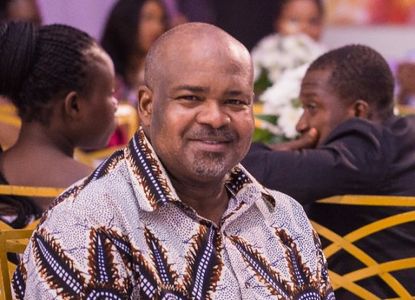 Dr. Casely Essamuah, BUSTH alumnus, has been selected as the next Secretary of the Global Christian Forum which brings together traditional ecumenical, evangelical and Pentecostal churches. He received his Th.D. in 2003 and has written a book titled, "Genuinely Ghanaian: History of the Methodist Church Ghana, 1960-2000." Read the full article here.
Cross-Cultural Friendship, Spiritual Practices, and Witness to World Christian Community
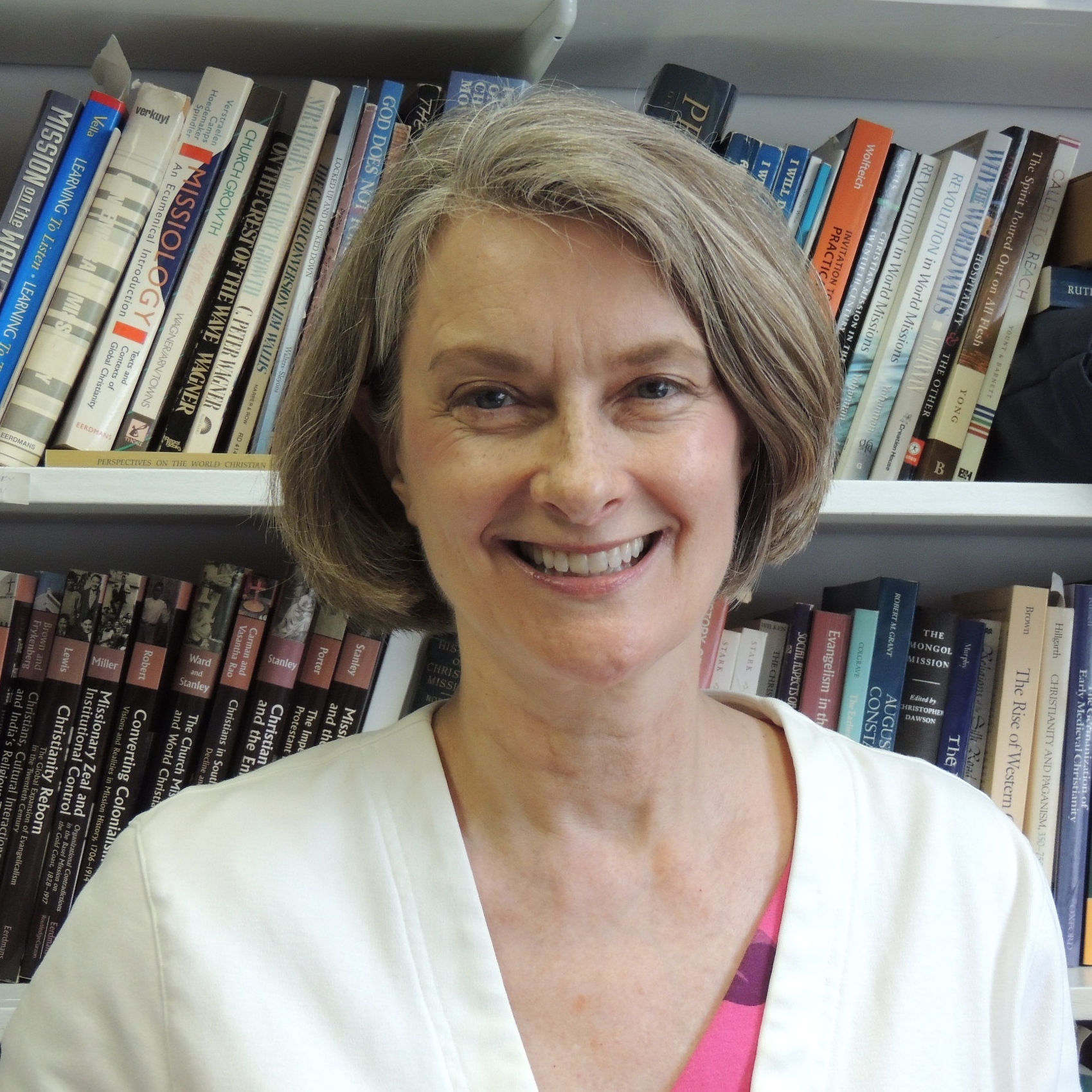 Duke Divinity School will sponsor the 2018 David C. and Virginia Steinmetz lecture featuring Dr. Dana L. Robert, Truman Collins Professor of World Christianity and History of Mission and also the director of the Center for Global Christianity and Mission. Her lecture will be titled "Cross-Cultural Friendship, Spiritual Practices, and Witness to World Christian Community: Twentieth Century Case Studies." More information can be found here.
American Society of Church History Winter Meeting 2019 Call for Paper
The Program Committee of the American Society of Church History, chaired by President-Elect Paul C. H. Lim, is pleased to announce its Call For Papers for the upcoming Winter Meeting.
The annual Winter Meeting of the American Society of Church History (ASCH) will be held Thursday to Sunday, January 3-6, 2019, in Chicago, Illinois, as a concurrent event to the annual meeting of the American Historical Association (AHA). All ASCH sessions will be held at the historic Blackstone Hotel, next door to the main AHA conference hotel.
Conference Theme: “Race and the Other: Whose Church, Which Histories?”
When the term “church history” is used in the North American context, whose church(es) do we mean? Has “church history” – both as a demarcator of a discipline and as a range of discursive parameters – served to signify inclusion of certain groups, while ignoring, occluding, or excluding others, however unintentionally?
Reflecting the conference theme, “Race and the Other: Whose Church, Which Histories?”, papers and panels are solicited that deal particularly and organically with the various ways racial and cultural others have been depicted historiographically; resisted or accommodated, tolerated or celebrated existentially; and become the mirror to reveal the fault-line of identity formation of various communities of Christian faith.
Proposals from the following periods and categories, inter alia, are welcomed:
1) Early Christianity and patristic literatures
2) Medieval and Byzantine
3) Reformation and Early Modern Atlantic
4) American: Colonial to Contemporary
5) Africana, broadly construed
6) Latino/a/x
7) Modern European
8) World Christianity
We solicit proposals that address the conference theme, or any other aspect of the history of Christianity and its interactions with culture, within traditional categories of historical periodization and geographical area, or across periods or regions. We also encourage proposals that engage in interdisciplinary discussion; place theological ideas and lived religious practices in historical context; examine particular genres, source materials or methods, including the use of digital humanities and non-textual sources; or treat the current state of the study of histories of Christianity. Sessions that deal with pedagogical issues of concern in the teaching of the history of Christianity, or with issues in the publication and dissemination of research to specialist and general audiences are also invited. Sessions may also consider a major recent book or offer critical assessments of a distinguished career.
Types of Proposal
We solicit three types of proposal for presentation: regular panels, roundtables, and individual papers. Each type is defined below.
Regular Panel: Structured presentations from three (or, rarely, four) scholars of original research papers. These papers must be no more than twenty minutes each. Moderated by a chairperson, these presentations are often commented upon by a respondent, after which there is a conversation among the panelists as well as time for audience questions.
Roundtable: Structured group discussion of a topic, question, theme, or book significant to the discipline of the history of Christianity. Such a discussion can be proposed in a variety of ways, at the discretion of the person submitting the proposal. Roundtables are limited to six participants, along with the chairperson. The aim of the roundtable is a discussion among the participants, who may present short papers (~five minutes each) to frame their further contributions. The roundtable format should reserve a substantial amount of time for interaction with the audience at the end of the formal discussion.
Individual Paper: While the Program Committee gives strong preference to regular panel and roundtable proposals, one can also propose an individual paper for presentation on the conference program. If accepted, an individual paper will be placed into a panel — usually constructed of other individual paper submissions —by the Program Committee.
To ease scheduling and foster diverse dialogue, the ASCH limits the participation of conference attendees to:
- 1 presentation of a paper, and
- 1 comment on a session or participation on a roundtable, and
- 1 chairing of a session.
Deadlines For Proposals
The regular ASCH deadline for proposals is March 15, 2018.
The priority deadline, by which all proposals to be co-sponsored by the AHA must be submitted, is February 15, 2018. Persons submitting AHA co-sponsored proposals must submit them to both the AHA and the ASCH, using the proposal submission forms of each society.
The Program Committee will do its best to announce the results of all submissions by April 30, 2018.
Submission Guidelines
To submit a proposal for a full panel, roundtable, or individual paper, go to churchhistory.org/proposals/. Submitters will be required to enter basic information about their proposal, as well as submit a proposal document.
Full panel and roundtable proposal documents will consist of a single PDF or Word file containing:
1) session title
2) a description of less than 300 words outlining the topic of the session
3) a description of less than 300 words of each paper
4) a biographical paragraph of each presenter, the session chair, and the respondent if applicable
5) an e-mail address and phone number for each participant
Full panel and roundtable proposals should exhibit diversity (gender, ethnicity, rank, scholarly location, etc.) in their composition. Sessions are typically ninety minutes in length and allow for three or four papers, a formal response, and audience interaction. The committee reserves the right to reconfigure sessions as needed.
Individual paper proposals will consist of a single PDF or Word file containing:
1) a description of less than 300 words
2) a biographical paragraph about the applicant
3) an e-mail address and phone number for the proposed presenter
Video Projection
Panels or papers requiring video projection should provide a clear rationale for doing so, as the expense involved is considerable. While we will make every effort to accommodate requests, unfortunately the Program Committee cannot guarantee that projection equipment will be available for every presentation.
Membership and Registration Requirements
All session participants (except those living and working outside the United States) must hold a 2019 ASCH membership by November 1, 2018 in order to remain on the program. For information about ASCH membership, go to http://www.churchhistory.org/membership
All session participants must purchase a registration for the 2019 Annual Meeting by November 1, 2018 in order to remain on the program.
Northeast Evangelical Missiological Society Regional Conference
 A complete program will be posted to the webpage soon: https://www.emsweb.org/
Directions to the campus and area info are available at http://www.nyack.edu/
Five Missions Conferences of 2010
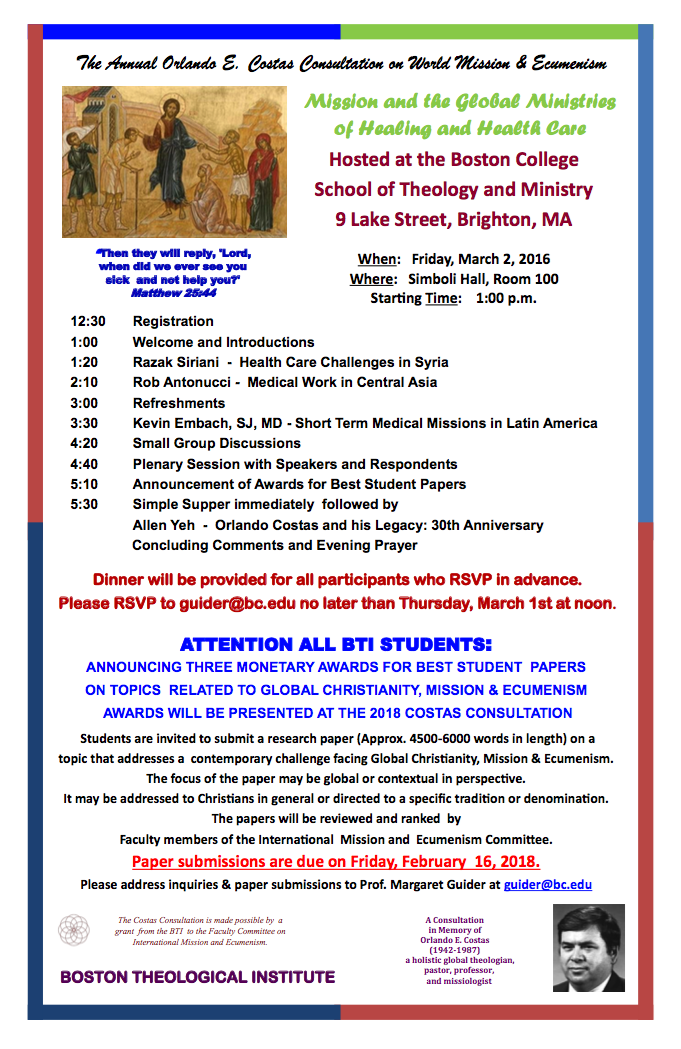
 Dr. Allen Yeh recently wrote an article on Evangelical Focus, remebering the 5 missions conferences 2010 (Tokyo 2010, Edinburgh 2010, Cape Town 2010, 2010 Boston, CLADE (Congreso Latinoamericano de Evangelización) V). The 2010 Boston meeting was held in Boston University School of Theology. Dr. Yeh will be speaking at the Costas Consultation this year.
Call for Papers: The Annual Orlando E. Costas Consultation on World Missions & Ecumenism
Call for Papers for the 2018 Yale-Edinburgh Meeting
Call for Papers for the 2018 Yale-Edinburgh Meeting on the History of the Missionary Movement and World Christianity
Date: June 28 to June 30, 2018
Location: New College, University of Edinburgh
The Procurators of the Propaganda Fide Papal Congregation in Canton and Macao
 Dr. Eugenio Menegon, CGCM faculty associate, recently published an article entitled "Interlopers at the Fringes of Empire: The Procurators of the Propaganda Fide Papal Congregation in Canton and Macao, 1700-1823" in Cross-Currents: East Asian History and Culture Review. The article can be found here.
Abstract: The office of the procurator of the papal Sacred Congregation for the Propagation of the Faith (Sacra Congregatio de Propaganda Fide) offers a unique case study of noncommercial interloping in the long eighteenth century in the Pearl River Delta, and reveals the complexity and fluidity of life at the intersection of Asian and European maritime environments in that special human ecosystem. The oceanic infrastructure of the Age of Sail and the Sino-Western trade system in Canton sustained the Catholic missionary enterprise in Asia, and the professional figure of the procurator represented its economic and political linchpin. Procurators were agents connected with both European and Qing imperial formations, yet not directly at their service. They utilized existing maritime trade networks to their own advantage without being integral parts of those networks’ economic mechanisms. All the while, they subverted Qing prohibitions against Christianity. Using sources preserved in Rome, this article offers new insights into the global mechanisms of trade, communication, and religious exchange embodied by the procurators-interlopers and their networks, with significant implications for the history of the Sino-Western trade system, Qing policies toward the West and Christianity, and the history of Asian Catholic missions.
Visiting Scholars and Ministers Fellowships
Bridwell Library is accepting applications for the 2018-2019 Visiting Scholars and Ministers Fellowships program. This year we are offering five fellowships with a $2,000 stipend. The stipend is meant to help defray research, living, and travel expenses during the tenure of the award and preference is given to applicants residing at least 100 miles from the Southern Methodist University campus. The program is open to all active scholars from Ph.D. students to retired professors, and to religious leaders of all faiths. If you know of persons who might benefit from this program please encourage them to go to our website where full information on the program may be found: http://www.smu.edu/Bridwell/
The deadline for applications is March 1, 2018.