Bringing You Back Home: Dave Diaz (MAIR ‘02) on the Education that Equipped him for a Career in National Security
Written by Charlotte Cheung (BA in International Relations and Economics, ‘27)

In Bringing You Back Home, we talk about how Pardee has shaped our alumni’s paths in significant ways that would not have been possible without their time here. Dave Diaz (MAIR ‘02), a veteran of the Marine Corps, the Pentagon, and the State Department, shares his thoughts on how Pardee has shaped his career trajectory, his most memorable course at Pardee, and the defining challenge US national security is facing over the next decade.
How did a Pardee education help you find your place in the world and give you the tools to decide how you might want to contribute to it?
My education at Pardee offered a substantive understanding of what challenges the United States is facing, what tools exist to address those challenges, and the effects of institutions on its dealings with the world. In particular, understanding how NATO and the Department of State forge relations with multilateral organizations and foreign ministries gave me the framework and the knowledge to understand how those mechanisms work internally and with each other.
More importantly, Pardee introduced me to situational problem-solving within international relations. I received an education on how international affairs professionals seek to understand problems and seek to identify the effects of different solutions or approaches on that problem, so they can then determine what the potential outcomes might be and figure out how those potential options relate to US interests. It’s important to understand that international affairs are not about only the challenges, opportunities, and tools available to address those. It’s also about the problem-solving and thought process and engagement approaches behind them. In essence, it’s both the components and the way one uses or goes about thinking about using them. The education I received wasn’t just “this is the problem, here’s the solution,” it was about what our interests are when we look at the world, and its challenges and opportunities, and prioritizing our resources accordingly.
Which professor really stands out to you as a guiding influence during your time at Pardee?
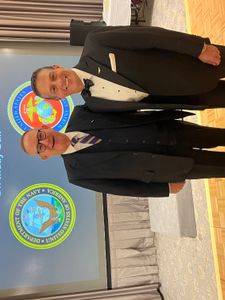
My background in the military, at the time, was one in which I tended to look at the US in bilateral relationships. The US and Iraq, the US and Iran, the US and the UK, the US and Russia, the US and China. Then I took a course on multilateral institutions with Professor Adil Najam (Dean Emeritus).
Professor Najam really placed those relationships in a global context, so it would broaden our appreciation of the complexity of what was going on. He helped me understand the complementary nature of the relationship between the United States and the United Nations and other multilateral organizations, in ways that helped address dynamic global conditions. He connected the US government – its role in service to the American people but also its activities around the world – and the UN, helping us see how they could work together around the world. It is about the institutions, the interests, and the third piece – the interactions. All of that happens in a fluid geopolitical context, not a vacuum. It was a great course.
Building upon the interactions between different interests and institutions, how do they inform national security in practice?
I’m now an adjunct professor at Georgetown University, and the first sentence of my syllabus states, “National security is inherently complex, dynamic, and uncertain.” The course starts on that premise – that it’s complex, with lots of interconnected parts; it’s dynamic in that as you move one or two things, several other things may also move; it’s uncertain because you don’t know how those other things will move. Matter of fact, those other things may be moving without your knowledge, and now you’re the one who’s reacting. You don’t know what the outcomes of these things will be because these are not linear relationships. It requires us to think about how to sustain efforts over time. Things don’t get fixed or improved in the near term; for the most part, they need a long-term, strategically coherent approach, sustained with resources and political support, to achieve lasting effects.
In the same way, it’s important to understand that national security isn’t just about proactively scoring wins for the American people. It is also about managing long-term strategic coherence in a dynamic global context for all our interests.
What do you think is the single biggest challenge facing US national security, both public and private sector, in the next 10 years?

I believe the most significant challenge to US national security over the next decade is to rebuild the American polity’s ability to overcome domestic political and informational dis-unity. We must regain the ability to understand external challenges in a coherent way before we can decide what to do about them. As a populace, if we cannot assess things from a common viewpoint – to agree on what truth is – we won’t really be able to address any significant external challenge or threat.
You can list a dozen external threats and challenges. If they’re significant, we won’t be able to deal with almost any of them if we can’t figure out the domestic piece. People are fond of saying Americans have faced worse threats and internal divisions – we’ve suffered a Civil War – but I’d argue that during those periods, we did not face the same variety and scale of external challenges that we’re likely to face in the next decade. If we seek to manage external national security challenges, we must prioritize common understanding in our approaches to interacting with each other at home.
You highlight the necessity of a core, binding factor – a national truth – to unite disparate interests. What do you think is the most likely mobilizing factor to get our game together, around which society can organize its efforts?
We have a lot of options in front of us. Many folks supposed it would be energy and turning towards green energy. That has not yet seemed to be the ticket, although that process hasn’t completely played out. Other folks might say it’s education or economic growth or critical infrastructure. For each theme, Americans have developed diametrically opposed viewpoints. While there are many reasons for this, the central cause may be the fracturing of the information environment. Half a century ago, we had essentially three to four television stations, and a dozen reputable, nation-wide news sources providing a somewhat coherent picture of what the nation was, and what it was facing. Now, we have a highly fractured and siloed environment where people get to curate information for themselves. When we get to curate our world – not just what they see of the world, but essentially the world as we experience it – we can shut out entire pieces of the world by shutting out different pieces of information. It is in this environment where analysis and decisions can be based on very different ideas of what’s true.
Regarding the question at hand, I would have thought the most likely contender would be democracy itself. I would’ve thought most people would see America, in and of itself, as a democracy, innately and inherently. That national identity is based on the rule of law and democratic norms – things that define the bedrock of the US and are core to the Constitution. I’m not sure even that is an infallible, concrete foundation right now. I hope it is. I hope we can find one or two things like that which we can use to rebuild enough societal cohesion to allow us to deal with external national security challenges that we are facing and will face in the next decade. And just as importantly, be able to take advantage of the windows that will open.