
Story and photos – Lyn Markey
A Banner Year for Darren Roblyer’s Lab, with 3 NIH Awards
BME Professor Darren Roblyer was awarded 3 prestigious R01 awards from the National Institute of Health, all in a 6 month period. The 3 awards total over $5 million over 4 years, and will include the development of 2 medical devices, based on the Roblyer Lab’s focus on optical technologies.
“It was a happy surprise to get all 3 in such a short period”, says Roblyer. “More than a year ago, we got the 1st reviews and we were close, but not over the threshold”. The NIH determines that threshold by ranking, and the size of their research budget. The development behind an approved R01 project can build over a career, and the application process itself can take years.
A robust development process
An R01 grant is the NIH’s most common and prestigious award for a specific, discrete health-related research project. It is designed to support independent, mature research that has strong preliminary data and a strong scientific rationale. According to Roblyer, “They’re tricky to get”, and depending on the agency, the acceptance rate is somewhere under 10%. In order to be considered for funding, NIH requires a very solid plan with a lot of early stage results.
“Every pilot project you start in the lab, you wonder if this will turn into an RO1 someday”, says Roblyer. “You have a body of work in this new area that supports a grant this large, but the bar is so high for getting to that point. Each of these has five, six, or sometimes 7 years of work behind them before having enough prior data and publications to actually get the award. And there can’t be any little missing pieces. The underlying technology and idea have to really be working. You need to have gone down the road quite a ways before it can get past the bar for funding. And usually you have to try multiple times for the same grant to get it over the bar.”
“Once you have an R01, the project is recognized by the funding agency and the community. It’s also a bit of a sign of the maturity of the lab. The first time R01 awardee is around 42 to 43 years old, according to the NIH. It would be hard to get a lab up and running just for a few years to have enough research to achieve an R01, although I should note that several of the incredibly impressive assistant professors in BME have done just that.”
BOTLAB – devices for monitoring health
Understanding how light interacts with living cells and tissues is the foundation of Roblyer’s medical device technologies. In his Biomedical Optical Technologies Lab, he and his team are testing ways to monitor biological processes – like blood pressure, oxygen levels, and disease progression – using light. Much of the lab’s research is collaborative with clinicians at BU’s Chobanian & Avedisian School of Medicine. According to Roblyer, “we generally build a device, test it in the lab, and then take it over to the hospital to do a clinical study with it. And that process is occurring in all 3 of these grants.”
Three grants centered on optical technologies
The first R01 grant, “Handheld Spatial Frequency Domain Imaging using Spiral Illumination for Skin Imaging” targets one of the most deadly autoimmune diseases, scleroderma. This chronic condition causing excess collagen production, leading to hardened, tightened skin and connective tissues, potentially affecting blood vessels and internal organs like the lungs, heart, kidneys, and digestive tract. It can lead to life-threatening complications. Early diagnosis and management can help control symptoms and improve quality of life. One of the difficulties physicians have in treating this disease is that they have a hard time knowing whether their patients are getting worse or better. “The thing you have going for you is that what’s happening with the skin tends to be reflected on the inside of the body. So if you can measure the skin, you generally have a sense of what’s happening inside. That’s where we come in”, says Roblyer.
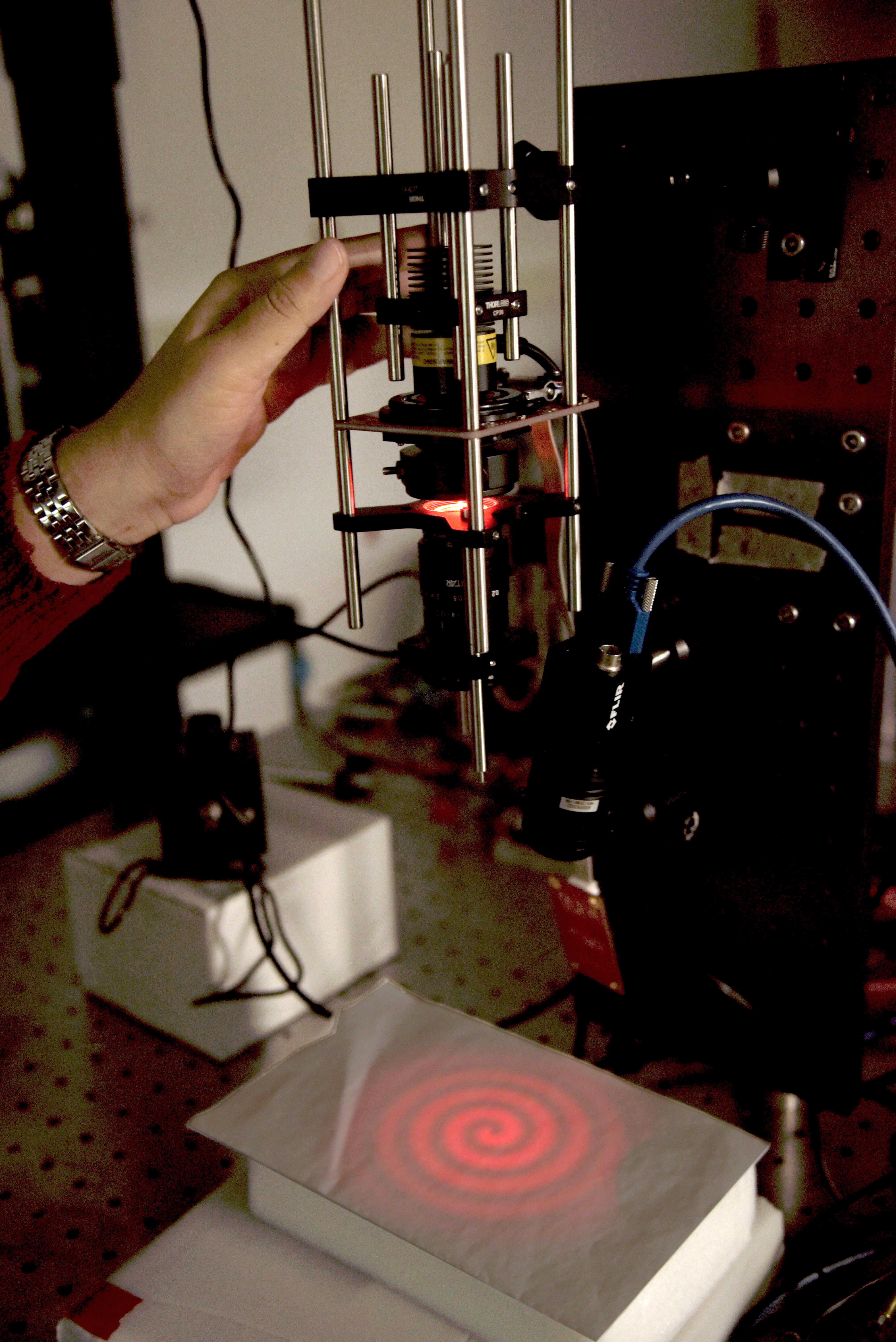
Using a technology that’s being developed in his lab called Spatial Frequency Domain Imaging (SFDI), Roblyer was initially surprised to see that different stages of the disease could be identified through this measurement of light scattering. Preliminary data shows that the SFDI works well for this. According to Roblyer, “If you do this at just the right wavelength, and just the right spatial frequency, it can reveal the extent of this specific disease. You have to tune things just right, and we’ve done a lot of modeling to back this up. One of the challenges is adapting the technology so that it could actually be used in the clinic on a day-to-day basis, and we will need to radically transform this big clunky device we use right now in our lab.” The grant is to build a portable, affordable handheld device based on the SFDI, that can be used every time a patient comes in for an appointment, to get a full assessment in just a few minutes. “As part of this project, we’re building prototypes of the device, testing in the lab, and then we’ll go over and bring it to the clinic, compare it with our current device, and do a clinical study of a large group of subjects”, says Roblyer.
The second grant “Assessing spatial frequency domain imaging as an objective quantification of longitudinal skin changes in scleroderma” is linked to the first award with the same co-PI, Dr. Andreea Bujor, a rheumatologist at the BU School of Medicine. The 2 grants are aiming towards a similar long-term goal, but two very different aspects towards achieving that goal. The first grant is for building the tool that can be used as part of the clinical standard-of-care, and the second grant is to test the underlying technology so see if it can successfully be used as a prognostic tool. Most of the measurements Roblyer and his collaborators have done so far represent single points in time for a given patient. The second grant is all about longitudinally monitoring the same patients over time as they are treated to determine if SFDI technology can assess if therapy is really working, and if the patient is improving.
The goal of Roblyer’s 3rd grant “High speed and wearable speckle contrast optical spectroscopy for cuffless blood pressure measurements” is to continuously measure blood pressure more accurately, using a new optical technique in a wearable device. “If we could monitor your blood pressure continuously, we could say a lot more about your cardiovascular health, and your risk”, says Roblyer. Current methods of measurement can have their limitations. Due to a combination of procedural errors, patient-related factors, device limitations, and the inherent variability of blood pressure itself, measurement with a traditional cuff can lead to significant inaccuracies and potential misdiagnosis of hypertension. For take-home monitors, which tend to be inconvenient for patients, compliance is very low. Other optical solutions include a hypertension feature in the Apple Watch, and although it has been approved, the sensitivity is only 42%, because the sensors that they’re utilizing do not have enough information in the signal.
Over the past several years, Roblyer has co-developed a blood pressure monitoring device with Professor David Boas, which is based on a technique called Speckle Contrast Optical Spectroscopy, or SCOS. SCOS tells us more about the entire cardiovascular system, including extracting information on how blood volume changes, plus how fast the red blood cells are moving. The team has already shown that this device can predict blood pressure with substantially higher accuracy. And that’s where this grant comes in. The project is another case of technology in a big box, and getting it down to a wearable device for greater patient access. It will require a special laser, a tiny camera, and a whole lot of engineering to get it into a very small package that subjects can take with them throughout their everyday lives. The team will also test the device in patients diagnosed with hypertension in collaboration with their clinical collaborators, John Forman and Naomi Hamberg at the Boston Medical Center.
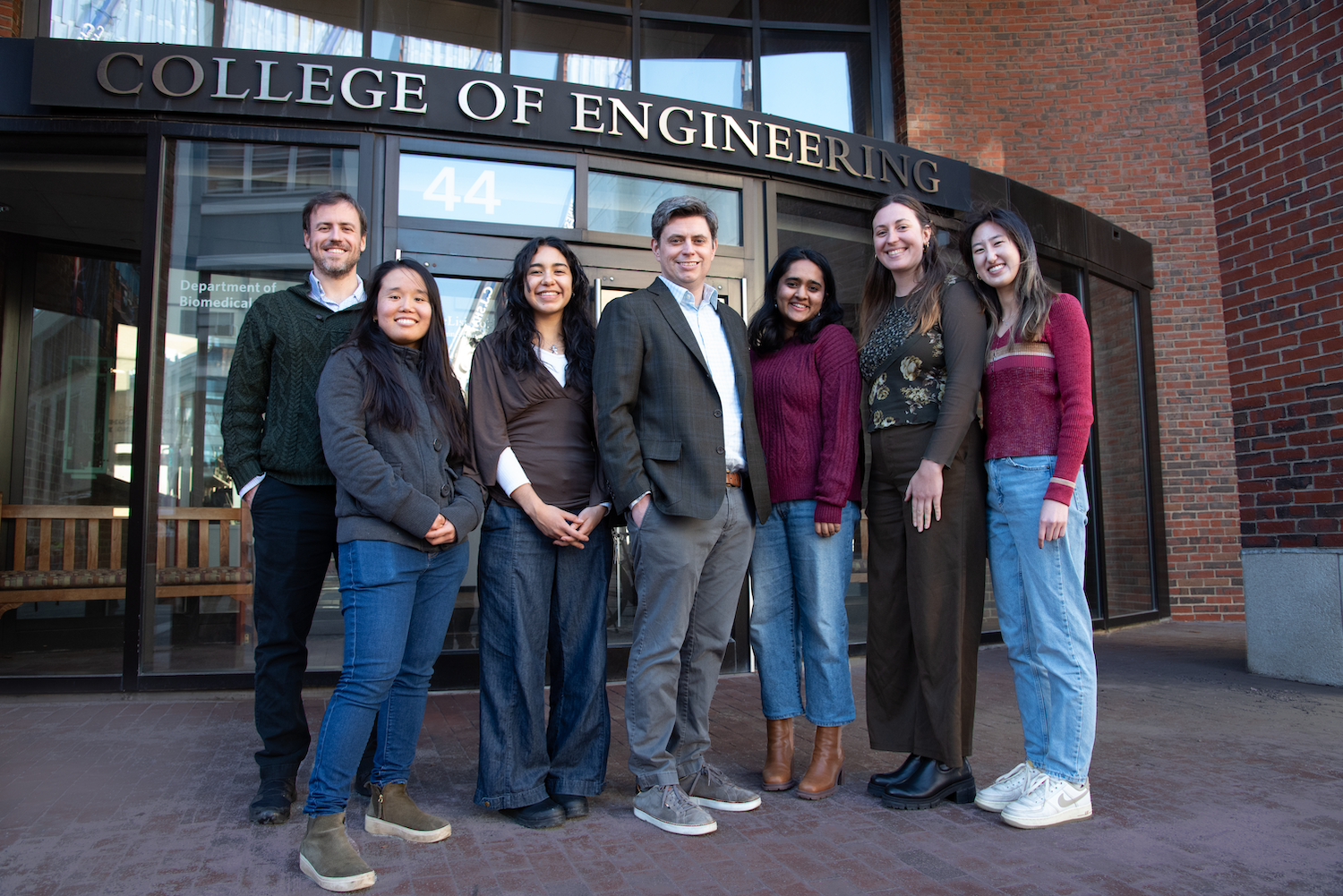
Professor Roblyer, Professor Boas, and a recently graduated PhD Student Ariane Garrett are cofounders of a new company, Rivus Optics, based on the same technology and application. The company will start developing the accurate, wearable version of SCOS here at Boston University, and continue to seek future funding opportunities. More than 100 million adults in the US alone have hypertension, and the device has the potential to greatly improve cardiovascular disease management.