Skip to Main Content
Boston University
  • Bostonia
  • BU Today
  • The Brink
  • University Publications

    • Bostonia
    • BU Today
    • The Brink
  • School & College Publications

    • The Record
Other Publications
Bostonia
  • Sections
Boston University’s Alumni Magazine

Being Boston’s University: The Many Ways BU Partners with the City of Boston

Special Feature

Being Boston’s University

BU is more than a hub of learning, teaching, and research. It’s firmly rooted in—and engaged with—the city of Boston, partnering with its government, schools, nonprofits, and neighborhoods in so many ways.

April 3, 2026
  • Bostonia staff
Twitter Facebook

From Packard’s Corner in Allston, along Commonwealth Avenue to Kenmore Square and the Fens, and over to Massachusetts Avenue in the South End, Boston University is deeply entrenched throughout the city of Boston. It has been that way since BU was chartered in 1869—and the University’s roots in the city grow deeper by the year.

At the highest vantage points in BU’s tallest buildings, you can take in glorious views of the Boston skyline and the Charles River. At street level, the University—140 acres and more than 340 buildings across 3 campuses—hums amid the churn of the city.

BU’s place in Boston is a big reason students choose to study here. And the city embraces the University. Besides its arts, culture, sports, history, food, and recreation, Boston offers endless educational, research, and service opportunities to faculty, staff, and students. Internships at city hall. Partnerships with nonprofits. Meaningful experiences with Boston Public Schools.

This engagement was established in the early 20th century, as the University grappled with the example it intended to set. Lemuel Merlin, BU’s third president, determined that the institution would thenceforth be “in the heart of the city, in service of the city.” That mission remains true today.

“From student organizations’ involvement to faculty research and institutional partnerships, BU makes our city a hub of innovation, where big ideas become breakthroughs,” says Michelle Wu, the mayor of Boston. “From leading community organizations to running businesses, BU students and alumni strengthen every one of our neighborhoods and remind us that Boston is at our best when we open our doors to the world.”

BU President Melissa Gilliam describes the relationship as symbiotic: “At Boston University, we say we are ‘Boston’s University,’ because we are deeply committed to serving this city, and because the city is deeply committed to us.”


A Commitment to Boston’s Schools

The University’s relationship with the district benefits both Terriers and Boston Public Schools students

Read More about BU and Boston Public Schools

Close

A Commitment to Boston’s Schools

BU President Melissa Gilliam speaks at the 2025 ceremony welcoming new Menino Scholars and Community Service Award recipients to the University. Looking on are Boston Mayor Michelle Wu (from left), Boston Public Schools Superintendent Mary Skipper, and Menino Scholar Maisha Kazi (CAS’26). Photo by Jeremiah Robinson/City of Boston

A key part of Boston University’s partnership with the city of Boston is its work with, in, and for the local school district. From free on-site dental care for thousands of Boston Public Schools (BPS) students (see below) to tuition-free education through BU’s Thomas M. Menino and Community Service Award scholarship programs, the University is committed to being a resource to the more than 40,000 students and 4,000 teachers in Boston—home of America’s first public school. Student teachers from BU Wheelock College of Education & Human Development—whose charter includes a unique commitment to BPS—fan out to schools across the district each year to build their classroom experience.

Wheelock’s College Access & Student Success office hosts a number of federally funded precollege programs, such as the Boston University Initiative for Literacy Development (BUILD) and Upward Bound, that work directly with BPS students across K–12—a total of approximately 1,600 students per year. In FY24, BU provided $123,000 in direct cost share to BUILD and Upward Bound.

“Boston Public Schools’ longtime partnership with Boston University means our students and staff have access to world-class academic programs, state-of-the-art facilities, supportive mentoring, valuable professional development, cutting-edge research, and life-changing scholarships. For the BPS community, BU represents generosity, opportunity, and possibility.”

—Mary Skipper, superintendent of Boston Public Schools

The Dr. Carol Johnson District Leadership Fellowship—coled by BU and BPS and named for a transformative former superintendent—trains up to 15 current BPS employees who aspire to grow as leaders in the district. Fellows have been collaborating on projects that center on the success of the district’s most underserved students.

BU is constantly exploring new ways to partner with BPS, from expanding after-school opportunities to bolstering advanced math education, says Mary Churchill, Wheelock associate dean of strategic initiatives and community engagement and a program director in higher education administration.

“We are doing amazing things,” she says of BU. “And yet, the question [we] constantly try to answer: How can we scale up some of those high-impact projects that will really change the life chances of people in the city?”

A Partnership by the Numbers

25

Four-year, full-tuition, merit-based Menino Scholarships awarded by BU each year to Boston Public Schools graduates—a total of 2,138 since 1973.

800+

First-year and transfer students have received loan-free scholarships through the Community Service Award program since 2009.

$300m+

In scholarships awarded by BU to BPS graduates since 1973 through the Menino and Community Service programs.

No Studying for These Exams

BU’s Henry M. Goldman School of Dental Medicine students visited Orchard Gardens School in Roxbury, Mass., this past December to give students dental exams. Here, Jayden Diaz opens wide for an X-ray. Photo by Jackie Ricciardi

The best teacher brings smiles to their students’ faces. A BU program helps make those smiles a little brighter.

Boston University’s Henry M. Goldman School of Dental Medicine brings dental care and programs right to the schools that need them most in Boston (as well as six other cities in Massachusetts), improving oral health for thousands of children ages 6 months to 21 years.

During the 2024–25 school year, the program served 15 Boston public schools and 26 early learning facilities. More than 2,000 BPS students learned about oral health care from BU students, and more than 1,600 Boston children received dental exams and fluoride treatments.

“By reducing early childhood caries, preventing pain and infection, and supporting consistent school attendance, these programs benefit children, support families’ well-being, and enhance the overall health of the city of Boston,” says Michelle Henshaw, SDM associate dean.
— Steve Holt

Close


Undergrads Supporting the City

From riverside cleanups to food distribution, students log thousands of volunteer hours in Boston each year

Read More About Students in The Community

Close

Undergrads Supporting the City

“Volunteering made me feel more a part of the community, and more at home here in Boston,” says Ocean Bruinius (COM’27), a BU Student Food Rescue volunteer. Click the photo above to watch a video about BU Student Food Rescue. Photo by Cydney Scott

Every year around Labor Day, hundreds of incoming first-year students descend on Comm Ave, receive a community service assignment, and then head into Boston for a day of volunteering at local schools: painting community murals, setting up classrooms, cleaning school grounds, and repainting fences and school property. In the spring, scores of undergraduates will expand on that work—helping to address social issues in Boston and across the country—as part of Alternative Service Breaks. These initiatives are among BU’s longest-held traditions, effectively turning communities into interactive maps of service.

In 1986, BU undergraduates formed a campus group as an unofficial way to facilitate community service opportunities. Its early initiatives—First-Year Student Outreach Project, Alternative Service Breaks, and the Student Food Rescue—are still some of the University’s most popular offerings. In 1991, it morphed into the Community Service Center and, in 2025, merged with the Student Activities Office to become the Student Leadership & Impact Center (SLIC).

While the center partners with organizations around the world, one of its core missions is represented by undergrad service in the city of Boston. “The community partners range from food pantries to homeless shelters to medical centers to schools,” says Margaret Babson, director of SLIC. “They are incredibly important to our work connecting with the local community and offering ways for our students to support and give back to Boston.”

Students might do maintenance and grounds work at the Mather School in Dorchester, sort and pack donations at the children’s nonprofit Cradles to Crayons, or work in the food distribution center at the Hattie B. Cooper Community Center in Roxbury. They’ll do riverside cleanups, serve meals to people experiencing homelessness, or support community 5K races.

“Within just the first few months of the fall 2025 semester, BU students logged over 1,500 hours through our signature programs,” says Babson. SLIC also coordinates the BU Student Food Rescue. Each week, students pick up food items from restaurants, bakers, and grocers and deliver them to more than a dozen shelters, children’s programs, transitional homes, and community organizations. One of the largest programs of its kind in the nation, Student Food Rescue was responsible for delivering more than 90,000 pounds of food in 2025.

Service opportunities for undergraduates abound within BU’s schools and colleges. The College of Engineering’s Technology Inspiration Scholars Program (TISP) recruits and trains talented undergraduates as “inspiration ambassadors,” and sends them into schools to explain an engineer’s role in society, offer fun, interactive activities, and encourage students to consider engineering as a career. Other TISP programs—all staffed by ENG undergraduates—include a free spring hackathon, where area students in grades 9 through 12 work in teams, participate in workshops, learn coding and engineering skills, and create innovative solutions to real-world problems.

While these and other volunteer programs have an impact on the city, they also leave a mark on BU students. “Volunteering made me feel more a part of the community, and more at home here in Boston,” says Ocean Bruinius (COM’27), a program manager for BU Student Food Rescue.

“When the University and student population are seen as true community partners, we all benefit,” Babson says. “Everything—service opportunities, internships, and community collaborations—are all a result of a positive relationship with the city.” —Sophie Yarin

Terrier Athletes Read to Children

Terrier Matai Baptiste (CAS’27) (left) reads a book about engineering to kindergartners at the Hurley K-8 School in Boston’s South End in December 2023. The Holiday Reading Program, a favorite of the children and the BU students, has taken place for nearly 30 years. Click the photo above to watch a video about the 2025 Holiday Reading Program. Photo by Cydney Scott

BU student-athletes volunteer more than 4,000 hours each year, joining community fundraising walks, advocating for causes, volunteering at local organizations, and participating in a variety of other service opportunities.

One long-running initiative is the Holiday Reading Program. For nearly three decades, Terrier athletes have visited local schools in December to read to children. In 2025, they read to more than 700 children in 40 classrooms at 6 Boston Public Schools.

One of the newest programs: in fall 2025, nine track-and-field athletes launched a Boston chapter of Run Your City (RYC), an international nonprofit run by student-athletes that aims to build community through running, regardless of skill level, gender, or socioeconomic status.

The student-athletes host track-and-field practices—from warm-ups to relays—for Boston-area children in kindergarten through grade eight, free of charge, at the BU Track & Tennis Center. The Terriers, led by BU RYC copresidents Caroline Collins (COM’28) and Luna Scorzelli (Sargent’28), moderate the practices, run with the kids, and coach them. “All the kids want to do is run,” Collins says. “They want to run laps and laps and laps.” —Crystal Yormick (COM’26)

COM Students Fill Local News Gap

Click the photo above to watch three video stories produced by BU students for Boston Neighborhood Network Media. Photo via College of Communication

As local journalism outlets vanish across the country, a partnership between BU College of Communication and the cable channel Boston Neighborhood Network Media (BNN) is offering an innovative solution.

Through a hands-on collaboration led by veteran journalist Tina McDuffie, a COM associate professor of the practice of journalism, upper-level broadcast students are producing professional-level video stories about the people and programs in 26 Boston communities—many of them low-income and underrepresented, including Dorchester, Roxbury, and Mattapan. In the process, the students build reporting skills and confidence, while helping BNN expand its community coverage.

McDuffie, who launched the partnership in 2022, says her goal is to instill in students her belief that journalism is a high form of community service.

Her students research, pitch, report, edit, and produce their own minute-and 30-second packages, while McDuffie provides guidance and support. BNN editors have final approval before the packages air on the network. The partnership has produced dozens of student-led segments, with topics ranging from public health and local politics to community events and profiles of neighborhood leaders. (A separate new COM program has journalism students contributing articles to nonprofit community news outlets.)

Natalie Candler, BNN news director and anchor, says the students’ contributions are invaluable. “They bring a new perspective to the station, and it’s flourished into a great collaboration.” —Amy Laskowski

Close


Connecting Beyond the Campus

BU graduate students are partnering with the city in myriad ways—to improve the environment, help elderly residents, and offer legal services to those in need

Read More About Grad Students In The City

Close

Connecting Beyond the Campus

Boston Green Academy students, on planting day, will collect data from the Miyawaki forest to track its long-term impact. Photo by Megan Jones

Miyawaki forests—which involve planting dense layers of native species in small urban environments—were popularized by Japanese ecologist Akira Miyawaki in the 1970s. Now, you can see one in Boston.

Megan Ryder (SPH’25), a research assistant at BU’s Chronic Traumatic Encephalopathy Center, won first place in the 2024 Innovate@BU Climate Innovation Challenge for her project pitch: planting a Miyawaki forest at a local school in need of more green space. Green spaces have long been shown to curb the urban heat island effect, a phenomenon where concrete and buildings trap and store heat and make the surrounding area warmer.

In fall 2025, Ryder partnered with Boston Green Academy (BGA) in Brighton. BGA students helped Ryder plant a 17-by-36-foot Miyawaki forest, with nearly 150 species of shrubs, trees, and flowering plants, on their campus. Each week, they measure air quality, temperature, and other variables. “This project is empowering students to engage in science,” Ryder says.

It’s just one way graduate students are part of the fabric of the community.

Photo: Megan Ryder, a BU student with curly blonde hair, smiling in front of greenery while holding gardening tools
Megan Ryder (SPH’25) at Boston Green Academy in Brighton, Mass., last October. Photo by Megan Jones

At Sargent College of Health & Rehabilitation Sciences, they are working with the city’s aging population. In partnership with the local nonprofit Hearth, the Cognitive Wellness Program (CogWell), established in 2019 by Magdalen Balz (Sargent’09), an associate professor in the speech, language, and hearing sciences department, seeks to combat age-related cognitive decline in older adults who have experienced homelessness. BU students meet with the seniors for cognitive therapy sessions. Sometimes students administer memory exercises and brainteasers to the participants; other times the seniors dictate activities themselves.

The Graduate School of Arts & Sciences Graduate Program in Urban Biogeoscience & Environmental Health (BU URBAN) sends students out to perform work with city partners. Among the projects: helping the nonprofit Trustees of Reservations to improve citywide composting and the Charles River Watershed Association to make water quality data more accessible.

Greater Research Opportunities for the Workforce (GROW) brings rising high school seniors from Greater Boston into BU labs for six weeks each summer, offering an immersive exposure to research to those who might not otherwise have access. Under the mentorship of BU faculty and graduate students—in disciplines ranging from archaeology and biology to computer science and neuroscience—students participate in hands-on research, hear from guest speakers, and develop communication skills by presenting their work at a summer symposium.

For students like Ten Harder (GRS’25,’28), the program GROW offers a first glimpse into what research—and a future in STEM—can look like. Today, Harder is a PhD student studying schizophrenia in BU’s molecular biology, cell biology, and biochemistry program. Photo courtesy of Harder

School of Law students participating in externship programs provided more than 5,100 hours of legal service to nonprofits in the city—including Greater Boston Legal Services and Lawyers for Civil Rights—during the 2024–2025 academic year alone.

“Lawyers have a duty to serve those in our community who otherwise could not afford legal representation,” says Angela Onwuachi-Willig, dean and Ryan Roth Gallo Professor of Law. “BU LAW is proud to uphold this duty through the advocacy of our students and faculty who serve many in need in the Boston area. The work of our students, faculty, and staff enables underserved populations to more effectively exercise their rights to legally defend and protect themselves. Through this hands-on service, students gain the skills of working with clients, and we at BU LAW learn from our clients about the systems they are challenged by and the circumstances that frequently render them in need of our help.”

Scholarships to City Employees

Click the photo above to watch a video of the City of Boston Scholarship Program event. Photo by Jackie Ricciardi

Harry Dam (CAS’21, Questrom’26) (above), director of operations for the Mayor’s Office, speaks during the 14th annual City of Boston Scholarship Program reception at BU last December. The BU program awards full-tuition scholarships to city employees pursuing MBAs at Questrom School of Business and master’s degrees and certificates at Metropolitan College, Chobanian & Avedisian School of Medicine, and other schools. The December event recognized 30 city employees, along with the supervisors who supported their education. To date, the program has aided more than 400 city employees.

Close


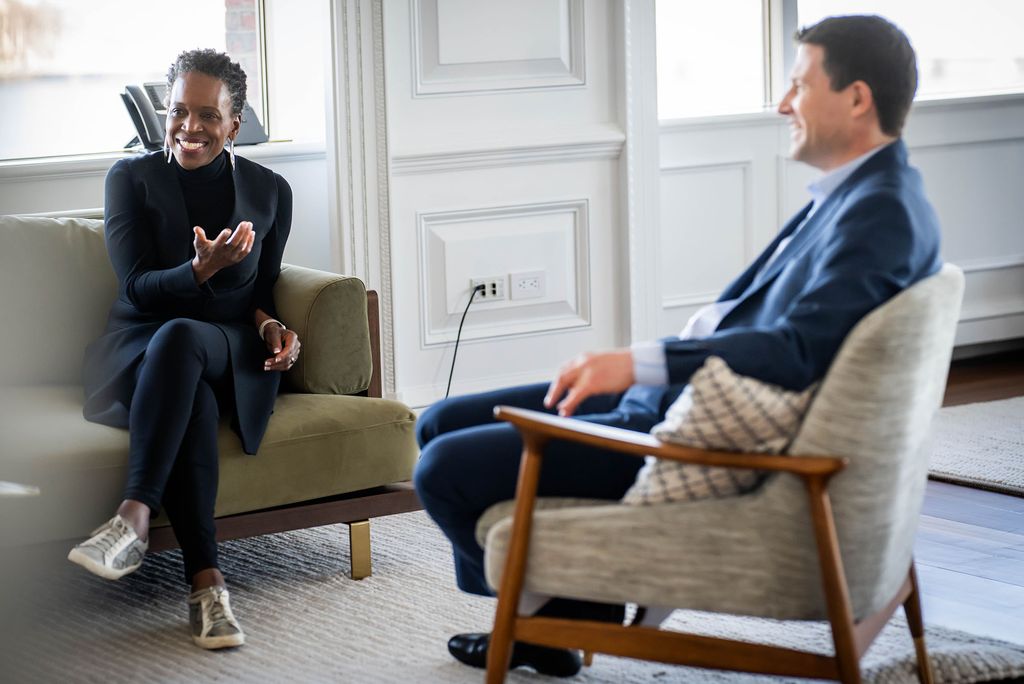
Photo: BU President Melissa Gilliam and BMC President Alastair Bell talk about strengthening the relationship between the two institutions on Friday, March 14, 2025. Photo by Jackie Ricciardi for Boston University

A 30-Year Partnership

In Boston’s South End, BU’s Medical Campus and Boston Medical Center serve the underserved

Read More About BU’s Medical Campus

Close

A 30-Year Partnership

Photo: BU President Melissa Gilliam and BMC President Alastair Bell talk about strengthening the relationship between the two institutions on Friday, March 14, 2025. Photo by Jackie Ricciardi for Boston University
BU President Melissa Gilliam and BMC Health System CEO Alastair Bell want to strengthen the relationship between the institutions. Click the photo above to read a recent conversation between Gilliam and Bell. Photo by Jackie Ricciardi

In Boston’s South End neighborhood, the city’s underrepresented communities and most vulnerable patients are directly benefiting from a vital, round-the-clock partnership between the Boston University Medical Campus—comprising the Chobanian & Avedisian School of Medicine, School of Public Health, and Henry M. Goldman School of Dental Medicine—and Boston Medical Center (BMC).

That partnership dates back to June 29, 1996, when the Boston City Council approved the deal to merge Boston City Hospital with Boston University Medical Center Hospital and create a new, private, not-for-profit entity called Boston Medical Center.

Today, the majority of the clinical faculty at BU’s medical school also hold appointments at BMC—the largest safety net hospital in Massachusetts and the University’s primary teaching hospital. BMC provides comprehensive clinical learning experiences for BU students in the MD, physician’s assistant, and other health professions programs. The relationship allows each new generation of doctors to experience what it means to help those most in need of urgent medical care.

“A large number of students choose to come to our medical school for the mission to serve the underserved, thus they become active learners in caring for these vulnerable patients under the supervision of our clinical faculty at BMC,” says Hee-Young Park, interim dean of the BU medical school.

In a recent address to the University community, BU President Melissa Gilliam, who is also a research scientist and a physician trained in obstetrics and gynecology, spoke about the importance of the partnership and how she and Alastair Bell, president and CEO of the Boston Medical Center Health System, want to “reinvigorate” the relationship.

“With Dr. Bell’s help, we have already begun the work to streamline educating our medical workforce, provide hands-on and crucial, practical experience for our students, strengthen our ability to recruit physicians and faculty, and strengthen our research enterprise,” she said. “Together, we can enhance our standard of care and invest in a role we both take seriously: to care for Boston’s underserved communities.”

Serving Vulnerable Residents

Going beyond their required clerkship rotations at BMC, many students demonstrate their commitment to the city’s most vulnerable residents by participating in volunteer service groups that take them into local healthcare facilities, nursing homes, and shelters—and even onto the streets.

Those groups include Student Sidekicks at Boston Medical Center, a program facilitated by the medical school, which matches students to children with chronic illness. Participants act as a buddy, providing support as the young patients and their families navigate the medical system.

Homeless Health Immersion Experience is a partnership between the medical school and Boston Health Care for the Homeless, where medical students conduct monthly clinical interviews and examinations at the Barbara McInnis House, a respite and outpatient care center on the Medical Campus.

Women to Women is a monthly program facilitated by SDM, which takes students to Rosie’s Place, a nearby women’s shelter, to conduct screenings, answer questions, and provide referrals and oral health products.

The Coalition for Adult Immunization delivers free vaccinations to under-resourced populations at clinics, nursing homes, and shelters in and around Boston.

And the Outreach Van Project, a longstanding program founded by students
in the medical school and SPH, provides residents of East Boston—a historically underserved neighborhood—with everything from meals and household essentials to referrals, basic screenings, immunizations, and mental illness and addiction counseling.

“All of our volunteer community service programs are so important, not only for the educational and clinical experiences they provide our students,” says Park, “but also for the people they serve in various ways.”

BU, BMC Researchers Help Boston Teens Build Overdose Prevention Program

Students from Roxbury’s John D. O’Bryant School of Mathematics and Science, including Samantha Lee (back, from left), Carlie Augustin, and Ella Gelling Zurek, came to the Medical Campus over the summer to help create a curriculum designed to teach peers about drug overdoses and how to prevent them. Photo by Cydney Scott

Last summer, a group of Boston high school students met at BU’s Chobanian & Avedisian School of Medicine to build something important. The students, most of them rising seniors at the John D. O’Bryant School of Mathematics and Science in the city’s Roxbury neighborhood, were working alongside BU medical professionals to cocreate a curriculum meant to teach their peers about drug overdoses. The program they devised could help fill a critical educational gap, says Sarah Bagley, an associate professor of medicine and pediatrics in the BU medical school’s Clinical Addiction Research & Education (CARE) Unit.

“We think that some of the risk factors for youth are a little bit different [from adults],” says Bagley, who is also a primary care physician at Boston Medical Center (BMC), BU’s primary teaching hospital. “Not as many of them may have opioid use disorder, and therefore may not need treatment to prevent overdose.”

Bagley and her colleagues at BMC and BU’s medical school and School of Public Health launched an equity-centered, peer-led overdose prevention program at O’Bryant, cocreated with students there. More than 40 high school students applied to join the program; the researchers narrowed the list to 17.

Throughout the summer, a team of BU and BMC addiction and harm-reduction researchers met with these O’Bryant students to teach them about topics such as public health, social determinants of opioid abuse, and overdose risk. Working in groups, the students then built a website filled with useful information about the risk factors for overdose; produced short, catchy videos about how to compassionately confront a friend who may be using drugs; and designed a presentation on recognizing signs of an overdose and what to do about it.

“I’ve always been interested in science, but learning more about the role public health can play is new for me,” says O’Bryant senior Agnes Arua. “I learned a lot about overdose that I can teach other people in my community—and being able to support my community means a lot.” —Molly Glass

Close


Research That Impacts the Lives of Bostonians

BU’s multidisciplinary expertise presents potential for innovative solutions

Read More About Research-Based Partnerships

Close

Research That Impacts the Lives of Bostonians

Victoria A. Lopez (Sargent’22, SPH’26) (right) discusses participation in a workplace heat exposure study with a restaurant employee in Chelsea, Mass. Lopez was part of a pilot project launched last summer that aims to investigate and address the health effects of extreme heat in Chelsea and East Boston. Photo by Megan Jones

Boston University research addresses big societal challenges—including those impacting the lives of residents of Boston and other urban centers. “Essential to these efforts is intentional collaboration with the people of Boston, and the city’s economic sectors, policymakers, and science and technology community,” says Kenneth Lutchen, BU vice president and associate provost for research. “This collaboration creates meaningful impact for the city, and provides students with invaluable hands-on experiences.

“Because most urban challenges cannot be solved and implemented by any single discipline,” Lutchen says, “BU’s multidisciplinary expertise presents huge potential benefit to develop innovative, practical solutions with real impact.”

Efforts include:

– The BU Center on Emerging Infectious Diseases, led by founding director Nahid Bhadelia, a Chobanian & Avedisian School of Medicine associate professor, partners with the Museum of Science to offer engaging events about its work fighting infectious disease threats around the world.

– Patricia Fabian, a School of Public Health professor of environmental health, and a team have developed a low-cost method for Boston Public Schools to measure ventilation efficiency in classrooms using real-time air quality data. Another SPH team has a research partnership with local nonprofit GreenRoots to investigate and address the health effects of extreme heat in Chelsea and East Boston. A pilot project aims to monitor heat stress among vulnerable workers and identify effective cooling strategies.

– Lucy Hutyra, a College of Arts & Sciences Distinguished Professor and chair of Earth and environment, explores the impact of urbanization on climate and ecosystems. She and her team created an app to help the city of Boston make informed decisions about planting new trees. Hutyra and her team also developed a model to help the city study how measures like increasing the tree canopy or painting roofs white to reflect sunlight away from buildings can help keep residents cool.

– The Henry M. Goldman School of Dental Medicine has conducted National Institutes of Health–funded studies in partnership with the Boston Housing Authority. The studies identified barriers to care in public housing communities, including the impact of low oral health literacy and limited access to preventive services for children, as well as the influence of social networks on caregiver health.

– Research on tobacco control and consumer protection by Katharine Silbaugh, a School of Law professor, has informed local policymaking, helping Boston strengthen regulations that protect residents—especially youth—from predatory sales and harmful public health outcomes.

Working Toward Resilient, Livable Cities

In 2014, BU cofounded the Initiative on Cities (IOC) with longtime Boston Mayor Thomas M. Menino (Hon.’01). An interdisciplinary center for urban research and learning, the IOC collaborates with urban leaders, policymakers, academics, and students to work toward resilient and livable cities.

Stacy Fox, executive director of the IOC, says sustaining relationships, conducting research, and producing policy briefs and reports are all multiyear efforts. “We’ve built long-standing relationships with the city and its departments to translate research into practical insights that inform policy and action on issues like housing, equity, public health, and climate
resilience,” she says. “While our work spans cities around the world, Boston remains at the heart of our mission.”

About a third of the IOC’s core programs each year have a direct focus on Boston, says Fox, engaging about 150 to 200 BU students and 30 to 40 faculty through programs like MetroBridge, which combines real-world community projects with coursework; Summer Internships & Fellowships, where BU partners with municipal governments to sponsor internship and fellowship opportunities for undergraduate and graduate students; and Public Impact Scholars, which equips BU faculty, lecturers, research scientists, and others with skills for translating research into policy impact, with tools to communicate effectively with nonacademic audiences, and with new perspectives on policymaking at the local, state, and federal levels.

The IOC recently announced the launch of the Gentrification & Urban Displacement Lab, a hub bringing together faculty, students, practitioners, and community partners committed to understanding urban change, culture, and inequality.

Partnering with the city “brings learning and research to life,” says Fox (CAS’06, MET’12). “Students work alongside city leaders on real challenges, gaining experience that deepens their education and prepares them for civic leadership. Faculty benefit from close collaboration with practitioners, creating a two-way exchange where research informs policy and real-world questions strengthen the scholarship. For Boston residents and communities, this partnership helps turn University research and student energy into practical ideas and tools that support more responsive, equitable policymaking and stronger outcomes across the city.”

Gender Wage Gap in Greater Boston Narrows, BU Research Data Finds

Lauren Jones, Massachusetts secretary of labor and workforce development, applauded the data collection effort at the conference. Photo by Cydney Scott

The gender wage gap among companies in Greater Boston shrank by nearly half in the past two years—from 21 cents in 2023 to 12 cents in 2025—according to data collected and analyzed by the Boston Women’s Workforce Council (BWWC) and Boston University researchers. The 2025 data means that for every dollar a man earns, a woman, on average, earns 88 cents.

This year’s gap—the average difference in compensation between working men and working women—is the lowest it’s been since the BWWC began collecting data more than a decade ago. One factor helping to narrow the gap is an increase of women in senior-level roles over the last two years.

The BWWC, housed at BU, partners with the office of Boston Mayor Michelle Wu and Greater Boston employers to close gender and racial wage gaps in the workplace. This year’s data is based on 125,000 employee records across 101 area organizations, Neha Gondal, a College of Arts & Sciences associate professor of sociology and a member of the University’s Faculty of Computing & Data Sciences, said during the BWWC’s biennial conference, held at BU in December. The organizations voluntarily provide data on all their full-time, Greater Boston–based employees on a biennial basis. The data are anonymized and aggregated using a unique encryption program developed by researchers at BU’s Rafik B. Hariri Institute for Computing and Computational Science & Engineering.

Lauren Jones, Massachusetts secretary of labor and workforce development, said the data collection effort enables lawmakers to “lead with data.” —Molly Glass

Close


Rolling Out the Welcome Mat

BU opens its campuses to Bostonians to enjoy the arts and cultural, educational, and recreational events

Read More About Open Campuses

Close

Rolling Out the Welcome Mat

Students from the Samuel W. Mason Pilot Elementary School in Roxbury cheer for the BU women’s basketball team as they take on Lafayette at Case Gym in January. More than 400 students and teachers from various Boston Public Schools attended this annual field trip. Photo by Jackie Ricciardi

One of the key ways BU engages with Boston is by opening its campuses—including its cultural venues, learning spaces, and athletic and recreational facilities—to city residents, hosting free or low-cost events and activities.

Some examples: Since 2018, the University has hosted Boston’s official Martin Luther King Jr. Day Celebration, an event commemorating the life and legacy of King (GRS’55, Hon.’59) that routinely draws 1,000 people from across the city. Once a week, weather permitting, the public can observe the night sky through telescopes at the Judson B. Coit Observatory, above the College of Arts & Sciences astronomy department building. School children often come to BU to learn about STEM careers, cheer on a Terrier hockey or basketball team, or attend a family event at Agganis Arena. Each year, BU’s Government & Community Affairs donates tickets for campus athletic or recreational events—with a total value of over $30,000—to local schools, nonprofits, and community partners.

Boston University President Melissa Gilliam at BU’s annual celebration of Martin Luther King Jr. Day, cosponsored by the city of Boston, on January 25, 2025, at the George Sherman Union. Photo by Zara Megett

As a hub for the arts, BU provides practice and performance space for the Boston Youth Symphony Orchestras, offers a summer home for the nonprofit Brighter Boston to train Boston Public Schools students in technical theater production, and often hosts Boston Young Contemporaries, a juried exhibition featuring graduate-level visual artists from around New England.

And an ever-changing roster of events is offered by the University’s Office for the Arts in partnership with the College of Fine Arts and other campus institutions, such as Wheelock Family Theatre, WBUR CitySpace, the Howard Thurman Center for Common Ground, and the BU Art Galleries. These partnerships culminate in dozens of yearly events that are open to the public, accessible, and nearly always free.

About 75 Trotter Elementary School fifth and sixth graders visited the Charles River Campus this past October, touring several facilities, doing STEM experiments, eating lunch at Warren Towers, and listening to mechanical engineering grad student Chae Woo Lim (ENG’29) (center) talk about soft robots. Photo by Jackie Ricciardi

“By removing cost as a barrier, we make professional artistry accessible to our neighbors,” says Harvey Young, dean of CFA. Each year, more than 20,000 people visit exhibitions held in BU’s two main art galleries, and approximately 2,000 people attend the CFA School of Music concert at Symphony Hall. Wheelock Family Theatre, which established a partnership with BU in 2018, reaches more than 10,000 children every year through their subsidized student matinee series. It’s also a Boston Family Days partner, which allows all school-age children in Boston and their families to attend performances for free on select days each month. A similar program, Wheelock Family Theatre’s matinee performances for BPS students, is one of Young’s favorite outreach events.

Cast members perform a musical number in Wheelock Family Theatre’s production of Mr. Popper’s Penguins in 2024. Photo by Jake Belcher

“To witness 500 young people—from all backgrounds—experiencing theater for the first time is an incredibly joyful and a truly magical experience,” Young says. This year, in partnership with BU Art Galleries, the Office for the Arts will host Biennial 2026: The Boston Printmakers. As with many events, it will be free and open to the public.

In 2025, the office spearheaded events representing the city’s open creative communities, such as Drawn Together: Comics, Food, and Collective Care, which included workshops and a gallery show. With such events, says Elana Harris (MET’23), interim managing director of the office, “our focus was on elevating local voices, fostering representation, and curating artwork that reflects the communities we serve.”

Graduate students from BU’s College of Fine Arts School of Visual Arts, the Massachusetts College of Art and Design, and the School of the Museum of Fine Arts at Tufts University, opened their studios on November 8, 2025, to give the public a glimpse into their artistic processes, current projects, and early thesis research. Photo by Dave Green

Close

Explore Related Topics:

  • Boston
  • Local
  • Share this story

Share

Being Boston’s University: The Many Ways BU Partners with the City of Boston

Share

  • Twitter
  • Facebook
  • Reddit
  • LinkedIn
  • Email

Latest from Bostonia

  • University News

    BU Asia Alumni Forum Celebrates 20 Years

  • Special Feature

    Being Boston’s University: The Many Ways BU Partners with the City of Boston

  • Alumni

    The Shipwreck Hunter: After the Diving Death of Her Partner, BU Alum Jennifer Sellitti Carries on with Their Shared Passion

  • Feedback

    Feedback: More BU Romance Novelists, and Some Marsh Chapel Moments

  • Remembering Astronomer Jeffrey Hughes

  • Remembering Pardee’s Joseph Fewsmith III, COM’s Jeremy Murray-Brown, and Wheelock’s Florence Rossman

  • bOOKS

    Reading List: New Fiction by Alum Nell Stevens, a Debut Novel by Shubha Sunder

  • Visual Arts

    Gallery: Anne Leone (CFA’81)

  • Visual Arts

    Sculptor and Alum Janice Corkin Rudolf Captures “Inner Essence” of Her Subjects

  • CFA Alumni

    Tony Award–Winning Producers Pledge $3 Million to CFA

  • Photojournalist Peter Southwick Dies

  • Entrepreneurship

    BU Alum Named to 2026 Forbes 30 Under 30 List

  • TV & Film

    BU Alum Is ″a Muppet Legend″

  • Social Media

    An Alum Shares the Best of Boston

  • Education & Social Service

    BU Alum Has Created A Sanctuary for Former Workhorses

  • Theatre

    Huntington Theatre Company’s We Had a World Is a Homecoming for Two CFA Alums

  • Varsity Sports

    They Have the Best Seats in the House—and Possibly the Longest Running Friendship in BU Hockey

  • Music

    Playing a Teenager May Earn This Alum a Grammy

  • Campus News

    After 90 Years Serving, the Dugout Says Good Night

  • Books

    BU Alum’s New Novel a Meditation on Friendship and Faith

Section navigation

  • Sections
  • Notable
  • Issues
  • Series
  • Videos
  • Topics
  • Archive
  • About + Contact
Get Our Email

Explore Our Publications

Bostonia

Boston University’s Alumni Magazine

BU Today

News, Research, Community

The Brink

Pioneering Research from Boston University

  • Twitter
  • Facebook
  • YouTube
  • LinkedIn
  • Instagram
  • Weibo
  • TikTok
© Boston University. All rights reserved. www.bu.edu
© 2026 Trustees of Boston UniversityPrivacy StatementAccessibility
Boston University
Notice of Non-Discrimination: Boston University prohibits discrimination and harassment on the basis of race, color, natural or protective hairstyle, religion, sex or gender, age, national origin, ethnicity, shared ancestry and ethnic characteristics, physical or mental disability, sexual orientation, gender identity and/or expression, genetic information, pregnancy or pregnancy-related condition, military service, marital, parental, veteran status, or any other legally protected status in any and all educational programs or activities operated by Boston University. Retaliation is also prohibited. Please refer questions or concerns about Title IX, discrimination based on any other status protected by law or BU policy, or retaliation to Boston University’s Executive Director of Equal Opportunity/Title IX Coordinator, at titleix@bu.edu or (617) 358-1796. Read Boston University’s full Notice of Nondiscrimination.
Search
Boston University Masterplate
loading Cancel
Post was not sent - check your email addresses!
Email check failed, please try again
Sorry, your blog cannot share posts by email.
Being Boston’s University: The Many Ways BU Partners with the City of Boston
0
share this