The Shipwreck Hunter: After the Diving Death of Her Partner, BU Alum Jennifer Sellitti Carries on with Their Shared Passion
After the diving death of her longtime partner, BU alum Jennifer Sellitti carries on their shared passion to find history’s lost vessels on the floor of the North Atlantic

Diver Jennifer Sellitti (COM’96) illuminates an anchor from the USS San Diego, a US Navy armored cruiser that sank off the coast of Long Island in 1918. Photo by Joe Mazraani
The Shipwreck Hunter
After the diving death of her longtime partner, BU alum Jennifer Sellitti carries on their shared passion to find history’s lost vessels on the floor of the North Atlantic
The Northeast Atlantic Ocean’s vast floor is the final resting place of an estimated 5,400 shipwrecks: warships and submarines, tankers and fishing trawlers, a pirate ship, and passenger liners, including the most famous of them all, the RMS Titanic.
For more than a decade, Jennifer Sellitti (COM’96), a public defender by day, and her partner, Joe Mazraani, cocaptained a ship that ventured into these cold, murky waters to find lost vessels and uncover their long-forgotten stories. Among their expeditions: they led crews who located the wreck of the USS West Point, a World War I troopship casualty, as well as the bow of M/S Stockholm, the Swedish ship that collided with the SS Andrea Doria, an Italian ocean liner, off Nantucket in 1956.

Before Sellitti met Mazraani, a criminal defense attorney, in 2014, she’d never given much thought to the wrecks littering the waters off the Eastern Seaboard—and had never been diving.
Mazraani had grown up in Beirut, during the height of the Lebanese Civil War, and fallen in love with the Mediterranean Sea. He immigrated to the US at the age of 15 and, in the mid-1990s, became a certified scuba diver. He developed a passion for diving sunken wrecks; in 2010, he founded Atlantic Wreck Salvage and acquired his own vessel, D/V Tenacious, a former fishing boat he repurposed for deep-sea salvage in the North Atlantic.
“I knew about this part of his life before we even started dating, and then, eventually, when we got together; it’s really hard to live with Joe Mazraani and not have shipwreck stuff be in your face all the time,” says Sellitti, who earned her open water diving certification in 2017 and her advanced certification in 2019. She’s now a US Coast Guard–licensed captain.
For a decade, the couple spent their days in the courtroom and most of their free time out on the water, or planning for their next trip once the weather warmed up. Mazraani could be brash and exacting, Sellitti says, demanding precision from his crew—every valve sealed, every canister checked. But underwater, he was different. “He was just so in his element,” she says. “He was so calm.”
The two worked well together. Mazraani served as captain and spent time diving, while Sellitti often handled surface support on the trips, ensuring safety protocols were followed and helping team members communicate. In 2025, she had something new to celebrate: she published a book about a 170-year-old maritime disaster and the wreck her team had been hunting.
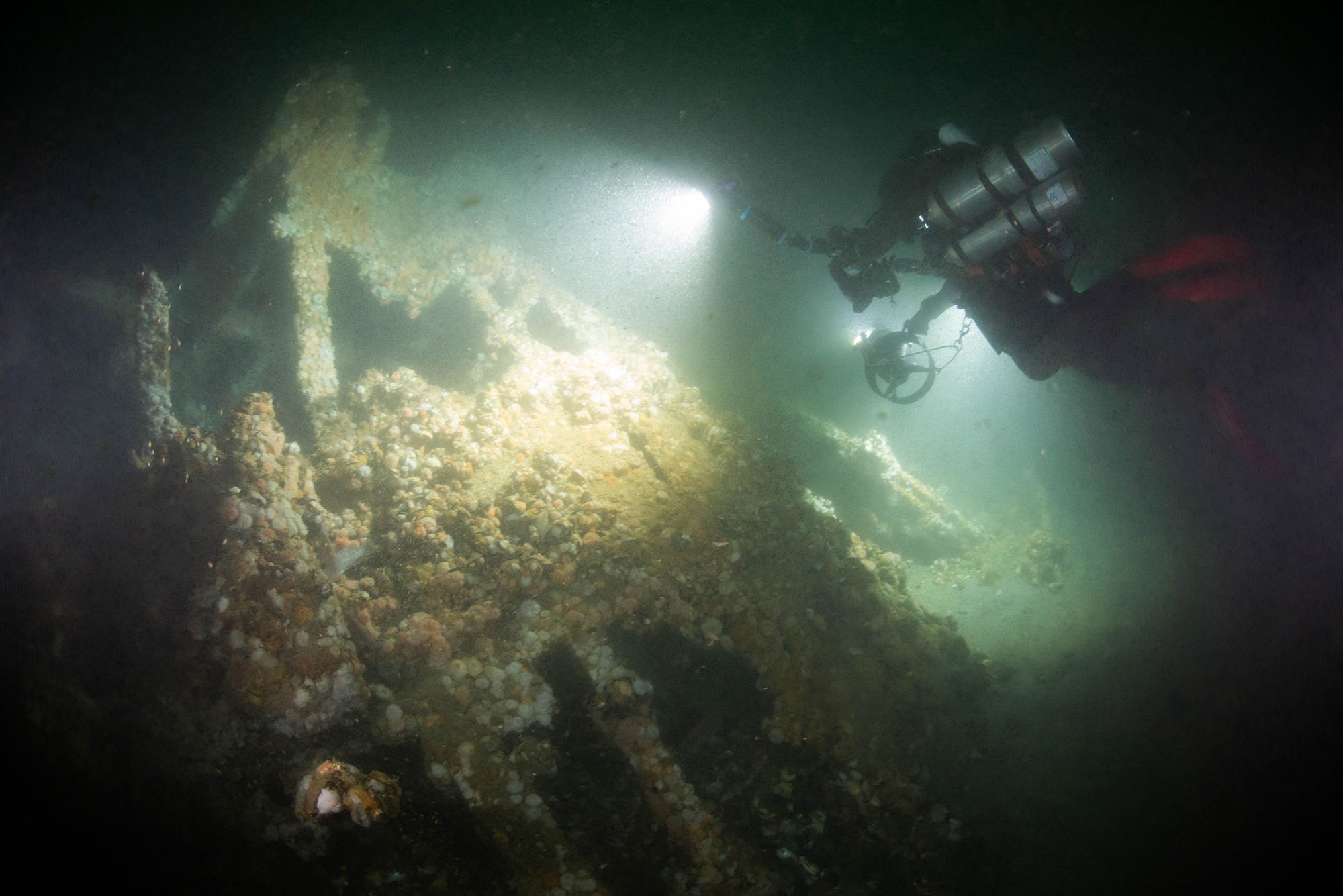
Everything changed on July 29, 2025. Mazraani was diving to a wreck in the Georges Bank area—roughly 200 miles off the coast of Nantucket—when he died unexpectedly. The cause was not believed to be diver error or equipment failure. He was 47.
Sellitti, who was with him that day and is still coming to grips with her loss, can’t bring herself to talk about the tragedy. But she knows she needs to lead the D/V Tenacious without the person who introduced her to shipwreck diving.
“He is that boat,” she says. “Every time we go out now, we feel him with us, in the best possible way.”
A Maritime Hit-and-Run
In 2016, Sellitti wanted to take on a shipwreck project of her own. The D/V Tenacious team suggested Le Lyonnais, a wreck that a crew member had searched for in the late 2000s and had back-burnered.
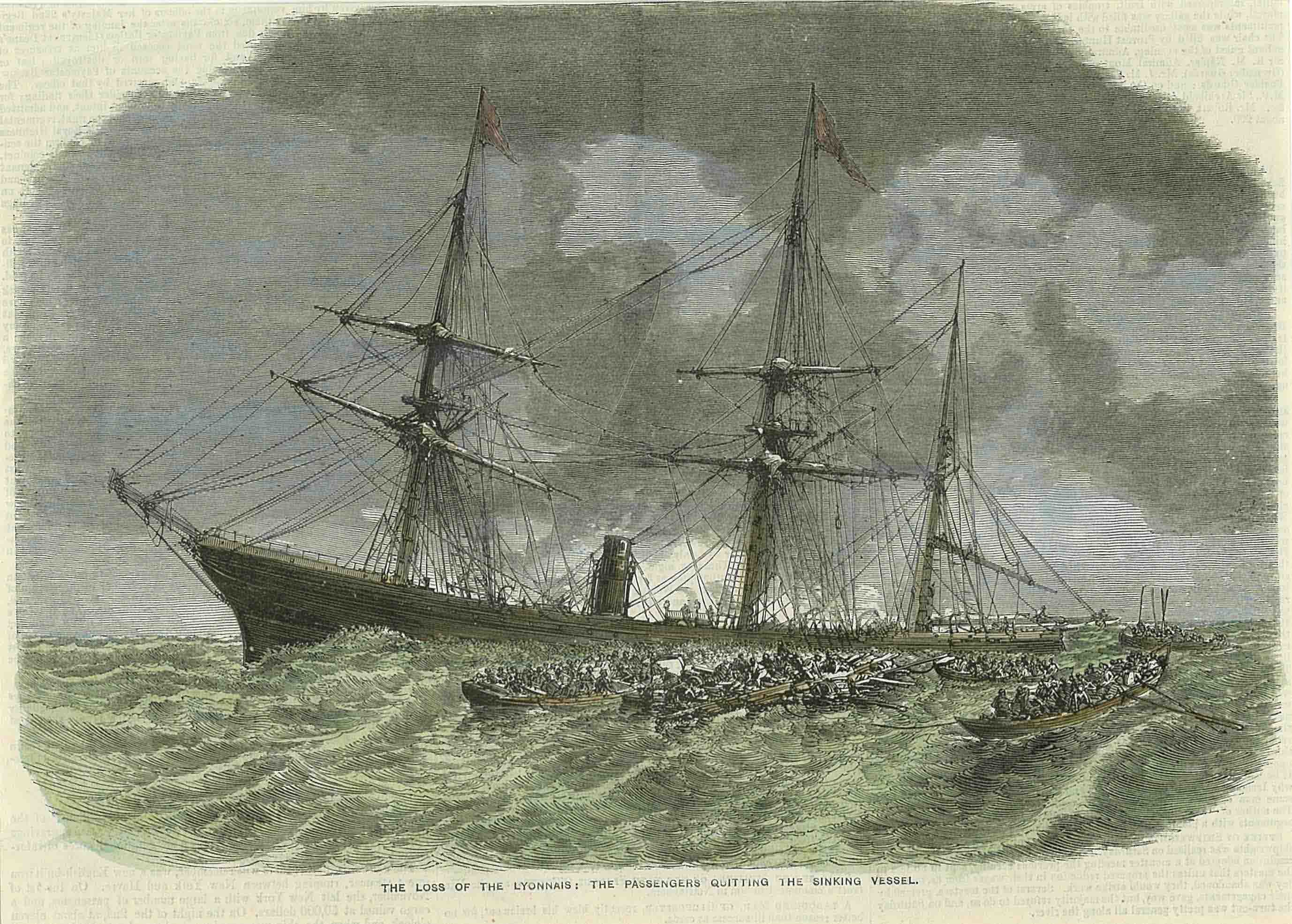
Le Lyonnais was a 260-foot, iron-hulled, passenger steamship that ferried travelers and cargo between France and the United States in 1856. A New York Weekly Herald reporter, Sellitti says, “inspected her at the dock and pronounced Le Lyonnais ‘built in the strongest manner’ and ‘fitted and sound in every respect.’”
But on the dark and hazy night of November 2, 1856, the American sailing vessel Adriatic struck the French steamship off the coast of Nantucket—and continued its voyage without stopping. Le Lyonnais sank, and 114 of its passengers perished, drowning or succumbing to dehydration or hypothermia in the days that followed. Just 18 people survived.
The American press exploded. Congressional hearings followed. The Adriatic was seized by French authorities, and its captain, Jonathan Durham, who denied wrongdoing, was put on trial. But no one would be held accountable; the onset of the Civil War halted the trial and further investigation into what became known as “the Adriatic affair.”
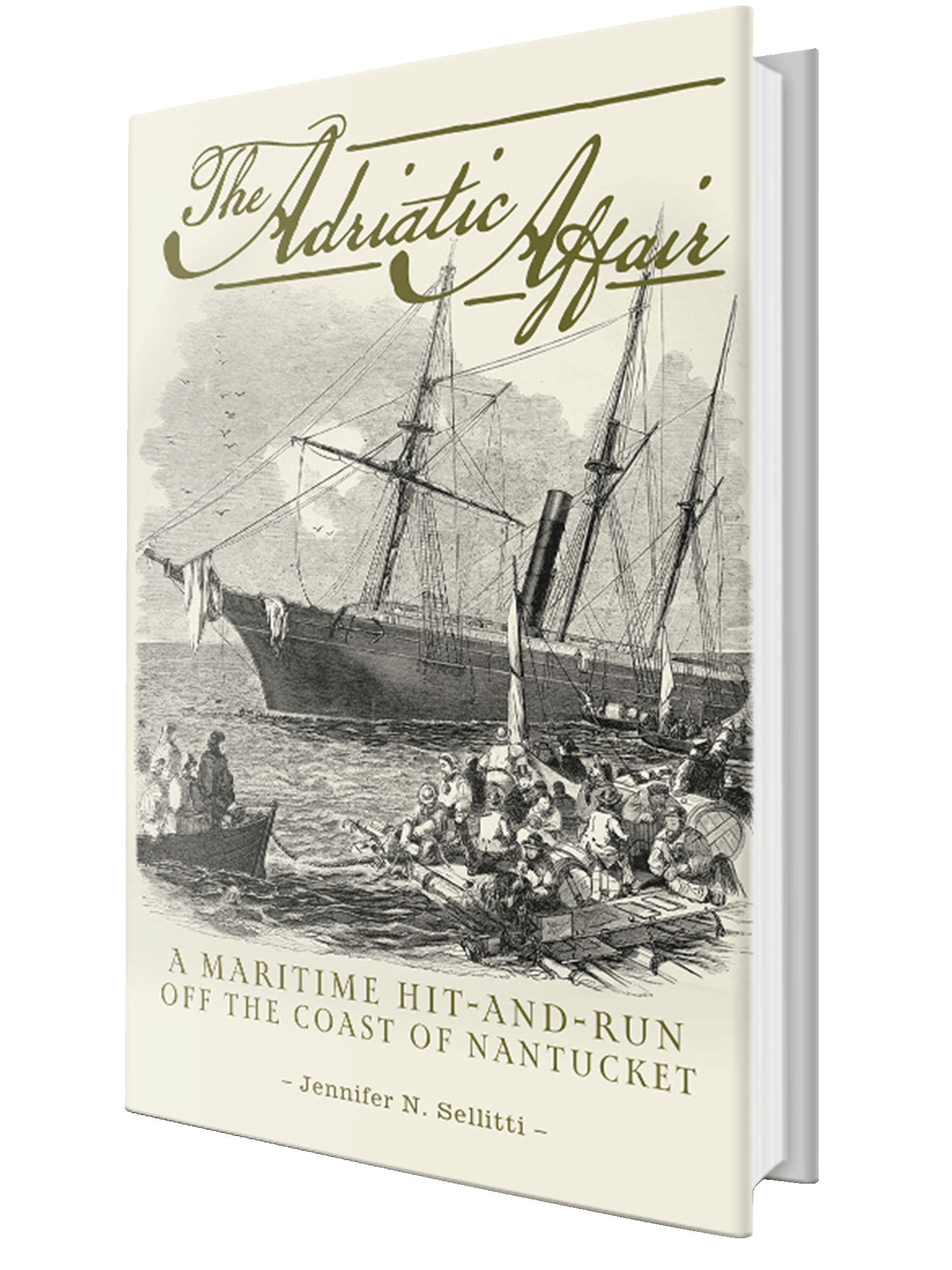
Sellitti spent a decade unraveling the truth and searching for the wreck, work she chronicled in her book, The Adriatic Affair: A Maritime Hit-and-Run off the Coast of Nantucket (Schiffer Publishing, 2025). Her legal training helped as she sifted through newspaper articles, survivor accounts of the sinking, and conflicting testimonies.
“Captain Durham had a lot of motives to lie,” says Sellitti. “These were individual statements made at individual times, and I had to layer them on top of one another. And that’s what we do at trials.”
She says she felt a responsibility to Le Lyonnais passengers—a duty to find out their final resting place. “The more I started digging into the story of Le Lyonnais,” Sellitti says, “the more fascinated I became by the story and the characters and the legal drama part of it.”
A Needle in a Haystack
Modern-day wrecks leave clues for search teams: military records, radio transmissions, approximate coordinates. None of that existed when Le Lyonnais sank. At that time, “captains used stars for navigation and measured their speed by using a chip of wood and a line of knotted rope,” Sellitti writes in her book. “They did not report their positions in coordinates, but rather estimates of how far they were from a mark on land or at sea.”
That’s not the only problem for divers. Ships rarely sink in their last reported position. And, of course, the Atlantic is vast.
Newspaper reports gave only rough estimates of the collision: between 40 and 60 miles from Nantucket’s South Shoal. In 2019, Sellitti discovered documents that put the site farther east. With weather and drift patterns, the team zeroed in on a new search area: the eastern edges of Georges Bank, a large, elevated area between Cape Cod and Nova Scotia.
By 2020, they were theorizing that the wreck lay 140 miles from Nantucket, in roughly 300 feet of water—farther than they’d ever searched before. They retrofitted the D/V Tenacious for the longer, riskier voyage. “There aren’t people actively diving in the waters regularly, and there are no tide tables,” Sellitti says. “There is no way of knowing when the current’s going to pick up. It is a really challenging and unforgiving environment to put divers in the water—and out of the reach of a meaningful chance of rescue if something goes wrong.”
To locate a site, crews determine a rough search area and drag sonar equipment behind the boat at a slow speed, scanning for “anomalies” of the seabed. One of their most essential assets is something called hang data—records of places that commercial trawl fishing boats avoid because their nets and equipment have been damaged or destroyed there, likely due to some kind of debris. The D/V Tenacious’ custom database includes almost half a million spots where that has happened off the East Coast.
“The secret to wreck hunting is matching the historical data to those hangs,” Sellitti writes. “Matching a wreck to one of those hundreds of thousands of points is finding the needle in the haystack.”
In 2023, the team used side-scan sonar on potential targets and found one that was especially promising. But rough seas delayed the dive. They reviewed the sonar data and compared the details of the unidentified ship to historical documents about Le Lyonnais and her sister ship, Cadix.
In summer 2024, they set out again for their spot in Georges Bank. In approximately 250 feet of water, the dive team found pieces of the ship that could help make a positive identification. They took pictures and studied the images back on board. Based on factors like the ship’s size, iron plating, portholes, a distinctive steam engine cylinder, and a deadeye—a wooden pulley used for rigging the sails—they made an identification. After five days and multiple dives to the site, they were certain the wreck was Le Lyonnais.
On that trip, they also located two other wrecks. When they returned to the spot in July 2025, they identified one of them as Seiner, a steam trawler that vanished on Georges Bank in January 1929 and was long thought to be too deep and too far offshore for divers to locate. It was during this expedition that Mazraani died.
Sellitti hesitated to announce their discovery of the Seiner in the wake of his death, but she ultimately decided to share the news over social media and in a press release. She soon received a call from a woman whose great-grandfather had died aboard the trawler.
That’s the kind of thing that we try to do—connect people, not just to the wreck itself, but tell them why the ship’s history is relevant to their communities and broader history.
“She said, ‘My grandfather was 11 years old when his father went to sea and never came back. It haunted him for his entire life. He wanted to know where his father died,’” Sellitti recalls. “I’ve talked to a lot of survivors and descendants of survivors, and I’ve never had anybody say that.”
When Sellitti told the caller about Mazraani’s death and her doubts about announcing their find, the woman told Sellitti, “You don’t know what closure this is giving my entire family.”
Moments like those are a reminder of why she needs to continue leading the D/V Tenacious, even in the face of her devastating loss. “When you can find survivors, or family members, and have these conversations, that’s worth more than anything,” she says. “It’s worth more than anything you could bring up from the ocean floor.”
Carrying On Without Joe
In the weeks after Mazraani’s death, Sellitti realized how difficult it would be to lead the team alone. “He did everything,” she says. “There was not a lot of knowledge that was shared about how this boat worked. He had screwed every single bolt into that boat. He put the engine in—we didn’t even have a mechanic. So there was this sense of not just dealing with somebody dying, which is hard enough, but also that this thing that bound us all together was going to die too. And that was really scary.”
Her team told her they would understand if she just wanted to sell the D/V Tenacious. But Sellitti was determined to find a way to make it work. A friend gave her a piece of advice she now holds close: she will never fill Joe’s shoes—and she doesn’t need to.
“He told me that you have to figure out what Tenacious is going to be with you at the helm,” she says. “And that looks different from how it looks with Joe at the helm. I know my goal moving forward is to combine my love for education and partnering with people, and doing more research. Tenacious is never going to be what it was with Joe, but together, we can be something that would make him really, really proud.”

Passionate about educating the public about maritime history, Sellitti serves on the board of the New Jersey Maritime Museum and is a member of Boston Sea Rovers, one of the largest and oldest dive clubs in the world. She is also the founder of All Aboard!, a program that brings maritime history into classrooms and communities.
Her team frequently visits schools and museums and posts on social media, showcasing the artifacts they’ve found and sharing stories about both a ship’s history and their expeditions. On the 105th anniversary of the sinking of the passenger liner SS Carolina—torpedoed by a German U-boat in 1918—Sellitti and members of the crew brought artifacts to a Puerto Rican community group in New Jersey, many of whom had ancestors who had traveled on the Carolina.
“That’s the kind of thing that we try to do—connect people, not just to the wreck itself, but also tell them why the ship’s history is relevant to their communities and broader history,” she says.
And these days, when Sellitti heads out in the Atlantic, she feels Mazraani there: steady, methodical, calm.
“I think when people die under circumstances like this, a lot of people say, ‘Oh, you shouldn’t be doing this, it’s too dangerous,’” she says. “But sometimes when you live life at the edge, the edge pushes back. Joe would be the first person to say, ‘Push the edge anyway, push the boundaries. Exploration and following your passion are worth the risk.’”