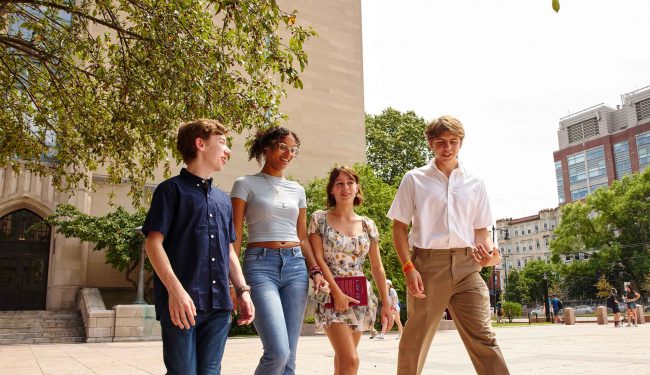
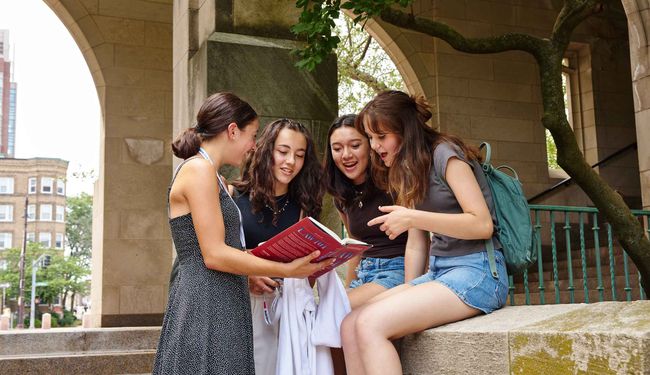
Boston University’s Summer Challenge seminars allow you to engage in a high level of learning and achievement with other high school students—without focusing on grades. Choosing two noncredit seminars (one morning, one afternoon), you’ll participate in lectures, discussions, individual and group work, project-based assignments, and field trips. Small class sizes ensure ample attention from experienced college instructors as you meet the challenges of college-level study.
All seminars are introductory and do not require previous experience or coursework. During the program, you will access all materials for your seminars via Blackboard Learn, the primary learning management system (LMS) at Boston University. Each seminar culminates in a final class presentation. All 21 seminars have been grouped into the following topic areas for your convenience:
Following the conclusion of your Summer Challenge session, a certificate of completion and letters of evaluation from both seminar instructors will be provided to you.
Health and life sciences
Abnormal Psychology
Investigate the essential concepts of abnormal psychology, focusing on the causes, symptoms, diagnosis, assessment, treatment, and prevention of psychological disorders. You will be encouraged to think analytically and challenge your beliefs regarding abnormal behavior and personality. Through case studies and interactive group discussions, you will gain an understanding of psychological disorders and an appreciation for the challenges of experiencing mental illness.
Session 1: Afternoon
Session 2: Morning and afternoon
Session 3: Morning and afternoon
Anatomy and Physiology
Understand the structure and function of the human body through anatomical models, animations, and specimen dissections. Learn how body systems work both independently and together to support life. Special conditions and disorders will also be studied as perturbations of the normal anatomy and physiology of human body systems.
Session 1: Not offered
Session 2: Afternoon – FULL
Session 3: Afternoon
Chemistry of Medicine
Gain an introduction to the science of medicinal chemistry through lecture and interactive exercises, with a focus on the mechanisms of action of drugs and other biologically active compounds. Students will learn the basic principles that connect chemistry, biology, and pharmacology to explain drug action and guide drug discovery. The course explores how chemists modify molecular structures to improve effectiveness, reduce side effects, and enhance safety, with real-world examples illustrating the development of successful medicines. By the end, students will have a foundational understanding of how modern pharmaceuticals are created and the scientific principles behind each step of development.
Develop a basic understanding of the causes, pathology, and cures of human infectious diseases by engaging in lectures and conducting experiments. Specific diseases such as influenza, SARS, and HIV are used to illustrate the mechanisms of human disease. The laboratory component of this seminar functions as an introductory microbiology lab that allows you to study the morphological and physiological characteristics of microorganisms.
Explore fundamental concepts in neuroscience, including how neurons communicate, how sensory information is processed, and the biological basis of memory formation. You will also study several neurological diseases and disorders, along with treatments such as medications and brain-computer interfaces.
Learn how to translate the latest nutrition guidelines into appealing food choices for health promotion and disease prevention. Explore nutrition basics including carbohydrate, protein, fat, calories, vitamins, and minerals, as well as nutrition preferences such as vegetarianism. You will calculate unique nutrition needs for individualized meal planning and develop skills and strategies to implement a healthy lifestyle through interactive sessions.
Explore fundamental business principles and how they are applied in today’s marketplace. Learn how to develop and leverage a business plan to effectively market and finance a new venture. You will work in teams to develop new product ideas and present a business plan to launch your new product into the market.
Session 1: Morning and afternoon
Session 2: Morning and afternoon
Session 3: Morning and afternoon
Criminal Justice
Explore the role of corrections and the impact of incarceration in America. Through case studies, films, presentations, and discussions, you will consider topics such as correctional theory, mass incarceration, and strategies for successful rehabilitation of offenders.
Session 1: Not offered
Session 2: Afternoon
Session 3: Afternoon
Economics
Examine the principles of economic behavior of individuals and firms, including individual consumer preferences, opportunity costs, thinking at the margin, and competition and cooperation between firms. Through class discussions and experiments, you will become familiar with the theory of consumer choice as well as the strategic behavior of individuals and firms.
Session 1: Morning and afternoon
Session 2: Morning and afternoon
Session 3: Morning and afternoon
Finance
Learn how to understand and apply fundamental concepts in finance. Receive an introduction to investment markets, financial accounting, interest rates, basic valuation, and time value of money. Through discussions, problem solving, and a final project, you will learn how to apply financial concepts to a range of business, investment, and personal situations.
Analyze current global events through various theoretical lenses of international relations used to describe political behavior in the international system. You will learn how to think critically about global issues and use international relations theories to examine relevant events in modern international politics. You will work in teams and participate in class debates to better understand the intricacies of decision making involved in resolving international conflicts.
Session 1: Morning
Session 2: Morning and afternoon
Session 3: Morning and afternoon
Law
Receive an introduction to the United States court system. Learn to read, interpret, and brief a court opinion as well as discuss the importance and effect of precedent under the common law. You will have the opportunity to sample the law school experience, gain fluency in legal vocabulary and procedures, and engage in mock adjudication sessions.
Develop an understanding of programming and computer science concepts such as software development, computer networks and security, and artificial intelligence. Learn about variables, if-else statements, while loops, input and output, functions, and simple data structures.
Learn engineering methods through topical challenges provided by the Smart Lighting Center. Investigate and experiment with tools and technologies used in the development of novel LED lighting, including its adaptation to applications such as visual light communication.
Session 1: Not offered
Session 2: Morning – FULL
Session 3: Morning
Communication and media
Journalism
Examine the various aspects of journalism and apply news principles and practices to an original reporting project. Through class discussions and practical exercises, you will learn to identify and develop sources, prepare for and conduct interviews, and report and write news. Class time is spent learning the histories of print and electronic media, studying the differences between the two formats, and presenting your work.
Learn about advertising, public relations, journalism, film, and television while exploring the wide range of careers available in the communications field. Classes focus on the history, current trends, and future of these media in America. You will work in teams on communication-related projects such as advertising pitches, film analyses, news reports, and television and print advertisements.
Learn the technical and aesthetic possibilities available when working in digital photography. Through a series of sequential assignments, you will explore the “digital darkroom” using digital imaging software to produce a portfolio of original images. This course introduces the essential tools, techniques, and concepts of photographic media, with an emphasis on composition, narrative, and use of natural light. Each student must bring a digital SLR camera with manual features.
Session 1: Not offered
Session 2: Afternoon
Session 3: Afternoon
Humanities
Creative Writing
Study and write poetry, fiction, and screenplays, with the end goal of creating a varied, original writing portfolio. You will explore the subject by reading and analyzing both classic and contemporary literature, responding to diverse prompts, meeting acclaimed authors, and rigorously workshopping each other’s writing.
Engage with works by authors that emphasize narratives of the journey both externally (environmental) and internally (psychological). Through seminar discussions, close reading, and film screenings, this seminar encourages university-level reading techniques, self-reflection, and critical observation of the journey narrative.
Session 1: Not offered
Session 2: Morning
Session 3: Morning
Philosophy
Confront some of the great debates in the history of philosophy. You will address such questions as: Do we know anything? Is there free will? What makes us morally responsible for our choices? Does life have any meaning? Is it possible for a computer to become capable of human-like consciousness? Through engaging in great debates, we hope to understand something about the nature of philosophy, including why and how we should go about doing it.
Session 1: Not offered
Session 2: Afternoon
Session 3: Afternoon
Visual Arts
Create original drawings and paintings from observation and memory, exploring how the use of representation, color, and abstraction can capture feeling and meaning. Utilize a variety of materials and approaches to focus on different qualities of how one interprets space and objects. On-site drawing experiences at locations around the city such as a visit to the Museum of Fine Arts provide inspiration for students.
Session 1: Not offered
Session 2: Morning
Session 3: Morning
A Day in the Life
What's it really like to be a Summer Challenge student?