‘Our Principles Should Always Guide Us’.
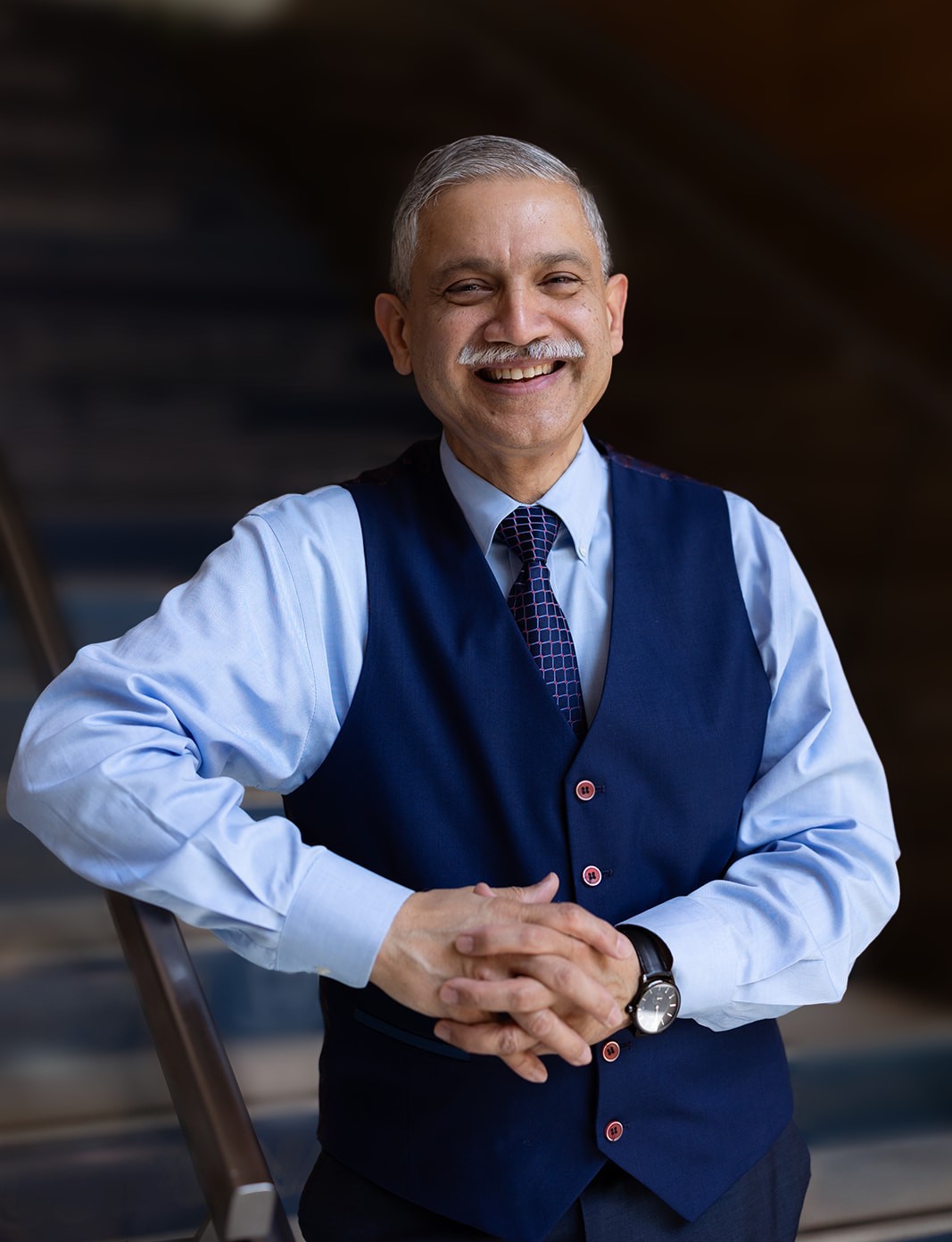
SPH Dean Adnan Hyder.
‘Our Principles Should Always Guide Us’
As public health continues to face immense challenges, Dean Adnan Hyder discusses his vision for the school and how the SPH community can navigate this moment.
Gun violence is often framed as a uniquely American problem, but in actuality, “it translates and migrates across countries and national boundaries just like an infectious disease does,” says Adnan Hyder. “So there is no reason why we ought not to consider it a global public health issue and, potentially, a global public health epidemic.”
Hyder made these remarks as the moderator for a May 2020 Dean’s Seminar at the School of Public Health, an event that was cohosted with the George Washington University Milken Institute School of Public Health (GW) to foster a greater understanding of the health consequences of guns worldwide.
Five years later, Hyder is bringing a wealth of expertise on violence and injury prevention, noncommunicable diseases, health systems thinking, and bioethics to SPH as the new dean and Robert A. Knox Professor. He begins this new role at a challenging and uncertain time for the field of public health and for universities, both of which are under threat from unprecedented federal funding cuts and public distrust in science. Anti-health agendas are threatening lives acutely—as evidenced by the recent shooting at the Centers for Disease Control and Prevention driven by vaccine misinformation—and over time, as harmful policies will inevitably continue to widen inequities and jeopardize the health of vulnerable populations.
These challenges call for an innovative and evidence-based public health response that places empathy, compassion, and equity at its core, says Hyder.
“For me, a fundamental goal for the School of Public Health will be to make communities and stakeholders understand that this school has a real impact on real people,” he says. “It’s not only about doing the right thing, but also communicating what we do so that people everywhere understand our role and work.”
Describing himself as a structural thinker, Hyder says capacity-building has been a central component of his career over the last 30 years, during which he rose to professor of global health at Johns Hopkins University Bloomberg School of Public Health (where he also received his MPH and PhD) before moving to GW in 2018, where he most recently served as senior associate dean for research and innovation and professor of global health before joining BU. He served in multiple leadership capacities at both institutions, working to improve global health systems in Africa, Asia, Latin America, and the Middle East, as well as designing or leading training in this sector.
“I like to organize and build things, and that became a good trait for me to have in administrative positions,” Hyder says. “The more I took on, the more I enjoyed them—and the more I found that I could do this work effectively.”
At JHU, he founded and directed the Johns Hopkins International Injury Research Unit, leading research on drownings in Bangladesh, childhood injury prevention in Malaysia, hospitalized injuries in China, road safety in multiple countries, among many other projects. At GWSPH, he was a founding director of the Center on Commercial Determinants of Health, which is among the first centers of its kind nationwide, studying how private industry contributes to illnesses, disabilities, and mortality across the globe. There, Hyder also published several manuscripts, including a case study that analyzes how major food and drink companies deliberately influence scientific evidence and expert opinions, as well as a viewpoint that explored how the firearm industry embraced marketing and lobbying strategies to minimize public concern on gun violence.
“Expanding the frontiers of public health research into other sectors through this type of interdisciplinary research has been key to understanding larger health and social problems confronting our country and world, and that is what makes our work so exciting,” says Hyder.
As he settles into his role as dean, Hyder says his first task is to “listen and learn.” Below, he shares more about his background, his priorities for SPH, and how the school community can navigate this tough moment for the field.
Q&A
with SPH Dean Adnan Hyder
You’ve mentioned that you started your career with a mission of social justice. Can you expand on what inspired you to pursue a career in public health?
I was inspired to join the field while I was a medical student at Aga Khan University in Karachi, Pakistan, my native country. After my first year of medical school, I traveled to the northern parts of Pakistan to collect data for a health and demographic survey. As I worked in remote areas of the country, I came across people who were living in abject poverty. It felt extremely wrong to me that my fellow countrymen and women were literally living in caves. There were children who were dying, and families had many other health and economic problems. I did not know it at the time, but the frustration and anger that I felt was what fueled my desire to work towards social justice. This desire stayed with me throughout my medical career, and ultimately led me to shift from clinical medicine to public health. This social justice mission has remained with me and continues to guide my thinking about how we can have an equitable world where all people have the ability and opportunity to achieve optimal health.
What led you to shift into a dean’s role?
As I progressed through my academic and research career, one of the elements that stayed with me was this notion of building capacity. Early on in my journey, I worked on training grants that enabled a US university to “twin” with a university in a low- and middle-income country to help develop, strengthen, empower, and build the technical capacity of colleagues in these countries. That experience was foundational for me, because it instilled a belief that those who are collaborating with me should be better off after a project than they were before. And this praxis strengthened my resolve to always have a ‘service’ career—service to the people, particularly to my own community.
In my role here at SPH, I am energized by bringing a community of people together, where all of us can be uplifted. I really want to think about growing the institution, supporting the people within the institution, and elevating all of us together.
This is a difficult time for public health. How do you think our school should navigate this moment, amid political pressures and public distrust?
First, I want to acknowledge that these may be considered the best of times, or the worst of times, depending upon how one views it. It is very true that threats to the academy, science, and evidence are coming from various directions right now. The role of universities and schools like ours is to uphold our core principles, which is that we value all human beings and their health, as well as science, including scientific inquiry and scientific methodology. Fundamentally, we are in the business of improving the health of the public, and our principles should always guide us.
But this is also new territory for many of us. Some of us have never seen the types of threats and pitfalls that are confronting us. These threats will challenge the intellectual, administrative, social, cultural, and political skills of everyone in our profession. I think the balance is going to be somewhere between retaining the principles of public health and negotiating it in a way where we can still be productive and still have impact, despite the contextual constraints around us.
As schools of public health, we are also facing challenges with funding, student enrollment, and our research. As a community, we have to work together to see how we can negotiate these times. I think schools that support their faculty, staff, and students, and that retain a sense of autonomy in confronting these problems, will do well. It’s not going to be easy, but I do believe that we can rise to this moment.
What are some of the priorities that you hope to address over the next year?
I want to be very clear that SPH’s priorities will emerge from our school and university community, not from me alone. My role is to study the school and to engage the leadership, faculty, staff, and students in conversation—and then use that insight to develop a strategic pathway as we enter our 50th anniversary year in 2026. I love the mission of the School of Public Health, and that’s why I am here. What we have to figure out is how we can achieve our vision and mission based on the new realities, and whether there are new and innovative strategies, pathways, and workflows that we should do in order to achieve them.
In that context, I would say that achieving financial sustainability, enhancing our research portfolio, making sure that students feel welcome and have great experiences, and increasing enrollment are broad areas that deserve our attention. By focusing on these areas, we can ensure that our school has a real-world impact that is recognized locally, nationally, and across the globe. We will be intentional about providing a benefit to the world around us.
How can the school better prepare students for a changing public health workforce?
Students expect to have a high-quality education that is meaningful to them, that is technically solid, and that allows them to enter the public health workforce. Every school attempts to do that—we’ve done an incredible job as I can see in the past, and we need to continue to do so. The nature of the workforce might change over the next few years, and the opportunities may not always be in the traditional spaces, so we have to look at new types of positions, placements, and opportunities—whether that’s in the private sector or in industry or in startups—that may be looking for people with public health expertise. SPH will begin our Council on Education for Public Health [CEPH] reaccreditation process this fall, and that process will present an opportunity for us to assess any changes that need to be made, especially in view of the current realities.
Is there anything else that you’d like the community to know about you?
I am very excited to work with this community of faculty, staff, and students, and continue to build this school. My first task is to listen and learn, and that listening and learning will lead to a lot of thinking and discussion with colleagues. Together, we will chart out a strategic direction that will be an editing and reorientation of the existing one. It’s really tough to take a fantastic product and make it better, but I think we can, together. I hope that every single member of the community understands that they are integral to the school and to work—and I am grateful for their role every day.