Student Reflection: Mia Knežević (IR ‘26) Recaps Talk on Iran Nuclear Program
On Monday, October 9th, experts from three Boston-area universities were brought together for a panel discussion titled “Putting the Iranian Nuclear Program in a Broader Context,” hosted by Pardee Professor Sanne Verschuren as part of “The Global Security Initiative.” The panelists — Gary Samore, Director of the Crown Center for Middle East Studies and Professor of Practice of Politics at Brandeis University, Ali Kadviar, an Associate Professor of Sociology and International Studies at Boston College, Yasir Kuoti, a Political Science Ph.D. student at Boston University, and Sanne Verschuren, Assistant Professor of International Security at Boston University — all contributed unique perspectives to make for an interesting, engaging discussion moderated by Pardee School Dean Scott Taylor.
Gary Samore began with a discussion about the evolution of Iran’s nuclear program, sharing an analysis of Iran’s nuclear strategy before and after the 12-day war (also known as the Iran-Israel war) that took place this past June. He emphasized that Iran’s “very successful” nuclear strategy over the past 20 years now lies “in ruins.” He discussed two potential strategies for Iran going forward — building nuclear weapons or negotiating another agreement — but also raised potential obstacles to both. Samore, who was President Obama’s White House Coordinator for Arms Control and Weapons of Mass Destruction (WMD) and has extensive private and public sector experience, brought valuable expertise on nuclear strategy and non-proliferation to the panel.
Ali Kadivar, who studies protest movements and has experience as a participant-observer of the pro-democracy movement in Iran explained what Iran’s nuclear situation might mean for the country and its people. He focused on the historical perspective by unpacking Iran’s decades-long security issues, especially during World Wars I and II, the 1953 coup in Iran, and the Iraq War. Kadivar also discussed anti-American sentiment in Iran and how support for nuclear weapons has likely increased among the Iranian people after the exchange between Iran and Israel in June.
Yasir Kuoti then zoomed out from the discussion on Iran to include more regional actors, bringing in the viewpoints of the Gulf States and states that he classified as having “no unified, functional authorities,” such as Iraq, Yemen, and Lebanon. Kuoti, who specializes in international relations and comparative politics with a regional focus on the Middle East and North Africa, highlighted that the region is so divided that there is no one particular perception of Iran’s nuclear program. Israel, however, does view Iran’s nuclear program as an “existential and intolerable threat to its existence,” according to Kuoti.
Finally, Sanne Verschuren discussed developments in the broader world of nuclear weapons. First, she argued that there is much more violence in the international system than ever before and that states are resorting more to tools of violence, which have rippling effects in the nuclear sphere. Then, she discussed the significant nuclear modernization happening in the world and how each of the nine nuclear-armed states continues to modernize their nuclear programs, adding new technologies as they emerge. Finally, she emphasized that there exists a “crippling understanding” in the world of how the nuclear system works and what it is supposed to do, adding that arms control is becoming an increasing rarity. Verschuren’s research focuses on how states fight war and why they construct novel weapon technologies, and she was thus able to bring a valuable perspective on general security policy and how it relates to the Iranian nuclear program.
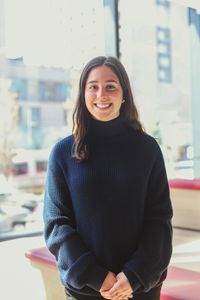
Mia Knežević is majoring in International Relations, with minors in History and Russian, and is particularly interested in the Balkans, former Soviet states, human rights, and migration. Mia previously served as a U.S. State Department Critical Language Scholar in Kyrgyzstan and has interned with Need4Deed, a Berlin-based nonprofit supporting refugees, as well as with the Post-Conflict Research Center in Sarajevo, Bosnia & Herzegovina. On campus, Mia is the Senior Editor for the Russia & FSU Section of the International Relations Review and a member of the Women’s Club Water Polo team. She looks forward to meeting new people and continuing to support the Pardee community as a Dean’s Ambassador. In the future, Mia hopes to work in the nonprofit sector or at an international organization, advocating for refugee protection.