
Wilson Wong Lab’s novel immunotherapy sees success in Senti trials
By Patrick L. Kennedy
A novel cancer cell therapy out of a Boston University lab might lead to safer, faster, less costly and more effective treatments for some of the toughest types of cancer. This immunotherapy, developed by a team of researchers under Professor Wilson Wong (BME), is a new form of chimeric antigen receptor (CAR) technology that more precisely targets tumors and protects healthy tissue. The experimental treatment is currently in clinical trials at Senti Biosciences, and the team recently published their work in Cell Systems, with Seunghee Lee (ENG’22) as first author.
In conventional CAR-T therapy (which is generally tried after other treatments have failed), a type of white blood cell called T-cells are extracted from a patient’s blood sample, genetically modified, and reintroduced into the patient, where the T-cells recognize and eliminate cancer cells. T-cells fight foreign bodies naturally, but the biomedical modification boosts their abilities with enhanced receptor proteins. These engineered receptors are designed to bind to proteins called antigens, which sit on the surface of cancer cells. The T-cell latches its receptor onto the cancer cell’s antigen and destroys the enemy.
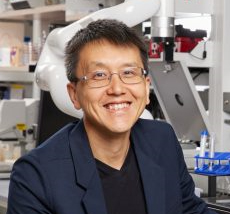
Unfortunately, every case of cancer in every patient is different, and the process of properly tailoring the T-cell therapy can take several weeks. “Sometimes, patients die while the lab is making the T-cells,” says Wong, who was recently named BU’s Innovator of the Year. Moreover, in a few extreme cases, patients die when the treatment backfires, with the T-cells targeting healthy cells. For example, in acute myeloid leukemia (AML), the same antigens found on the cancerous cells are also found on the stem cells of the patient’s bone marrow.
That’s why Wong’s lab has been working for several years to improve the specificity of CAR-T therapies. “Any time you improve specificity of a cancer therapy, you eliminate some of the side effects,” Wong says. “We are basically designing a type of chimeric antigen receptor that can perform a unique logic.”
Applying principles of computing to cellular engineering, the team is programming T-cells to seek out multiple types of antigens, but only on the cells that pose the threat. “We tell them what target to go after, basically,” says Wong. “That’s what CARs do, but our designs make them a little bit smarter; we make them do some logic computations.”
The system contains two receptors, an activating CAR (aCAR) and the team’s novel inhibitory CAR (iCAR). While the former enables the T-cell to latch onto and destroy tumor cells, the latter stops the T-cell from attacking healthy cells that present the same antigen.
Wong, Lee, and colleagues call the system a NOT-gated circuit, a reference to its instructions to not assault healthy cells. The team iterated and evaluated more than 60 iCAR-aCAR pairs before hitting upon the winning combination. In Senti’s clinical trials, T-cells equipped with the NOT-gated circuit were used to treat patients with AML. Forty percent of them enjoyed complete remission—a high success rate for these patients, for whom previous treatments had done little to nothing.
“It’s a whole new paradigm in therapy design,” says Wong. Instead of a bespoke therapy that takes weeks to produce, the BU and Senti researchers envision a scaled-up, off-the-shelf treatment that can be given to all sorts of cancer patients almost as soon as it’s prescribed. And in addition to T-cells, the team successfully implemented the NOT-gated circuit in natural killer (NK) cells, another tool in the body’s immune system. That demonstrated that the technology can be applied not only to cancer but to autoimmune and other kinds of diseases as well.
“We’re the first to do this with NK cells,” says Wong, who is quick to heap praise on the doctoral students and postdocs who toiled on the project in his lab. “They did all the work,” he says. Besides Lee, the team included included Jingyao Chen (ENG’24), Menna Y. Siddiqui (ENG’23), Jaehoon Choi (ENG’26), and Joey Huang (ENG’24,’26) as well as several researchers at Senti Biosciences. “Our work is a foundation, but Senti identified AML as the right use case, and it’s exciting to see the platform move into a clinical trial,” Wong says. “I’m glad we played at least one important part in this whole process.”