Khalil Awarded Vannevar Bush Faculty Fellowship
BU synthetic biologist will study epigenetic memory to create new, self-assembling biological materials
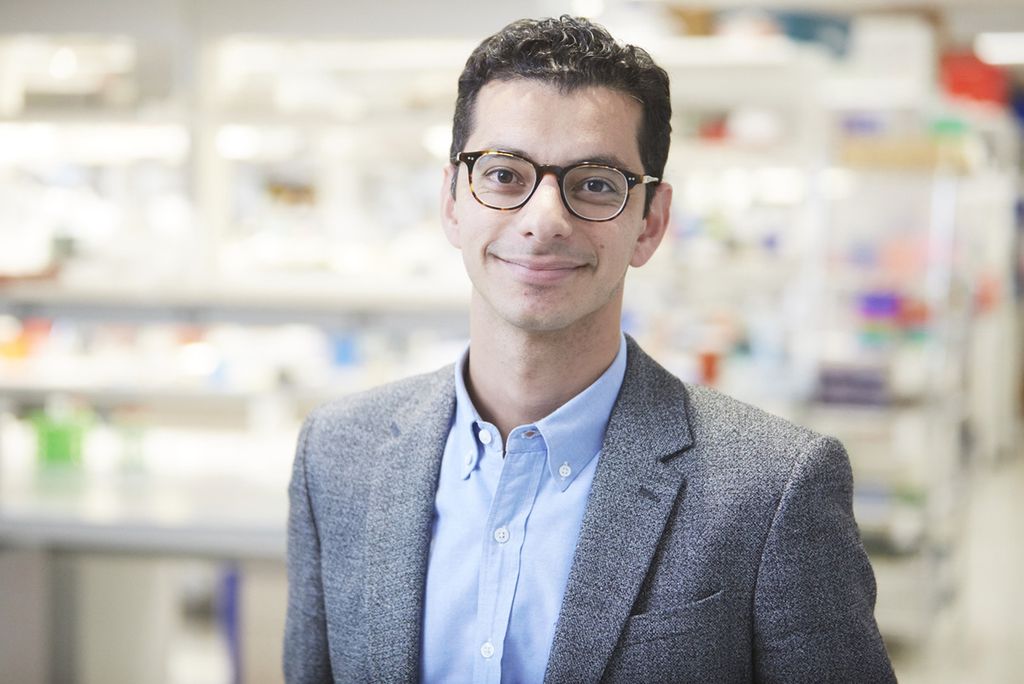
By Jessica Collarossi
Much like hacking a computer, Ahmad ‘Mo’ Khalil hacks nature and the microscopic biological systems that make all life possible. In his lab at Boston University, Khalil, associate director of BU’s Biological Design Center (BDC) and College of Engineering associate professor of biomedical engineering, has created entire cell colonies capable of being programmed to perform tasks, from eliminating cancer cells to making new classes of drug compounds, all by mimicking cellular systems that have evolved over the course of many millennia. Now, Khalil has been awarded the 2020 Vannevar Bush Faculty Fellowship—the Department of Defense’s most prestigious award for a single investigator—to explore how cells are capable of passing “memories” down to the next generation of offspring cells, a dynamic known as epigenetic memory.
With his work supported by the fellowship, Khalil will discover how to manipulate epigenetic memory in cells to program self-assembling biological materials, like tissue and other cellular structures. The Brink caught up with Khalil to learn more about his research plans.
Q&A with Ahmad ‘Mo’ Khalil
The Brink: How did you become interested in synthetic biology?
Khalil: I was initially trained in mechanical engineering, where I learned the principles of designing and building complex systems. Traditional approaches to studying biology involve anatomic and genetic dissections, so what drew me to synthetic biology was its potential to offer an inverse approach to studying biological systems, such as designing [genetic components] and combining them in meaningful ways to create new and functional cellular systems from the bottom up.
What aspect of your work will you be exploring with the Vannevar Bush Faculty Fellowship?
The fellowship will be used to explore a fundamental capability of all living cells: the ability to program long-lived memories of their environments. These epigenetic memories, which can be passed on as useful information from one generation to the next, are not encoded by changes to the genome of the cell. Establishing these epigenetic memories allows cells to learn and adapt to their environments, and crucially is at the heart of how [similar] cells build multicellular structures, tissues, and organisms. Despite this appreciation, our ability to direct and engineer this capability is limited. Through the fellowship, [my team] will use synthetic biology approaches to learn about how epigenetic memory is established and manipulated, and how we can direct these processes to program cells to self-organize into desired multicellular structures and materials.
Can you explain the possible applications of epigenetic memory?
As we know, memory is fundamental to manufactured devices like computers. Thus, the ability to encode epigenetic [memories] is fundamental to programming complex computations in living cells. You can imagine future applications, such as engineered cellular sensors that can record and recall environmental signals. Epigenetic memory is also the basis of genetic switches toggling the expression of genes—like an ON/OFF switch. Many biomedical and biotechnological applications rely on precise control of gene expression, for example, controlling differentiation of stem cells or controlling [therapeutic delivery].
This work could also be used to program self-assembling cellular materials that could utilize epigenetic memory to enable on-demand fabrication, maintain structural organization in light of cell division, self-repair following stress or disruption, and have diverse and tunable material properties that respond to surrounding environmental conditions. We believe that these biological materials will enable [new] dynamics and properties [that are currently] impossible in conventional materials.
You have mentioned doing a decent amount of traveling before coming to BU—what drew you to Boston?
I was born in the Middle East to Palestinian-Jordanian parents, so my family moved quite a bit when I was young. By the age of 10, I had lived in Dubai, Jordan, Greece, Saudi Arabia, and the United States. After finishing my undergraduate studies at Stanford, I decided to move to Boston to pursue my graduate studies at MIT. Moving from one place to another is never easy, especially as a kid, but I think these experiences helped make me adaptable, resilient, and appreciative of diverse ideas and thoughts. The unparalleled intellectual and research environment in Boston has kept me here ever since.
What led you to help found the Biological Design Center?
We founded the BDC with a vision to bring together diverse researchers around the common goal of figuring out how to engineer biological systems, to study their evolutionary design, and to apply them as new solutions for biomedicine and other applications. I was excited about the potential to play a leading role in realizing this vision, and helping to grow the BDC into the preeminent synthetic biology center it is today. Among my proudest accomplishments as the BDC’s associate director is helping to lead our successful application for the first-in-the-nation National Institutes of Health Ph.D. training program in synthetic biology. Through this program, we are creating a training environment that produces exceptional synthetic biologists who will revolutionize scientific fields and biotechnological industries.
What are some of the biggest problems you are working to solve with synthetic biology?
Much of our work has been foundational in nature, focused on understanding the design of molecular circuits that control how genes are regulated in cells. Through this work, we have developed new tools and a strong intellectual foundation for predictably controlling cell and tissue behavior, which we believe will ultimately lead to breakthrough diagnostics and therapeutics for human health. In one immediate application, we are collaborating with [BU College of Engineering associate professor of biomedical engineering] Wilson Wong to develop genetic tools that allow better control of immune cell function to improve cell-based cancer therapies. Another problem we are working to solve with synthetic biology and related technologies in the lab is curbing the rapid spread of antibiotic resistance.
What motivates you to stay innovative?
Trying to keep up with my exceptional and creative graduate students and postdocs!
When you’re not in the lab, how do you spend your time?
I have four young, lovely kids at home. These days, when I’m not in the lab, I can be found changing diapers, reading Harry Potter, coaching soccer, conducting DIY science experiments at home, or any number of kid-related activities.
This story originally appeared on The Brink.