The College of Engineering offers a unique way for you to advance in rapidly growing economic sectors that have a critical need for trained engineers. Solve pressing societal challenges with an interdisciplinary Specialization in Artificial Intelligence and Machine Learning, Robotics, or Cybersecurity.
Specialization Coordinators:
Robotics: Prof. Baillieul
Cybersecurity: Prof. Stringhini
Artificial Intelligence and Machine Learning: TBD
Robotics
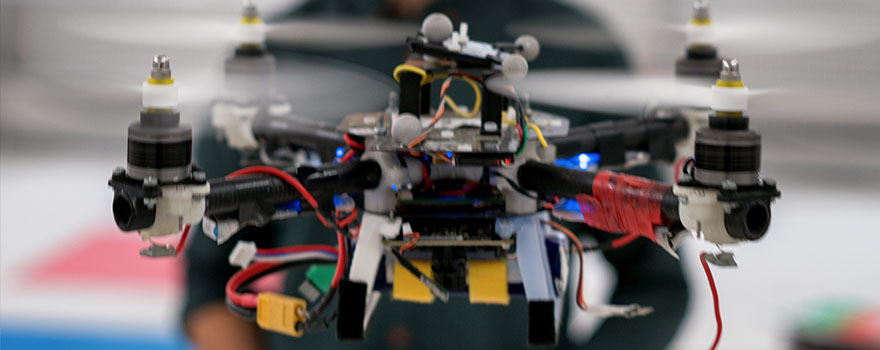
The need for robotics expertise is rapidly expanding, creating opportunities as diverse as prosthetics and telemedicine, self-driving vehicles, feedback control systems, brain-machine interfaces, and the Internet of Things. Robotics is inherently interdisciplinary, combining elements of electrical, computer, biomedical, systems, and mechanical engineering. The Robotics specialization will prepare master’s degree students for careers in research and development, deployment, and operation of individual or multi-coordinated robotic systems.
Requirements for Robotics Specialization
The Specialization in Robotics can be earned and added to any Master’s degree title on the transcript by fulfilling the following requirements.
Students planning to pursue a Specialization in Robotics should declare their intent as early as possible in their programs to facilitate course planning.
Specialization requirements:
All Master’s Degrees require a minimum of 8 classes. The Specialization designation requires a sequence of four courses (16 credits) consisting of two required courses (8 credits) listed below and two courses (8 credits) chosen from the list of approved elective courses.
Required courses (2)
-
- EC/ME/SE 501 Dynamic System Theory
and one of either:
- ME/SE 740 Vision, Robotics, & Planning, or
- ME570 Robot Motion Planning
Elective courses (2)
- EC 516 Digital signal processing
- EK 505 Introduction to Robotics and Autonomous Systems
- EC 535 Embedded systems
- CS 542 Machine learning
- EC/ME/SE 544 Networking the physical world
- ME 568 Soft Robotics
- ME 570 Robot motion planning (Can be taken as an elective if not taken as a required course)
- ME 571 Medical Robotics
- EC/ME 701 Optimal and robust control
- EC 702 Recursive estimation and optimal filtering
- ME/SE 704 Adaptive control
- EC 719 Statistical pattern recognition
- EC/SE 732 Combinatorial optimization and graph algorithms
- EC/SE 734 Hybrid systems
- ME/SE 740 Vision, Robotics, & Planning (Can be taken as an elective if not taken as a required course)
- EC/ME/SE 762 Nonlinear systems and control
- BE 747 Advanced signals and systems
- CS 640 Artificial intelligence
Practicum Requirement: Completion of a well-defined relevant practicum component through one of the following vehicles: A term project in ME/SE 740, ME 570, or ME 571, or a degree-specific project, thesis, or independent study.
All practicum proposals must be approved by the Specialization Coordinator and the appropriate approval form must be submitted to the Graduate Programs Office. After completion of the practicum, a written summary of the project must also be submitted for approval (see Practicum Approval form for more information).
Cybersecurity
The cybersecurity field is expanding exponentially, with career paths growing twice as quickly as other information technology jobs. The Cybersecurity Specialization provides in-depth theory and practical cybersecurity skills to prepare students for careers in software engineering, embedded systems, and networking. It will also provide a context for cybersecurity threats and mitigation strategies for devices and accessories built by tomorrow’s engineers, ranging from protecting corporate and government systems to home and building automation and medical devices.
Requirements for Cybersecurity Specialization
The Specialization in Cybersecurity can be earned and added to any Master’s degree title on the transcript by fulfilling the following requirements.
Students planning to pursue a Specialization in Cybersecurity should declare their intent as early as possible in their programs to facilitate course planning.
Specialization requirements:
All Master’s Degrees require a minimum of 8 classes. The Specialization designation requires a sequence of four courses (16 credits) consisting of two required courses (8 credits) listed below and two courses (8 credits) chosen from the list of additional courses.
Required Courses (2)
- EC 504 Advanced Data Structures
- EC 521 Cybersecurity
Elective Courses
- CS 552 Operating Systems
- CS 538 Cryptography
- CS 558 Network Security
- EC 503 Learning from Data
- EC 528 Cloud Computing
- EC 535 Embedded Systems
- EC 544/SE 544/ME 544 Networking the Physical World
- EC 700 Advanced Computer Systems & Architecture
- EC 700 Vulnerability, Defense Systems, and Malware Analysis
- EC 700 Advances in Cybersecurity and IoT Security
Practicum Requirement:
Completion of a well-defined relevant practicum component through one of the following vehicles: The required course EC 521 Systems Security, EC 700 Vulnerability, Defense Systems, and Malware Analysis, a degree-specific project, thesis, or independent study, approved by the Specialization Coordinator. The practicum must be approved by the Specialization Coordinator and the appropriate approval form must be submitted to the Graduate Programs Office. After completion of the practicum, a written summary of the project must also be submitted for approval (see Practicum Approval form below for more information).
Declaring a Specialization
After matriculating into an existing degree program, all Master’s degree students are eligible to pursue an appropriate Specialization, which will be added to their degree title on their transcript. Students interested in declaring a Specialization should complete and submit BOTH forms to enggrad@bu.edu:
Specialization Practicum Approval Form
Specialization Declaration Form