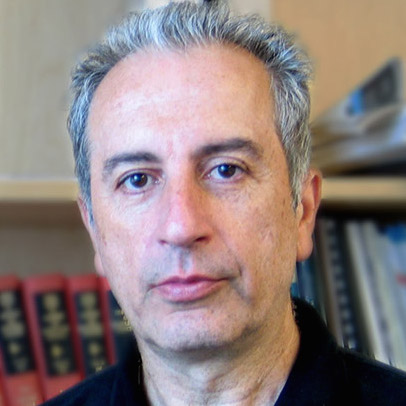
Simon Kasif, PhD Professor (BME, Bioinformatics, Computer Science)
Education M.S. & PhD, Computer Science, University of Maryland
B.Sc., Mathematics, Tel Aviv UniversityPrimary Appointment Professor, Department of Biomedical Engineering
Publications
Research Areas Prof. Kasif’s (2AI2BIO)* group (formerly Systems and Genomic Systems Biology/Medicine Lab) has been using advanced Artificial Intelligence and data science frameworks for modeling and analysis of metabolic and signaling networks and their dis-regulation in aging, diabetes, obesity, cancer and inflammation. His group also develops new machine learning and data integration methods and their applications in biomedical sciences and biotechnology generally.
Professor Simon Kasif is a co-founder of the Center for Advanced Genomic Technology (CAGT) with Charles DeLisi, co-founder of COMBREX: COMPUTATIONAL BRIDGES TO EXPERIMENTS PROJECT with Rich Roberts and Martin Steffen, and a member of the I2B2 Center (Informatics for Integrating Biology and Bedside). He was a participant in the Human Genome Consortium that produced the first public draft of the human genome. Since the early 1990’s he has been working on developing artificial intelligence ideas, frameworks, methods and algorithms in the context of biomedical science and engineering.
His contributions to computational biology include:
• The co-development of Glimmer, one of the most widely used AI based gene finders in the community (with Steven Salzberg and Art Delcher)
• Mummer, the first whole genome comparative alignment system (with Salzberg and Delcher)
• Early advocacy of the use of Bayesian probabilistic networks (AI graphical models) in computational biology (1992)
• Introduction of probabilistic functional linkage networks for gene function prediction (with Stan Letovsky)
• An early deployment of network signatures of disease (with Zak Kohane and Manway Liu) for diabetes as part of I2B2 activities
Most recently his research has been focused on transforming biological research using AI frameworks and AI safety in biological, medical and health sciences.
View all profiles