
Meet Gayatri Sundar Rajan, a MechE alumni and societal engineer working to close the gaps that keep underserved populations from accessing life-changing water and energy technologies. When she graduated from Boston University in 2022 she wanted to use engineering to address urgent global challenges. Today, she is a PhD researcher at the University of Oxford and the founder of a budding sustainability-focused startup, Apka Shakti.

Her research at Oxford focuses on technologies for sustainable development and growing industries, specifically systems that cogenerate water and cooling to accelerate energy access in off-grid contexts. But she sees her work as far broader than technical design. “There’s a communication gap and a digital technology gap,” she explained. “Engineering is a key part, but it’s not the only part. The real question is: how do we bring existing resources to the people who need them most?”
That question extends beyond academia, starting her company, Apka Shakti, a name derived from the Sanskrit phrase for “your energy”—which aims to translate emerging water and energy innovations into practical, community-ready tools. “We haven’t done a hard launch yet, but the company’s been around for about a year,” she said. “The goal is to connect technology to people in a meaningful, impactful way.”
Finding a Path at BU
Gayatri’s commitment to socially driven engineering emerged during her time at Boston University. What initially drew her to BU, was the openness of its engineering culture. “I liked that BU gave engineers their own spaces, but anyone could come in and build something,” she recalled, emphasizing the role of makerspaces like EPIC and the SILab. “That culture shaped how I saw myself as an engineer.”
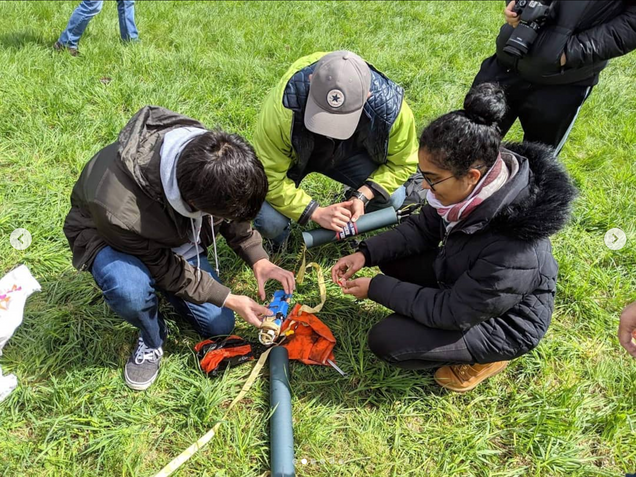
As a first-year student, Gayatri joined the Rocket Propulsion Group, providing an intense introduction to hands-on engineering. “It showed me what it means to take something from design to a physical system,” she said.
Later, her senior design project—a desiccant-based atmospheric water harvester—helped her break into the water-technology field she continues to work in today. “It all sounds linear, but it really wasn’t,” she laughed. “It was just trying things and asking, ‘Do I like this?’”
Gayatri’s first research experience came through BU’s Campus Climate Lab, where she worked under Professor Michael Gevelber on a project analyzing the electrification potential of the Charles River Campus. “It taught me what research really is,” she said. “You’re trying to answer questions no one has answered before. There’s no clear method, and you have to define the question yourself.” The process, she said, helped her develop intuition about what matters and what is “signal versus noise.”
In 2019, she joined a humanitarian engineering program run by what was then BU’s Institute for Forced Displacement. With a group of students, she traveled to Lebanon to work alongside the American University of Beirut and visit Syrian refugee camps. “It was the first time I saw how complex real-world challenges are—from public health to regulation to cultural communication,” she said. The experience shifted her interest away from aerospace toward water and sustainability. “I saw how language barriers—literal and disciplinary—can stop people from accessing resources. That was huge for me.”
Growing Into a Researcher
Transitioning from BU to Oxford, Gayatri said, was harder than she expected. “Undergrad is very much, ‘Here’s what you need to do—now do it.’ A PhD is the opposite. You have to define your own direction.” Moving countries and building a support network from scratch added difficulty.
But the challenge changed her approach. “I had to redefine what it means to succeed,” she explained. “It can’t be about outcomes. It has to be about the process—about doing good work. That mindset shift made everything much more sustainable.”
Now, she views her PhD not as a standalone step but as part of a lifelong mission. “This is just the current manifestation of what I want to do in the world,” she said. “After my PhD, I want to run the company fully, expand these projects, and ultimately focus on bringing water and energy access to people who’ve been forgotten—sometimes three times over.”
Advice for Students
Her advice to incoming engineering students is simple: experiment widely, and stop obsessing over grades. “Your A-plus won’t matter as much as something you tried really hard to learn,” she said. “Don’t box yourself in. Try things—even if they’re difficult at first.”
Looking Ahead
Ultimately, she sees her work taking her around the world—wherever water and energy access is limited and the need for innovation is pressing. “You want to give everybody a shot so they can choose,” Gayatri said. “Technology should enable that. That’s what drives me.”