

MISI’s leadership team: Chris Wells (from left), Eric Gordon, David Abel and Amy Geller Photo by Doug Levy
Putting Media to Work for the People
One year in, COM’s MISI center is fostering collaborative, creative and effective forms of communication
On a warm September afternoon, two dozen people filled a BU conference room. Journalists, researchers, nonprofit staffers, a photographer, a pastor and an environmental analysis and policy student sat with professors of mass communication, renaissance art, anthropology, film studies, religion and romance studies.
Attendees introduced themselves, shared details about their work and, as an icebreaker, chose a desired superpower. Someone wished for an empathy wand. Another wanted the power to extract evil. One after the other, people chose society-saving abilities, which was fitting, given the reason they’d all gathered for the first Center for Media Innovation & Social Impact (MISI) fellowship orientation.
COM announced MISI in early 2025 with a bold mission: to rebuild trust in science, democracy and community. “This center was born out of ambitions to help society unlock its potential through amazing communication,” says COM Dean Mariette DiChristina (’86). “Communication helps the world work, but if communication isn’t going well, then the world can’t move forward.”
Universities are places where we can explore possibilities and where we have safety to fail…. Many of the communications structures and systems that support our democracy are decomposing. This work is urgently needed.
—Eric Gordon
The college committed $2.25 million to fund the center over five years. Additional support will come from grants, including a three-year Mellon Foundation award that provides $487,000 to support environmental justice work grounded in the humanities.
MISI will support three groups of fellows for the 2025–2026 academic year: research, selected from COM faculty; humanities, selected from scholars across BU; and community impact, selected from beyond academia.
With the center’s support, the fellows have 10 months to bring their ideas to fruition. Yi Grace Ji, an assistant professor of mass communication, advertising and public relations, is looking for ways to use chatbots to fight loneliness among Boston-area senior citizens. Joanna Davidson, a College of Arts & Sciences associate professor of anthropology, wants to write about her work in the West African nation of Guinea-Bissau for a nonacademic audience. Mark Araujo, the community engagement manager at Boston Food Forest Coalition, wants to tell stories of the people using Boston’s network of green spaces planted with forageable foods and gardens. They represent three of the first 15 projects the center is supporting.
“Universities are places where we can explore possibilities and where we have safety to fail. Big business isn’t going to do this,” says Eric Gordon, MISI’s director and a professor of the practice of journalism. “Many of the communications structures and systems that support our democracy are decomposing. This work is urgently needed.”
Trying Something New
Before coming to BU in January 2025, Gordon was the founding director of the Engagement Lab at Emerson College. There, he helped to develop a collaborative method of storytelling that will be central to MISI’s work: Instead of telling stories about the communities most impacted by society’s greatest challenges, tell stories with them.

The Engagement Lab pioneered initiatives like Transforming Narratives of Gun Violence and Transforming Narratives for Environmental Justice, bringing community members, communicators and medical practitioners together to collaborate on impactful and sustainable projects. The products that emerged from the Engagement Lab included virtual reality experiences, games and documentary films. Gordon says that BU’s size and strengths—particularly in the humanities—will elevate this work further.
“We need to be experimenting,” says Gordon. “We need to be creating different kinds of tools that are in support of movements, in support of institutions, and in support of people who are trying to make a difference in the world.”
Helping Gordon build MISI is a leadership team of David Abel, associate director of creative works and a professor of the practice of journalism; Amy Geller (’16), associate director of impact and an assistant professor of film and television; and Chris Wells, associate director of research and a professor of emerging media studies. Kannan Thiruvengadam, who runs an urban farm in East Boston, brings an outside perspective, codirecting the community impact fellowships with Geller.
Impactful Projects
Gordon hopes that MISI can foster projects that blend core skills from COM’s traditional disciplines—journalism, filmmaking, mass communication—and find new ways to use them.
“It’s about applying those disciplines to social change efforts,” he says. “What if we took those skills and worked alongside people who are experiencing environmental injustices on a daily basis? Could we actually see some change in the world?”
One of Gordon’s first steps as MISI director was to begin building connections across the University; one year in, those efforts are paying off. The BU Center for the Humanities, in the College of Arts & Sciences, partnered with MISI on the humanities fellowship. BU Spark!, an experiential learning lab in the Faculty of Computing & Data Sciences, is supporting several projects. Each partnership creates more opportunities for MISI fellows to create something unique—and impactful.
Brooke Williams, one of MISI’s first research fellows, is an investigative journalist and associate professor of the practice of computational journalism. She wants to build a tool that will help the public track combined sewage overflows—the mixture of untreated wastewater and stormwater released into waterways by overwhelmed sewer systems across the US. Her idea is to use publicly available satellite images to measure the algae blooms that form in polluted water—but that’s a complicated technical challenge. “I’m not the expert in any of this,” Williams says. “I’m excited because we’re opening the door to this new space where we might find a way to address the impacts of climate change without being scientists.”
Michelle Amazeen, associate dean for research and another MISI research fellow, is creating an archive of native advertising—sponsored content that can be mistaken for journalism—to show how it helps the fossil fuel industry burnish its reputation. Amazeen is an expert in misinformation, but building a public-facing communication tool is outside her comfort zone. “Eric’s good at building things,” she says of Gordon. “I’m not a computational scientist. So for computer science and data science, I don’t have the right language to articulate exactly what I need. He does—he’s my connector.
Communication with a Twist
MISI’s three groups of fellows kicked off their work with the center at the September orientation, but the center’s official public launch came in November 2025 with the Communicating Climate summit.
Panels featured communicators, policy experts and scholars in conversation about issues ranging from misinformation to artificial intelligence. True to form, MISI’s summit also included a twist: The middle of the day was devoted to a workshop called Circus for Communicating Risk. Pedro Mello e Cruz, a circus acrobat and an educator, guided participants through a series of exercises intended to reveal how individuals and groups react to risk and how people can collaborate better while solving problems.
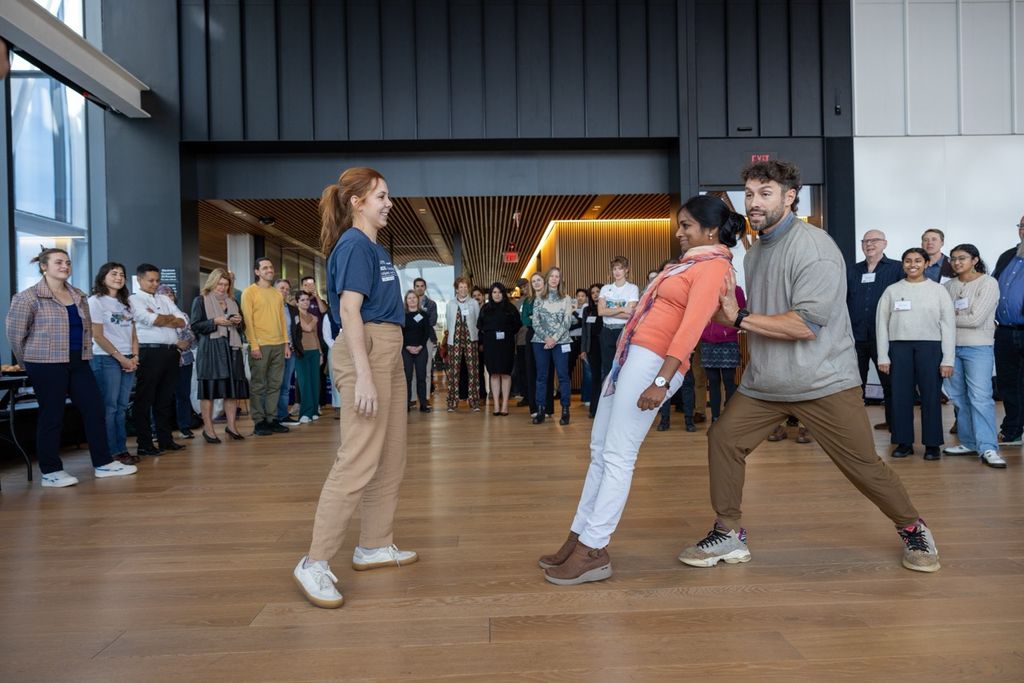
“To be able to embody the feeling of risk is a great way to start identifying appropriate policies and communication tactics,” Gordon says. He borrowed the idea from a friend who had arranged similar workshops for officials at the World Bank and the United Nations.
The inaugural summit featured smart people searching for solutions in creative ways—a microcosm of the center itself.


