Papers & Publications
Moving Forward Together: Ecumenical Meeting

From 26 to 28 March 2019, the University of Notre Dame (Indiana, USA) hosted representatives of the five Christian world communions formally associated with the Joint Declaration on the Doctrine of Justification (JDDJ) to discuss implications of that landmark agreement in the context of growing closeness and collaboration between them. Church leaders came from the Roman Catholic Church, the Lutheran World Federation, the World Methodist Council, the World Communion of Reformed Churches, and the Anglican Communion.
The meeting opened with an ecumenical evening prayer service led by local clergy and members of the Notre Dame community. The event concluded with a public panel entitled “From Conflict to Communion: The Future of Christians Together in the World.”
Participants at the consultation recognized the urgency of presenting afresh the core message of the JDDJ that “by grace alone, in faith in Christ’s saving work and not because of any merit on our part, we are accepted by God and receive the Holy Spirit, who renews our hearts while equipping and calling us to good works.” They stressed the relevance of this gospel message for our conflicted and wounded world.
The representatives discerned further steps on the journey toward deeper ecclesial communion and a more visible common witness. Challenged with showing the deeper bonds that have been developing over the past two decades, the group welcomed the 2016 “Lund Imperative” to act always from the perspective of unity rather than from the point of view of division. The participants also affirmed the method of differentiating consensus that allows for agreement on common convictions while maintaining different confessional expressions.
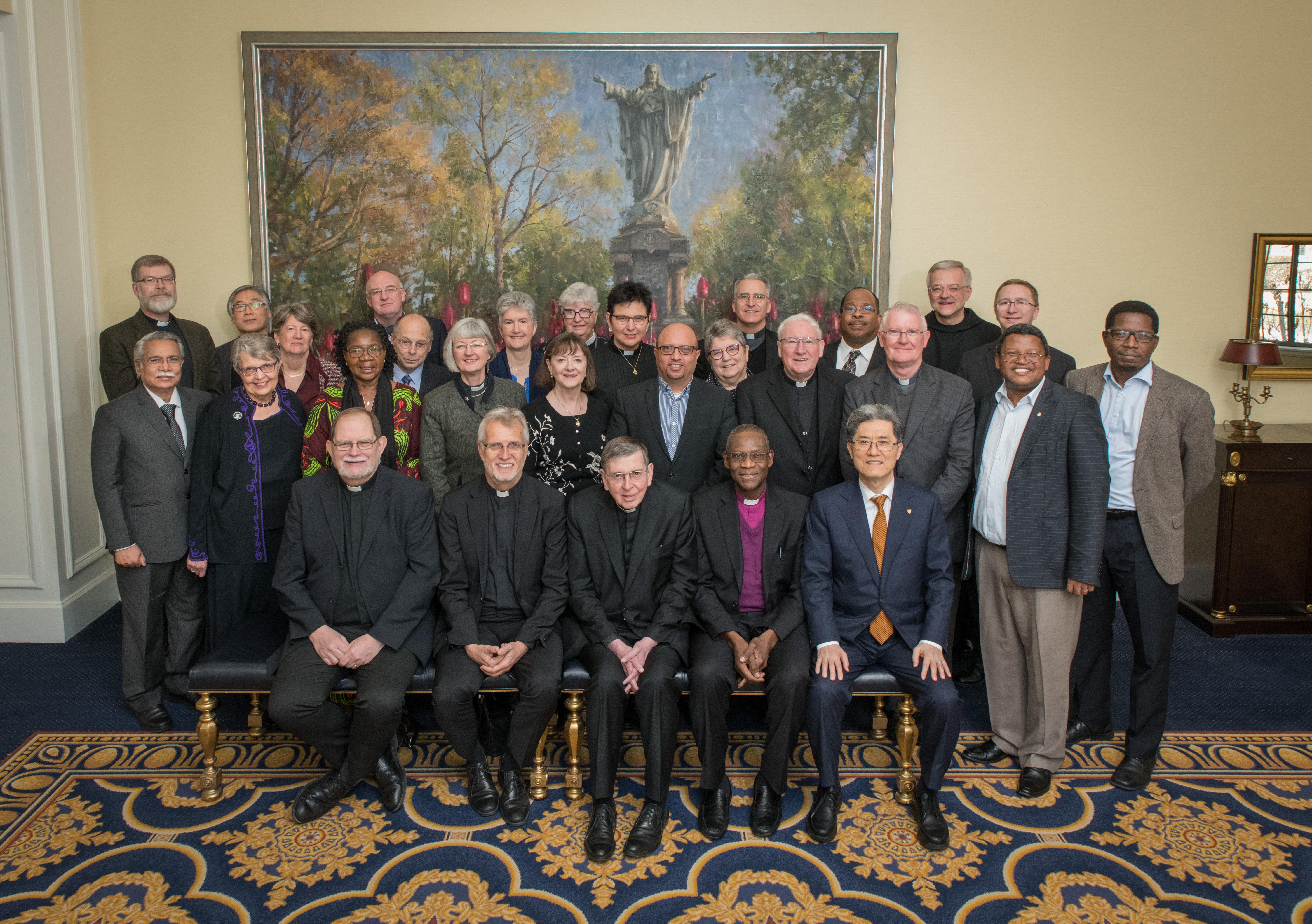
The purpose of the meeting was not to achieve theological breakthroughs, yet participants were able to discuss key issues of mutual recognition of ministry, highlighting ways of strengthening cooperation in pastoral ministry and social outreach. The group discussed the need for strategies to address the connection between justification and justice, and proposed the production of a range of common resources such as catechetical tools. Together participants encouraged the strengthening of the common bond of baptism in ways appropriate to local contexts.
The participants recognized the need to apply the 1952 Lund Principle, which calls them to act together in all things except when significant differences of conviction compel them to act separately. To continue the conversation, the participants decided to set up a steering committee to carry forward their ongoing work.
The members of the Consultation expressed gratitude for the generous hospitality shown by the University of Notre Dame which enabled them to move forward together on their journey. It was their prayer that the Holy Spirit bring to completion what God has begun.
Joining the Choir
 Nicolette Manglos-Weber's new book, Joining the Choir: Religious Membership and Social Trust Among Transnational Christians was published by Oxford University Press, and recently reviewed by the American Academy of Religion's Reading Religion.
New Book
 Nimi Wariboko, the Walter G. Muelder Professor of Social Ethics, has recently published a new volume: Ethics and Society in Nigeria: Identity, History, Political Theory. This pathbreaking book constructs a socio-ethical identity of Nigeria that can advance its political development. Its method is based on the rediscovery of the practices and principles of emancipatory politics and a retrieval of fundamental virtues and capabilities that go to the core of the functioning of pluralistic communities. Ethics and Society in Nigeria: Identity, History, Political Theory critically engages history, myth, political philosophy, and religion to demonstrate that Nigeria has an unfolding historic identity that can serve as a resource for sustaining increasing levels of human flourishing and democratic republicanism.
Located at the intersection of history and political theory, this work identifies the nature of Nigeria's moral problem, forges the political-theoretic discursive framework for a robust analysis of the problem, and shows a pathway out of the nation's predicament. This three-pronged approach is founded on the retrieval of moral exemplars from the past and critical engagement with history as a social practice, philosophical concept, discipline of study, form of social imaginary, and witness of the flows of contemporary events. Using this methodology, author Nimi Wariboko analyzes various forms of political, religious, and revolutionary identities that have been put forth by different groups in the country and then examines their usefulness for the transformation of Nigeria's problematic socio-ethical identity.
Aspiring to Be an Three-Mile-an-Hour People
"Aspiring to Be a Three-Mile-an-Hour People," is the latest article from Visiting Researcher Jon Bonk. It recently appeared ion Vision: A Journal for Church and Theology.
In Praise of Greatness: Nimi Wariboko and Africa’s Leading Public Intellectuals
 Nimi Wariboko is featured in a new book on Africa’s leading public intellectuals and living legends. The book, In Praise of Greatness, by the famous historian Professor Toyin Falola of the University of Texas chronicles the life and scholarship of Africans who have made substantive contributions to knowledge. Wariboko is cited as one of Africa's intellectual pioneers.
The back cover explains: In Praise of Greatness, employing poems and prose, pays homage to those African scholars, artists, and public intellectuals who have been exemplary in developing significant ideas and institutional legacies with far-reaching political, social, and cultural impact. Here are remarkable lives of dedicated service that have transformed society, extended the frontiers of knowledge, preserved values, and offered unique perspectives that replace universalism with pluriversalism. In twenty-two chapters that deploy dynamic poetics, distinct cultural tools, and rich traditions, the book presents multiple global-local biographies of preeminent scholars, living legends, and intellectual giants of Africa and its diaspora. Through individual stories, cumulative analyses demonstrate the existence and elaboration of an ontological and epistemic infrastructure that embodies the powerful paradigms that are essential to attaining progress, promoting ethical scholarship, and presenting distinguished Africans to the outside world. The book argues for the maintenance of strong academic traditions and new social thinking beyond patriarchy, as well as more serious attention to poetic and artistic creativity in surviving, navigating, and transforming the varying forces of modernity and globalization with meticulous and sustained attention to local needs and contexts. In Praise of Greatness advances the agenda of nation building by showcasing the formidable works and enduring genius of prominent individuals who have discovered pathways to optimal outcomes for themselves and others through myriad heroic efforts and honorable relationships of generosity and trust. In Praise of Greatness seeks to inspire intellectual productivity in an emergent generation of scholars; to provide a unique lens for interpreting the past and present; and to promote a collective narrative around African development.
Nimi Wariboko is the Walter G. Muelder Professor of Social Ethics at the Boston University School of Theology and a Faculty Associate of the Center for Global Christianity and Mission.
Bartolomé de las Casas
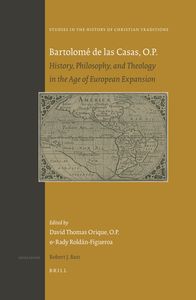 For scholars of world Christianity, Bartolomé de las Casas is a fascinating figure. A missionary to the New World, he struggled to express a theology that could address the extraordinary conditions that colonial expansion and colonization created. In Bartolome de las Casas, O.P.: History, Philosophy, and Theology in the Age of European Expansion, prominent scholars from such disciplines as history, Latin American studies, literary criticism, philosophy, and theology come together to think about the man and his message. The volume was edited by David T. Orique, O.P. (Providence College) and Rady Roldán-Figueroa (Boston University), who also co-wrote the introduction and have chapters of their own in the volume.
Pedagogical Dilemmas in the Global Church
After publishing an article about power and privilege in relation to colonial subsidies and the education of missionary children in the Belgian Congo, Anicka Fast received feedback from people around the world. Their comments spurred her to explain her larger project, and the aims of her research. She also reflects on the complexity of writing history and getting it 'right.' Published in Anabaptist Witness, her reflections on the task and challenge of writing mission history are rich food for thought.
Ambivalent about Mission?
The Council of International Anabaptist Ministries held a symposium on "The mission of God and global partnerships." Anicka Fast shared ideas about "Reclaiming Mission," for those ambivalent about the very idea.
Anabaptists in Nigeria
In 1958 a group of congregations in southeastern Nigeria solicited affiliation with the North American Mennonite Board of Missions (MBM), declared themselves Mennonite, and sought missionaries and assistance. MBM responded by sending missionaries and by providing assistance to Mennonite Church Nigeria (MCN) and others in the region. The collaboration between MCN and MBM developed during a period when partnership was becoming a primary paradigm in the Protestant missionary movement as well as in the Anabaptist tradition.
In his recent article, R. Bruce Yoder ('16) highlights five themes in the missiological discourse about partnership during the last half of the twentieth century and uses those themes to explicate aspects of the engagement between MCN and MBM during the same period. The themes are (1) collaboration, (2) context, (3) reconfiguration of mission structures, (4) bilateral and multilateral approaches, and (5) ambiguity. The first section examines partnership in the Protestant mission movement. The second shows that these themes also arise in Anabaptist mission discourse. The third section presents the case of Mennonite Church Nigeria and Mennonite Board of Missions, showing the partnership paradigm to be a compelling missionary vision while clarifying challenges that may require consideration of additional mission models.
Lay and Ecclesiastical Travelers from Europe to China in the Long 18th Century
 In Illusion and Disillusionment: Travel Writing in the Modern Age, Eugenio Menegon opens the edited volume with a chapter on "Desire, Truth, and Propaganda: Lay and Ecclesiastical Travelers from Europe to China in the Long Eighteenth Century." The introduction explains: "The letters written by this early modern eighteenth century traveler, the Italian Serafino da San Giovanni Battista (1692-1742) provide a stark contrast to the other travelers and essays in the collection, offering a good starting point for our discussion. Penned as utilitarian documents, these letters were not meant for printed public consumption. The correspondence does not offer lengthy reflections on cultural difference, or the meaning of Serafino's voyage. However, the letters do include reports on the logistics of travel, and relate the difficulties of early modern travel, just before the onset of modernity in travel writing. The focus on the material reality in Menegon's essay diverges from the literary representations of voyages included in the rest of the volume, but is also linked to them in its exploration of illusion and disillusionment in missionary travel and activities."