News of the extended network of faculty, alumni, students, visiting researchers, and mission partners is regularly updated, and some of the big ideas or major events in Global Christianity are covered in the CGCM News.
World vs. Global; Christianity vs. Christianities
 In a recent interview with Aaron Hollander of the Graymoor Ecumenical & Interreligious Institute, Dana Robert unpacked what is behind some of the most loaded but under discussed terms in the study of World Christianity. The result is an excellent primer in the field. It is available in the June 2019 edition of Ecumenical Trends, or available for download below.
Mission and Unity
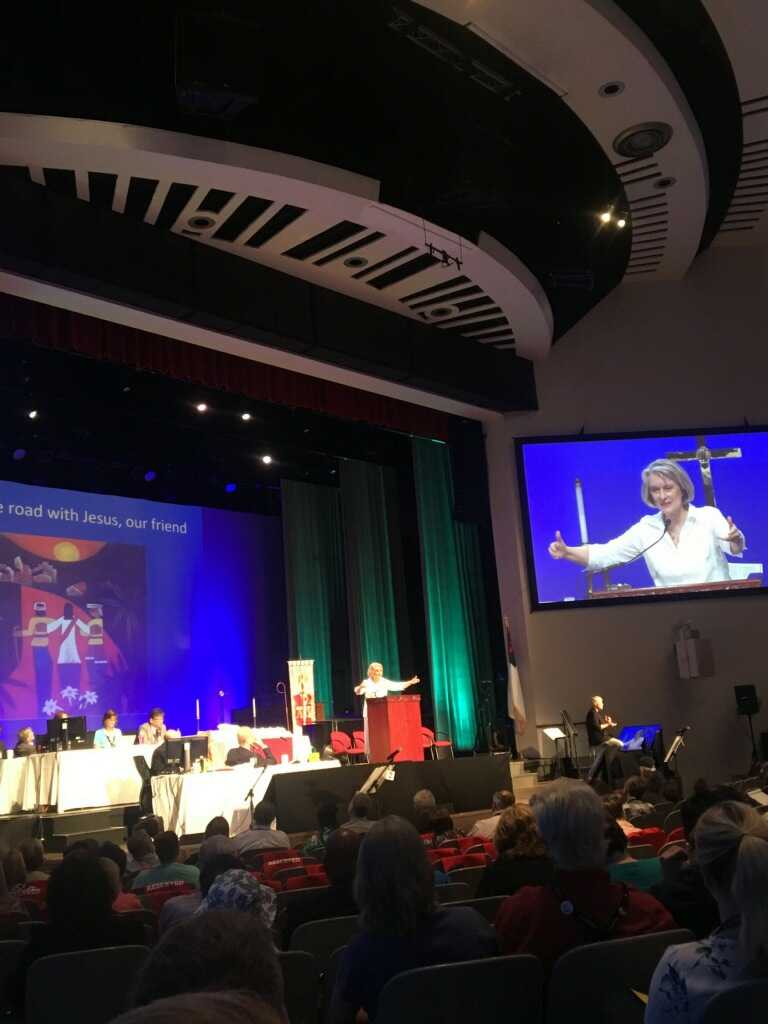 At the Florida Annual Conference in June 2019, Dana Robert spoke to the delegates and mission and unity built on the foundation of friendship. “These days, the ‘together’ part of mission might be the toughest part of the mission we face,” she noted. Yet, maybe for that reason, friendship is a powerful witness. It creates a community, and a community leads to sharing the good news of Jesus, serving God and your neighbor, setting the oppressed free, and making people whole.
OMSC and Princeton Seminary Create New Partnership
PRINCETON SEMINARY AND OVERSEAS MINISTRIES STUDY CENTER FORGE PARTNERSHIP
The two institutions mark their new alliance at MOU signing ceremony June 5

NEW HAVEN, Conn., June 5, 2019– President M. Craig Barnes of Princeton Theological Seminary and Executive Director Thomas J. Hastings of the Overseas Ministries Study Center (OMSC), a renowned research institute for world Christianity and gathering place for global Christian leaders, signed a Memorandum of Understanding (MOU) today in New Haven, Connecticut. The MOU provides for OMSC to relocate its operations and programs to the Seminary beginning in summer 2020. After a two-year transitional period, OMSC will become an official program of Princeton Seminary.
“Princeton Seminary is deeply grateful to welcome the Overseas Ministries Study Center to our campus community. OMSC has an outstanding reputation for serving scholars and church leaders from around the world through its exceptional programs. The center’s residents and programs will enrich our community and deepen our students’ understanding of world Christianity,” says Barnes. “OMSC will complement the Seminary’s vibrant academic program in world Christianity, led by Professors Afe Adogame, Raimundo Barreto, and Richard Fox Young. Their enthusiasm and strong support were instrumental in bringing OMSC to Princeton.”
Under the MOU, OMSC will continue to run its signature four-fold ministry, including its residential community of global leaders, research scholars, and artists; International Bulletin of Mission Research; study program; and Artist in Residence Program. Also, OMSC’s Asian Christian art collection will be displayed on campus.
The new alliance between the organizations will provide opportunities for OMSC scholars as well, including the ability to audit select classes; access campus resources like the more than one million books and microforms that are housed at the Seminary’s world-class library; and fully engage in campus life including participating in daily worship services, attending lectures, accessing student services, and partaking in the many community events.
“With its passion for shaping Christian leaders for ministry around the world and vision for covenant community, we cannot imagine a more appropriate new home for OMSC than Princeton Theological Seminary,” says Hastings. “As OMSC prepares to celebrate our centenary in 2022, we are confident that we will continue to thrive at Princeton Seminary as a unique ecumenical center for sustained two-way traffic and koinoniaamong global church leaders, cross-cultural missionaries, research scholars, and artists.”
About Princeton Theological Seminary
Princeton Theological Seminary, founded in 1812, is the first seminary established by the General Assembly of the Presbyterian Church. Its mission is to educate leaders for the church of Jesus Christ worldwide. Its students and more than 11,000 graduates from all 50 states and many nations around the world serve Christ in churches, schools and universities, healthcare institutions, nonprofit agencies, initiatives for social justice, mission agencies, and the emerging ministries of the church in the 21stcentury.
About Overseas Ministries Study Center
OMSC was founded in 1922 as the Houses of Fellowship in Ventnor-by-the-Sea, New Jersey, as a place for North American Protestant missionaries on furlough to recover their health, and to have their spirits lifted through fellowship, before returning to their mission fields abroad. Recognizing the need for serious academic research on mission and on the dramatically changing face of world Christianity, the predecessor of the International Bulletin of Mission Research, called the Occasional Bulletin from Missionary Research Library, was begun in 1950. In 1967, the name was changed to Overseas Ministries Study Center, and a study program was inaugurated with seminars focusing on issues related to the many ways the world’s churches participate in God’s mission. Beginning in the 1970s, OMSC hosted annual gatherings of mission leaders from historic Protestant denominations, Roman Catholic orders, and evangelical agencies. OMSC moved to New Haven in 1987, where its reputation as a unique ecumenical hub for global missional engagement and research has continued to grow. In recent years, OMSC’s program residents have come almost exclusively from the majority world’s churches in Africa, Asia, and Latin America.
Promotion
 Kendal Mobley ('04) was recently promoted to Associate Professor of Religion and the Spiritual Life Center Coordinator at Johnson C. Smith University in Charlotte, NC.
Message from the Director
The Passing of a Generation
The past six months have seen the deaths of several major figures in the fields of mission studies and World Christianity. It is important to offer gratitude for their lives and leadership. Their work has influenced many of us connected with the Center for Global Christianity and Mission.
Ed Schroeder, one of the leading Lutheran missiologists of his generation, died March 1, 2019. Ed was unfailingly cheerful and was a voice of moderation in the American Society of Missiology. He was a founder of Seminex and strong supporter of the Crossings Community. In December of 2018, Norwegian Lutheran missiologist Knud Jorgensen passed away from leukemia. From 1998-2009 he was Director of the Scandinavian mission foundation Areopagos and 2008-2010 dean of Tao Fong Shan in Hong Kong. As co-chair of the Edinburgh 2010 study process, Knud edited dozens of books and papers that proceeded from the networked missiological conversation following that historic meeting.
January saw the death of Prof. Lamin Sanneh of Yale University, one of the founders of the field of world Christianity. Prof. Sanneh was an Executive Committee member of the Dictionary of African Christian Biography and founder of the Yale-Edinburgh Conferences, in which Boston University students and faculty regularly participate. Our current issue of the Journal of African Christian Biography is devoted to his memory https://dacb.org/news/journal/.
This month the death of Prof. Dan Bays of the University of Kansas and Calvin College occurred. I first met Dan around 1990. We were part of a small network that began charting a path forward for what by the year 2000 would be called the field of World Christianity. Dan played a key role in gathering scholars of the old Christian college archives in China, and bringing together Chinese and western scholars of Chinese Christianity. With his irenic and modest personality, and superb scholarship, Dan broke new ground in the study of Chinese independent evangelicalism, and Chinese Christianity in general. We served together on the Research Enablement Program committee, that during the 1990s distributed 110 grants to individual scholars for research on Christianity worldwide. Every year we met in Nashville with a new group of scholars for inter-disciplinary seminars that built momentum toward a collaborative scholarly consciousness, now called World Christianity. I have kept the photo of our committee on my desk since it was taken in 1995.

From left to right, top row, are Geoff Little (staff person); the late David Kerr, Islamicist and expert on Christianity in the Middle East; the late Paul Hiebert, leading mission anthropologist; Bob Frykenberg, Historian of India; and the late Dan Bays, Historian of China. Bottom row shows Dana Robert, mission historian; John Pobee, Ghanaian ecumenical theologian; Gerald Anderson, Director of Overseas Ministries Study Center and Boston University alum; the late José Miguez-Bonino, Argentinian ecumenical theologian; and Mary Motte, FMM, Catholic missiologist.
May the saints who have gone before us rest in peace. I give thanks for their lives, their scholarship, and their witness.
Dana Robert, Director
Global Christianities: Perspectives, Methods, and Challenges
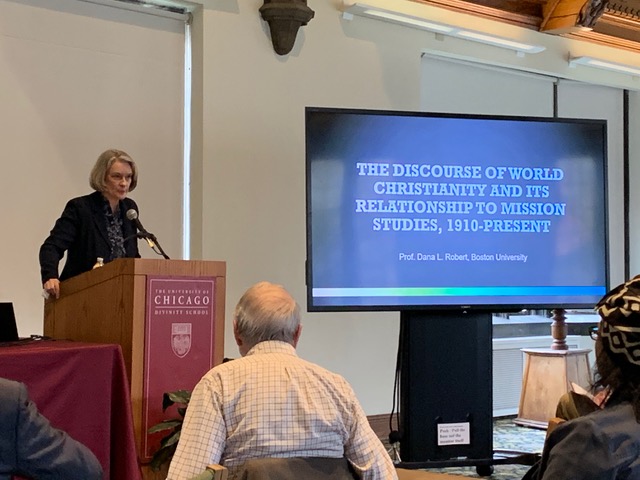 The University of Chicago hosted its second conference on Global Christianities on May 2, 2019. Dana L. Robert delivered the keynote address, "Mission Studies and Global Christianity." The conference attracted scholars and students from many institutions, as other topics included "The Study of Global Christianity from a Post-Colonial Perspective," and "Challenges, Concepts, and Prospects" for World Christianity.
Chinese Christian Art and Literature
 The Center on Religion and Chinese Society at Purdue University convened artists and scholars to discuss Chinese Christianity and art. Among those gathered was Associate Director, Daryl Ireland, who spoke about "The Cross in Popular Chinese Christianity." Ireland explored the meaning of the cross in Protestant Chinese Christianity in the first half of the twentieth century through its use in propaganda posters.
The 2019 Im Conference of Korean Christianity
Colonialists, Missionaries, and Nationalist in Korea and Beyond
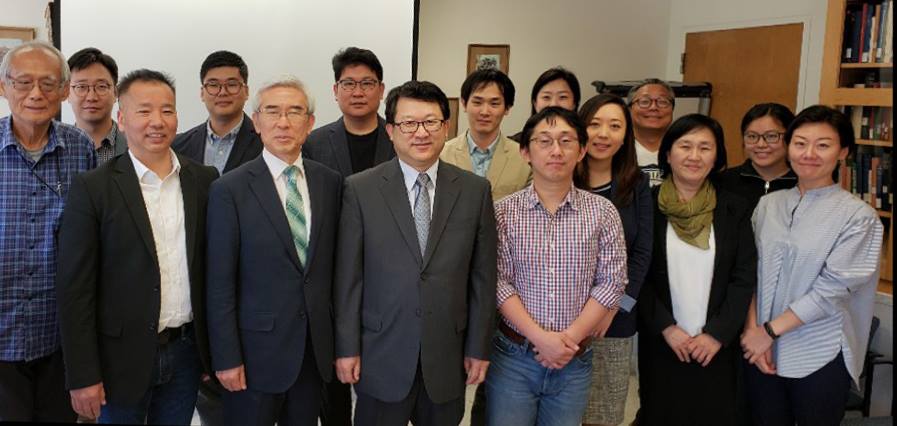
The University of California Los Angeles held a conference for scholars in all Korea-related and world-Christianity fields, so they could present their researches on Korean Christianity, especially on the topics related to (1) Christianity in North(ern) Korea (2) Colonialism and Christianity, 1910-1945, and (3) Christianity, Nation Building, and US-Korea Relations, 1945-1965. Among those gathered were three scholars who passed through the CGCM. The host of the event, Dr. Sung Deuk-Oak, Dr. Yeonseung Lee, and Dr. Soojin Chung.
Costas Consultation
 On April 5th, the Boston Theological Institute held its annual Costas Consultation on International Mission and Ecumenism. This year, the event was held at the Boston College School of Theology and Ministry, and the theme was World Christianity and the Arts. Talks included "Icons and World Christianity," by Fr. Maximos Costas of Holy Cross Greek Orthodox School of Theology, "Chinese Christian Poster Art," by Daryl Ireland of Boston University School of Theology, "World Christianity and Architecture," by Karla Britton of Dine College, and "Ethnodoxology," by James Krabill.
Four students were also awarded certificates and prize money for outstanding essays in World Christianity and Mission.
Interpreting Campaign Posters
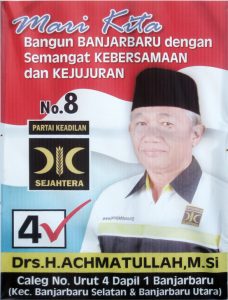


Riding around on the back of a motorcycle in 2009, Assistant Professor of International Relations at the Frederick S. Pardee School of Global Studies Jeremy Menchik snapped photos of hundreds of Indonesian campaign posters. That number has now grown to over 10,000 images, which Menchik and his co-author Colm Fox have painstakingly coded and analyzed to better understand the politics of identity in Indonesia.
Election poster campaigns are the most prominent form of campaign advertising in Indonesian elections. These posters are usually large, colorful, featuring a large image of a candidate dressed in a suit, Islamic, or indigenous clothing, and packed with emotive messages, symbols, and images. Posters can also have an impact. Election posters affect voting behavior by raising name recognition, signaling competitiveness, and increasing participation.
In a recent paper presented at the International Studies Association, Menchik and Fox undertook quantitative content analysis from election posters of over 750 Indonesian candidates from Islamic political parties in order to map the conditions under which they make moderate or immoderate appeals. Explaining why Islamic parties moderate is important for understanding the conditions that drive radical movements to moderate rather than undermine democratic institutions.
They find that party ideology, demographics, urban/rural differences, and level of government drive candidate behavior. This finding demonstrates the conditions that drive moderation and immoderation, and suggests a new data source and new opportunities for studying the conditions under which anti-system parties will challenge democratic values or help to make democracy work.