News of the extended network of faculty, alumni, students, visiting researchers, and mission partners is regularly updated, and some of the big ideas or major events in Global Christianity are covered in the CGCM News.
Call for Proposals: China, Christianity, and the Dialogue of Civilizations
The US-China Catholic Association will host a conference on “China, Christianity, and the Dialogue of Civilizations” to take place March 13-15, 2020 on the campus of Santa Clara University. This conference will examine efforts to locate engagement between Christianity and Chinese civilization in the context of shared values and the common good. See conference homepage for more information: www.uscatholicchina.org/conference-2020.
Conference organizers seek proposals for panels from potential panel conveners. Panels will address a given topic from several mutually illuminating perspectives, taking into account Catholic and other Christian experience. Panels that have already been proposed include:
- The Sino-Vatican accord in historical and comparative perspective
- Sinisization of religion: Meaning and application
- Youth culture and contemporary society
- Environmental issues, faith communities and the common good
Panel conveners can simply invite contributors and moderate the resulting session, or they can also present, in which case the USCCA would work with the convener as needed to arrange for a session moderator.
A note about this particular conference model: Attendees will include both academics and people involved in various faith communities. The goal is to make the insights of the academic community and the perspectives of its various disciplines available to the larger, informed public.
Panels will also form the basis of “state of the question” chapters in an edited volume. These chapters need not recap the sessions in question, but rather, taking into account the proceedings of the conference, they will provide an intelligent commentary on the issues raised, again, for the larger, informed public.
Panel conveners will have right of first refusal for the chapter related to their panel. Publisher and parameters will be finalized in consultation with potential contributors.
To propose a panel session, send an email to USCCA.Conference@gmail.com with:
- Working title
- Panel description (200 words or so)
- Possible contributors (optional)
Soft deadline for submission: September 20, 2019.
For inquiries contact:
Anthony Clark, Professor of Chinese History, Whitworth University
AClark@Whitworth.edu
Stephanie Wong, Assistant Professor of Theology, Valparaiso University
Stephanie.Wong@Valpo.edu
Michael Agliardo, SJ, Research Scholar, Santa Clara University and
Executive Director, US-China Catholic Association
MAgliardo@SCU.edu
Yale-Edinburgh 2020: Oral, Print, and Digital Cultures in World Christianity and the History of Mission
Studies in world Christianity and the history of mission have not been afraid to engage the topic of culture. However, they have mostly referred to the encounters of Western Christian cultures with another, whether that be Confucian and Hindu culture, or the indigenous cultures of the Americas, Africa, and Oceania. This year's theme uses the language of culture to speak about three different mediums in which the Christian message is communicated and the Christian life is practiced. These cultures have developed somewhat chronologically, but they also simultaneously coexist in the contemporary world.
Oral culture is a vivid dimension of Christian expression, from the psalms of David to the sermons of Jesus and the prayers of the saints. Methodist missionaries, following the legacy of the Wesley brothers, readily preached and sang their faith. Christian hymnody has found local expression, be it in African American spirituals or ghazals and bhajans in India. Prophecy and glossolalia are often regarded by Pentecostals and charismatics as indicators of the faith. Christ's passion has been recalled in the Philippines through the indigenized form of the pasyón epic, whereas apparitions of the Virgin in Guadalupe and La Vang and of Saint George in Palestine have been vehicles to narrate the faith.
Print culture has also been an important medium for Christianity. Missionaries used print to propagate their message with vernacular Bibles and hymnbooks, catechisms and apologetic tracts. The widespread translation and dissemination of The Pilgrim's Progress has globalized seventeenth-century Puritan Christianity and provided a narrative for expressing local virtues. The Western printing press, introduced by missionaries to Shanghai, helped transform the treaty port into a major hub of print capitalism. Christian magazines and lantern slides were used to convey images of distant peoples to sending churches and mobilize publics against slavery and opium, whereas vernacular novels, short stories, and periodicals have contributed to the formation of independent nation-states and to unify diasporic populations.
As we have entered the digital age, the growing digital culture has opened up new vistas for world Christianity and the history of mission. New methods have been created to engage our subject, from the digitization of archives to the visualization of missionary populations on maps alongside centers of political and religious power. Digital technologies have opened up new possibilities for mission across borders, Christian public engagement over social media, and connecting Christian migrants around the globe. Yet Christian online activities have also been curtailed by forms of state censorship such as the Great Firewall of China. Digital media also exposes hierarchies of resourcing, showing which Christian communities have access to the technological infrastructure for a vibrant online presence and which communities are marginalized by their poverty or lack of expertise.
Oral, print, and digital cultures may transcend societies, but they find unique expressions throughout world Christianity and the history of mission. We anticipate our conference will open up a lively interdisciplinary conversation among historians, theologians, and social scientists studying religion, as well as to include scholars of other disciplines, such as media studies and digital humanities.
A statement on the theme, written by our conveners, is available at the Yale-Edinburgh Group website through the link below:
http://divinity-adhoc.library.yale.edu/Yale-Edinburgh/2020theme.htm
A Call for Papers will be announced to the list and made available on the website in January 2020.
Please direct any questions about the theme essay or the 2020 meeting to Dr. Emma Wild-Wood (emma.wildwood@ed.ac.uk) and Dr. Alexander Chow (alexander.chow@ed.ac.uk).
Call for Papers: Translation, Literature, and Publishing in Chinese Christianities
Co-organised by the History Research Centre (Manchester Metropolitan University) and the Centre for Sino-Christian Studies (Hong Kong Baptist University)
An international conference on translation, literature, and publishing in Chinese Christianities will be held at Manchester Metropolitan University on 18 and 19 June 2020. Scholars are invited to submit abstracts for papers exploring one or more of the conference themes.
Conference Themes
The history of Chinese Christianities is inseparable from the work of missionaries and Chinese Christians in producing and disseminating Chinese Christian texts. The religious ideas that inspired the Taiping Rebellion, for example, were rooted in Hong Xiuquan’s reading of a Chinese Bible and Liang Fa’s Good Words to Admonish the Age. While older historical works tended to stress the agency and work of foreign missionaries, more recent scholarship has brought to light the role played by Chinese individuals in the interrelated processes of translation and localisation.
Building on this foundation, the conference aims to explore the contributions of both foreign and Chinese Christians to the translation of Christian texts into the Chinese language and the creation of Chinese Christian literature. The conference also aims to explore the impact of printing technologies on the spread of Christianity among the Chinese and the ways in which Christian publishing stimulated technological innovation in Chinese printing. The conference will focus on the period from Robert Morrison’s arrival in China (1807) to the present. The organisers will, however, also consider papers that look at translation, literature, and publishing during earlier periods in the history of Chinese Christianities.
Theoretically, the conference is rooted in a fundamental acknowledgement that Christianity is constantly transforming itself through its interactions with different languages and cultures around the world. This process of transformation has turned Christianity into a globally local religion and has contributed to the emergence of many diverse forms of Christianity in China and the Chinese-speaking world. Rather than looking at an abstract, singular Christianity in China, the conference seeks to explore translation, literature, and publishing in multiple Chinese Christianities.
Please send your paper title and a 200-word abstract to c.kilcourse@mmu.ac.uk by 30 September 2019.
Contact Information
Dr Carl Kilcourse, Senior Lecturer in East Asian History, Manchester Metropolitan University, c.kilcourse@mmu.ac.uk
Dr George Kam Wah Mak, Assistant Professor of Religion and Philosophy, Hong Kong Baptist University, ggkwmak@hkbu.edu.hk
Call for Papers: Pentecostal Strategies of Public Engagement
11th GloPent ConferenceBasel, February 14-15, 2020
The eleventh international and interdisciplinary conference of the European Research Network on Global Pentecostalism (GloPent.net) will be held on 14–15 February 2020 at the University of Basel, Switzerland.
Conference Theme: Pentecostal Strategies of Public Engagement
Convenor / contact: Andreas Heuser (andreas.heuser@unibas.ch)
Call for Papers
The growing evidence of Pentecostal public engagement has attracted academic attention, espe- cially, but not exclusively in arenas of the Global South. Recent explorations of the global ‘Charis - matic city’, the notion of an African ‘Pentecostal republic’, or assertions about ‘property Christianity’ in China point to peculiar Pentecostal taxonomies in the public realm. Pentecostal politics of public prayer, ‘spiritual warfare’ or ‘crusades’ seek to transform religious landscapes, while ‘Dominionist’ theologies claim to transcend narrow Pentecostal interests in order to ad- vocate the common good. Megachurches establish networks to access political, economic and cultural elites. Prosperity theologies also target social transformations and partly enable struc- tural innovations in economic life. The Pentecostal media revolution with its constitutive ele- ments of religious broadcasting and publishing interferes in local public discourses; professionalized e-church performances disseminate transcultural strategies to impact a given political culture. Whether Pentecostal migrant communities in the Global North are pursuing a strategic ‘reverse mission’ to ‘conquer secular nations for Christ’ remains open to debate.
Thus, Pentecostalism entails a variety of modes, forms and patterns of public mobilization or a religious mobilisation of public realms, which are the theme of this conference. Our keynote speakers will address a diversity of public strategies in the Global South: Heinrich Schäfer (Uni- versity of Bielefeld) will discuss Pentecostal political agendas in Latin America; Ilana van Wyk (University of Stellenbosch) focuses on Pentecostal public strategies in Southern Africa; and Nanlai Cao (Renmin University, Beijing) will address Pentecostal patterns of public engagement in China and within the Chinese diaspora.
This call for papers invites contributions to our parallel panels. We are particularly interested in presentations that study concepts, strategies and agendas of how Pentecostals shape public spheres. Papers may present case studies or comparative analyses of Pentecostal strategies of public engagement. What are peculiar issues, themes, and areas of Pentecostal public engage- ment? How do Pentecostal communication, network and support structures look like in specific contexts? Last but not least: what are the limits of Pentecostal theo-political imaginations, and who are opponents of Pentecostal strategies to direct and redirect of public opinion making?
Proposals for entire panels or individual papers from current research on a different aspect of Pentecostal Christianity are also welcome, but we advise to contact the conference organiser be- fore submitting your abstract.
Submission deadline for abstracts: 30th September 2019 (300 words max/send to Anna Kühleis: anna.kuehleis@unibas.ch)
For further information, see
Call for Submissions: Religious Conversion in Africa
Special Issue Information
Dear Colleagues,
This is a call for essays for a special issue of the peer-reviewed international journal Religions on the topic of religious conversion in Africa. Over the past decade, scholarly attention has focused on the “explosive” expansion of Pentecostalism across the African continent and its narrative of discontinuity with the pre-Pentecostal lives of Pentecostal adherents. This sophisticated research has demonstrated how the emic prioritization of rupture within the Pentecostal discourse of conversion was predicated on a desire to overcome the dysfunction and insecurity of life in neoliberal Africa.
The predominance of Pentecostal Christian practices and discourses within this literature has shaped recent investigations into conversion in three ways:
First, it has marginalized concurrent processes of religious change in Africa that do not necessarily conform to a discourse of rupture. These include, for example, the expansion of East Asian religions (e.g., Hinduism), the growth of new expressions of Christianity (e.g., Russian Orthodox Old Believers and Jehovah’s Witnesses), or the movement from one Christian denomination or tradition to another.
Second, the prioritization of rupture has meant that discussions about the role of cultural endurance and continuity in religious change have fallen largely out of fashion. There are material and psychological realities, however, such as abiding social relations with half-siblings from a polygamous marriage or the language(s) one speaks, that cannot be wished into oblivion following conversion.
Third, even as recent literature on conversion in Africa has reinvigorated scholarly inquiries into the phenomenon of conversion and religious change, it often reproduces older theories’ assumptions about the direction of religious conversion, from “traditional religions” to “world religions”. As a result, developments such as the reemergence of African indigenous religions through the advent of spiritual tourism and their spread throughout diasporic communities (e.g., Vodún in Benin, and Orisa in the Americas) are undertheorized with respect to conversion.
In light of these observations, we invite essays from any historical era, methodological approach, and theoretical framework that seek to make original contributions with respect to conversion and religious change in Africa. We especially welcome essays that interrogate issues of method with respect to source material, offer critical assessments of theories of conversion with respect to religious change in Africa, and are based in contexts beyond Christianity and/or Pentecostalism.
Authors who are interested in submitting an essay to this special issue should send a 250-word abstract of his/her/their paper to the guest editors at Jason.Bruner.1@asu.edu and dhurlbut@bu.edu by 1 September 2019. Notification of accepted proposals will occur by 1 October 2019. Final manuscripts will be due on 1 April 2020. All essays will be peer reviewed.
If you have any questions, please feel free to email the guest editors.
Sincerely,
Dr. Jason Bruner
Mr. David Dmitri Hurlbut
Guest Editors
Manuscript Submission Information
Manuscripts should be submitted online at www.mdpi.com by registering and logging in to this website. Once you are registered, click here to go to the submission form. Manuscripts can be submitted until the deadline. All papers will be peer-reviewed. Accepted papers will be published continuously in the journal (as soon as accepted) and will be listed together on the special issue website. Research articles, review articles as well as short communications are invited. For planned papers, a title and short abstract (about 100 words) can be sent to the Editorial Office for announcement on this website.
Submitted manuscripts should not have been published previously, nor be under consideration for publication elsewhere (except conference proceedings papers). All manuscripts are thoroughly refereed through a double-blind peer-review process. A guide for authors and other relevant information for submission of manuscripts is available on the Instructions for Authors page. Religions is an international peer-reviewed open access monthly journal published by MDPI.
Please visit the Instructions for Authors page before submitting a manuscript. The Article Processing Charges(APCs) of 1000 CHF (Swiss Francs) per published paper are partially funded by institutions through Knowledge Unlatched for a limited number of papers per year. Please contact the editorial office before submission to check whether KU waivers, or discounts are still available. Submitted papers should be well formatted and use good English. Authors may use MDPI's English editing service prior to publication or during author revisions.
Keywords
- Religious Conversion
- Religion
- Ethnography
- Anthropology of Religion
- History of Religion
- New Religious Movements
- African Traditional Religions
- African Christianity
- Islam
- Africa
Chinese Theologies Conference
Call for Papers
A series of three conferences will be held 2020-2022 at Yale Divinity School (New Haven, Connecticut) on Chinese Theologies: mainstream, non-mainstream and academic. The first conference will be held June 1-2 2020, and scholars are invited to submit abstracts for papers discussing any aspect of theological thought/ individual theologians from a range of mainstream churches (pre-1949) or TSPM/ Chinese Catholic Churches (post-1949). Economy travel and accommodation will be paid for participants. Please send paper topics and 200 word abstract (in Chinese or English) to chloe.starr@yale.edu. All conference participants are expected to offer original papers for inclusion in an edited volume.
中国神学研讨会论文征集通告
自基督宗教进入中国,产生了许多值得关注和研究的神学思想与神学家。为反思和总结中国近现代及当代的神学,耶鲁大学神学院计划于2020 - 2022年举行三次以 “中国神学:主流、非主流和学术”为主题的系列学术会议。第一届会议主题为“中国主流神学”,举办时间2020年6月1-2日。 诚邀各位专家学者就如下主题提交论文:某神学思潮或神学家,范围包括1949年以前的主流教会或49年后的三自教会和天主教会。如果您的论文被接受,主办方将承担您的往返旅费(经济舱)及住宿费。与会者的论文最后将结集出版。请有意参加的学者将论文题目和200字摘要(中文或英文)在2019年09月1日之前发送至chloe.starr@yale.edu。
Yale-Edinburgh 2019
 This year, the Yale Edinburgh Group lamented the loss of one of its co-founders, Lamin Sanneh. Several sessions were built into the program to commemorate his insights and contributions to the field, and there was a special memorial held as well. In his absence, Dana Robert opened the meeting with a lecture on where the Yale-Edinburgh group fits in history, and she also concluded the meeting with reflections on themes she heard over the three days. During breaks, she spent time with such friends as Linda Ochola and Wanjiru Gitau.
Third International Congress on the History of the Order of the Preachers in the Americas
July 18-19, 2019
Providence College, Providence, Rhode Island
USA
The third international congress will focus on Dominicans in different scenarios and historical periods in the Americas: the Order’s establishment, diffusion, and organization; its actors, institutions, and ministries; its tradition as manifested in foundations, missions, parishes, colleges, and universities; its theological and philosophical thinking; its economic activities and political participation, and its artistic expressions and cultural heritage.
The complete program is available here. (A)Conf. Program 6.25.19, final
Second International Conference on Bartolomé de Las Casas
July 15-16, 2016
Providence College, Providence, Rhode Island
USA
The second international conference on Bartolomé de Las Casas will focus on how his life, labor, and legacy offers a prism for the interpretation of the interaction, expansion, culture, and ancestry of Indigenous people, Africans, Europeans and Asians in the American Hemisphere. The organizers programmed this Lascasian conference to coincide with the III International Conference on the History of the Order of Preachers in America, to be held July 17-19th (Wednesday-Friday) at Providence College (Dominican conference link). Participants can benefit from and contribute to the rich combination of unique research interests afforded by these two international gatherings.
The complete program is available here.(A)Conf. Program 6.25.19, final
Preserving History
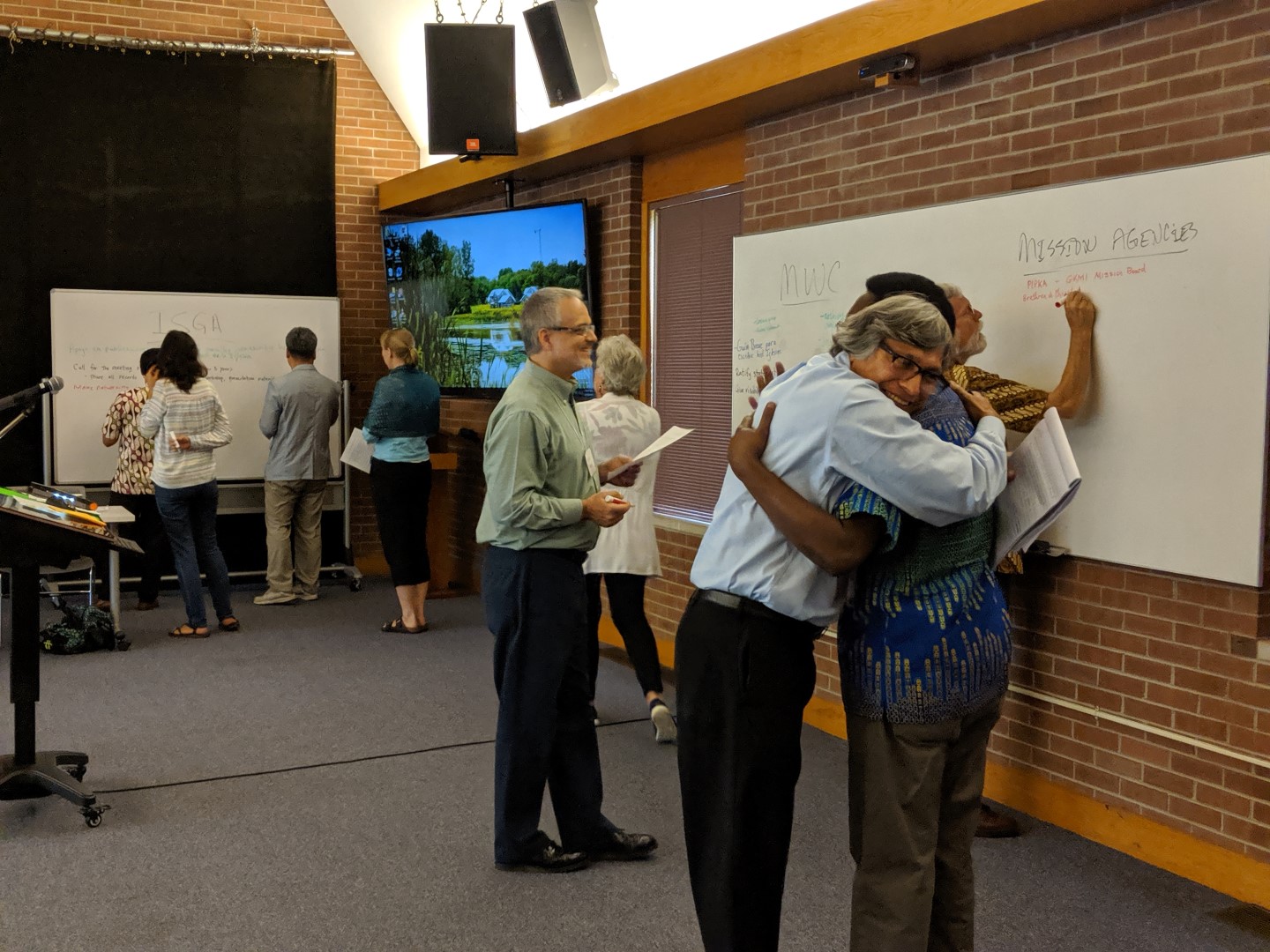
“The global church works best when all her parts are engaged in sharing their stories,” said Patrick Obonde, director of missions at the Anabaptist Leadership Education Centre in Kenya.
On 17–19 June 2019, historians, pastors and archivists did just that at “Power and Preservation: Enabling Access to the Sources Behind Our Stories,” at Goshen College, Indiana, USA. An initiative of the Institute for the Study of Global Anabaptism (ISGA), the conference had 16 presentations on the state of the historical sources and storytelling in African, Asian, North American, and Latin American Anabaptist churches and organizations.
Presenters addressed resources, access and commitment to preserving history in their contexts.
Although each raised unique concerns, common themes emerged.
- Oral history is a priority. Digitizing sources has great potential for preservation and increased accessibility, but it also requires significant financial resources.
- The love of power or fear of its loss can make access to historical documents difficult.
- A tradition of localism is a barrier to preservation. “Everyone feels comfortable with how things are,” said Ursula Giesbrecht, archivist of the Menno Colony in Loma Plata, Paraguay. “It is always difficult to move away from your customs.”
At the end of the symposium, the group drafted a statement that synthesized the themes addressed at the gathering.
“As followers of Jesus Christ our history connects us, reminds us of the Spirit’s activity among us, and calls us forward into the future,” it declares. “Archives play a crucial role in helping us to understand the inseparability of the stories of church and mission.”
This statement declares the importance of historical identity, the urgency of recording stories, and the necessity of access to sources in a healthy church community. The statement also recognizes barriers churches face in preserving and providing access to historical sources, and concludes with a list of commitments signed by 29 participants from 12 countries.
According to Roth, the idea for the symposium was born in conversations with Anicka Fast, a doctoral student whose research on Mennonite mission in DR Congo was inhibited by limited or restricted access to archives, and by the precarious condition of documents. Together with Bruce Yoder, who recently completed a PhD on the history of Mennonite missions in Nigeria, the organizers sought to broaden the discussion regarding preservation and access, and address how historical narratives shape the identity of the global church.
Pamela Sari, whose PhD research examined Jemaat Kristen Indonesia (MWC member church in Indonesia), is hopeful about the future of Mennonite archives. “The church is truly gifted with leaders, missionaries, members, scholars, archivists who care deeply about its history. I pray that God will continue to increase our capacity to stay planted in the love and truth of Christ and his Word.”
—An MWC release by Laura Miller / Goshen College