News of the extended network of faculty, alumni, students, visiting researchers, and mission partners is regularly updated, and some of the big ideas or major events in Global Christianity are covered in the CGCM News.
Call for Papers from The Circle of Concerned African Women Theologians (The Circle)
Circle of Concerned African Women Theologians (The Circle), U.S Chapter
Circle and Womanist Theologians Sankofa Research Project
Co-editors: Ericka Shawndricka Dunbar, Ph.D., and Yoknyam Dabale, Ph.D. Candidate
Introduction: Musa W. Dube, Ph.D.
The Circle of Concerned African Women Theologians was founded in Ghana, West Africa in 1989 with the purpose of amplifying Pan-African and inter-religious theological perspectives of African women. As a means of embodying Sankofa, our next conference in 2024 will be a pilgrimage back to Ghana. In preparation for our return, we are engaged in several research projects that analyze and expand the work of the Circle theological matriarchs, that is, the founders and the earliest champions of the Circle. The Circle has always included sisters both on the continent and in the Diaspora. This call is an expansion of projects already underway that center on the US founding matriarchs, as we endeavor to go back and retrieve their insights and contributions to create more equitable and just futures for African(a) women specifically, and African(a) peoples more generally. Additionally, this is a broader call for exploring other thematic aspects of the Circle, diasporic identities, and womanist theologies.
We invite papers that reflect not only on the crises that have marked African(a) women’s lives in the diaspora but also on future possibilities and collaborations. These opportune two special-volume issues aim to include papers that capture African(a) women’s reviews of and resistance to gender and ethnic-based oppression and violence across various continents; and resilience in the face of and revision of ideologies, attitudes, and theologies that undergird such practices. The scope of this issue is intended to be broad and inclusive of diverse methodologies, theories, and approaches. Topics may include, but are not limited to, the following:
-
Archival and scholarly research looking at the scholarship, contributions, and legacies of US Circle Sisters. How have their lives, work, and impact contributed to building communities of resistance, resilience, and revision across various contexts?
-
Exploration of the intersections of gender, race/ethnicity, places/space, identity, and what we pass on to our future generations.
-
Exploration of what it means to belong in diasporic places/spaces and resources for navigating those (physical, social, religious, geopolitical) landscapes.
-
Assessment of liberation theologies formed in the context of African(a) culture and religion.
-
Analyses of social issues such as gender and ethnic constructions and hierarchies, poverty, marginalization, sexualized violence, language, etc.
-
Examination of prejudices and biases, freedom/liberation, and research that examines African(a) women’s personal, professional, public, and political representation emphasizing existing cultural norms/biases, questioning societal prejudices, inequities toward women, and resistance to those practices.
-
Investigation of cultural influences on womanist perceptions/perspectives and theologies.
-
Circle Members’/Womanists’ transnational and global activism and resistance in all forms.
-
Africana Womanists subjectivities and experiences in Academia.
-
Intersections of Womanist Theologies and Afro-futurism.
-
Exploration of immigrant women and religious identity in the diaspora.
-
Analyses of African (a) motherhood, health, marginalization, and belonging in Eurocentric spaces looking at it through the religious lens.
-
Reflection on ways in which mainstream Eurocentric feminist theological discourse on gender influence African(a) discourse on womanhood.
Timeline: Please submit a 200-300 word abstract by April 21, 2022
Please send all submissions and any questions to: thecircleuschapter@gmail.com
Decisions on publication will be made on: May 15, 2022
The deadline to complete papers is: September 15, 2022
The volumes are peer-reviewed and will be published by The Journal of Black Women and Religious Cultures
BWRC Formatting Guidelines:
Generally, manuscript lengths are 24 to 32 double-spaced pages, approximately 6,500 to 10,000 words (excluding the abstract, notes, and bibliography). Essays must include an abstract of not more than 200 words.
Manuscripts must be double-spaced, left-justified, using 12-point Times New Roman type, and submitted as Microsoft Word .docX files.
Required writing style: Full Chicago humanities citations as endnotes only
All manuscripts undergo double-blind peer review. To facilitate anonymous peer review, author names should be indicated on a separate cover page but NOT be included on any other page within the submission. The cover page should include the title of the submission, the author’s (s’) name(s), email address, and institutional affiliation(s).
Call for Papers on “Colonial Violence: Secular and Ecclesiastical Perspectives (1919-1975)”
VID Specialized University, Stavanger (Norway)
Centre of Mission and Global Studies
International Conference - Call for Papers
Colonial Violence: Secular and Ecclesiastical Perspectives (1919-1975)
Praia, Cape Verde, 7-9 November 2022
The history of violence in the colonial contexts in the twentieth century has received considerable scholarly attention in recent years. With regard to some colonial spaces, the topic of colonial violence has, in fact, flourished as scholars have deployed new theories and methodologies to explore the mechanisms and typologies of violence across a range of colonial spaces/societies. Despite all this, inter-and transdisciplinary and empirically grounded approaches to colonial violence remain rare and considerably underexplored. Colonial Violence: Secular and Ecclesiastical Perspectives (1919-1975) seeks to gather scholars from different disciplines such as History, Art History, Church History, Legal History, Law, Anthropology, and Historical Sociology to study the phenomenon of colonial violence. The main goal is to discuss the attitudes of secular and ecclesiastical colonial and anti-colonial actors towards colonial violence, in its different forms and manifestations, at different levels from international fora to colonial territories, in colonial and non-colonial contexts.
Colonial Violence: Secular and Ecclesiastical Perspectives (1919-1975) is organized by the Centre of Mission and Global Studies of VID Specialized University of Stavanger, Norway, and will be held on 7-9 November 2022 in Praia, the capital city of Cape Verde, West Africa (Venue: National Library of Cape Verde).
Keynote lectures will be delivered by Diogo Ramada Curto (Instituto Português de Relações Internacionais, Universidade Nova de Lisboa, Portugal); Aurora Almada (Instituto de História Contemporânea, Universidade Nova de Lisboa, Portugal); Mika Vähäkangas (Lund University, Sweden).
Proposals are invited for twenty-minute papers which explore any aspect of the history of colonial violence. Papers are welcome from any academic discipline. Interdisciplinary papers and studies of the European colonies in Africa and contributions addressing the dynamics of loyalties in the context of approaches to colonial violence are particularly encouraged. Potential topics could include (but are not limited to):
- Methodologies for histories of colonial violence in the twentieth century (source interpretation; archival purge/erasure; theoretical perspectives).
- Typologies of colonial violence (forced labour/slavery, cultural violence; environmental violence; psychological/symbolic violence; violence against cultural heritages, etc.).
- Conflict of loyalties in the justifications/rationalizations and condemnations of colonial violence.
- Resistance and dynamics of loyalties in colonial violence narratives.
- Colonial violence in the international secular and ecclesiastical conferences (Bandung Conference; Vatican II and other ecclesiastical meetings and conferences; the Pan-African Congresses, etc.).
- Supranational and transnational organizations’ reaction to colonial violence (League of Nations; United Nations, World Council of Churches; the Holy See, the World Labour Organization; the World Health Organization).
- Colonial and non-colonial states’ (Germany, the Scandinavian countries) approaches to colonial violence.
- Churches, religion/spirituality, and colonial violence (prohibitions; justifications; complicity and loyalties).
- Native voices, perspectives/representations of colonial violence.
- Legacies, memories/reminiscences, and scars of colonial violence.
Proposals, consisting of a title, an abstract (max. 250 words), and a short academic track record, should be sent to jairzinho.lopes@vid.no by Friday, 15 May 2022. Feedback on the proposals will be sent by 3 June 2022. This conference is scheduled to be held in person in Praia, subject to the global public health situation.
For any queries and further information, please contact the conference organizer, Dr. Jairzinho Lopes Pereira (jairzinho.lopes@vid.no).
More information can be found here.
Call for Papers on the Theme of Majority World Epistemologies
Highlights from Faculty Associate Dr. Jonathan Bonk
The Center for Global Christianity and Mission celebrates the diverse and valuable contributions of our Faculty Associates.
Dr. Jonathan Bonk offers the following report on his recent work:
"I continue to serve as President of the Korean Global Mission Leaders Forum. From November 9-12 in Pyeongchang, South Korea, we convened our 6th biennial forum --- this one on the theme 'Missions and Money.' The forum was a hybrid affair, but went very well. The book containing forum papers, case studies, and workshops was officially released in March, together with a Korean version of the book.
"We are also planning for one more forum under my watch, also in Pyeongchang, scheduled for November 7-10, 2023. We're tackling what is perhaps the most challenging theme of the series: "Global Calamity and Mission: Climate Change and the Gospel of Hope."
"I published a short article on “Andrew Walls: Mentor, Friend, Exemplar” in the Journal of African Christian Biography. Vol. 6, No. 4 (October 2021), Pp. 3-21. And I've agreed to do a 5,000-word article on "The Writings and Legacy of Andrew F. Walls” for The Palgrave Handbook of African Christianity from Apostolic Times to the Present, scheduled for publication in 2023.
"I continue to preach somewhat regularly in our Mennonite congregation, and I have given a lecture and been featured in one "conversation" as a Canadian Mennonite University Fellow here in Winnipeg. The topic of that particular conversation was: "'Exterminate all the brutes': A conversation on Christian mission's complicity in the west’s grand quest to "civilize" the uncivilized and "develop" the underdeveloped." You can tell I've been reading Joseph Conrad and Sven Lindqvist and Raoul Peck! Not very cheery stuff, but necessary.
One-week course in Rome on the History of Religious Orders and History of Catholicism – June 13-17, 2022
Faculty Associate, Dr. Eugenio Menegon, Chaired a Session of the Renaissance Society of America
CGCM faculty associate, Dr. Eugenio Menegon, chaired a session of the Renaissance Society of America on March 31st, 2022 in Dublin, Ireland on “The image of Confucius in the writings of Catholic missionaries between the 17th and 18th Centuries”.
Read the full article here.
New Book Released by Faculty Associate Jon Bonk
 New Book Released by Faculty Associate Jon Bonk
The Realities of Mission & Money: Global Challenges & Case Studies
The Realities of Money & Missions provides a unique level of credibility and transparency as it calls for evangelicals to reevaluate their relationship with money, both personally and corporately. Global case studies, workshops, and testimonials cover a broad range of topics such as:
- Misalignment between fiscal theology and practice
- Environmental stewardship, community development, and business as mission
- Mobilization, fundraising practices, and “faith financing”
- Short-term missions, patronage, and dependency
- Power dynamics and structural injustice
The Realities of Money & Missions was not written by experts in the fields of investment, money management, or fundraising, but by men and women whose calling as missionaries, pastors, and administrators has brought them face-to-face with the complex, real-life issues involving the intersection of money and ministry.
Highlights from CGCM Faculty Associate Prof. John Thornton
The Center for Global Christianity and Mission celebrates the diverse and valuable contributions of our Faculty Associates.
Dr. John Thornton, CGCM faculty associate, offers the following report on his recent work:
"I wrote quite a bit last year, and some of it was published, the rest is more or less waiting. Probably the biggest work was on my biography of Afonso Mvemba a Nzinga, King of Kongo. I have a contract to publish a biography of Afonso, as well as English translations of his letters and a few allied documents. He wrote a bit over 20 letters between 1506 and 1542. You might remember the bio of him I wrote for the Dictionary of Christian Biography.
"I finished an intermediate draft, and the publisher is now sending it around to readers to assess its potentials as a textbook. This is not a review for publication, that peer review is done. Rather it is a sort of copy-editing exercise to improve style and presentation. We hope the book will be out in 2022.
"As far as global Christianity is concerned, I also gave a recorded public lecture on how Kongolese Christianity intersected with other African religions to create Vodou in Haiti. This was presented on April 29th as a part of Harvard's ongoing lecture series, and is available on YouTube at https://www.youtube.com/watch?v=arANJmBdy5s The title of the lecture is very misleading, it was a preliminary title that never got changed.
"I gave a talk in Portuguese, an interview with a Brazilian academic named Fabio Ferreira, on the history of Kongo which did deal with religious topics, this was on May 25th. It is also on YouTube at https://www.youtube.com/watch?v=ALPHLok-E74
"I was also part of a conference at the Kongo Academy, a new organization that does a lot of work on Kimbanguism. They invited me to talk about the eighteenth-century prophet D. Beatriz Kimpa Vita, the 'Kongolese Saint Anthony' as a precursor to Kimbangu.
"I also wrote several other pieces, but they were not on topics dealing with religion or global Christianity, for example, a revision of my earlier estimates of the population of Kongo (published in the Journal of African History) and an article on the expansion of the Lunda empire, which I think is a chapter in a book that might already be published."
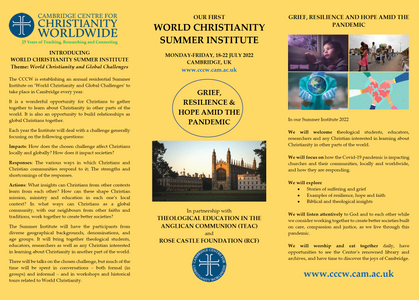
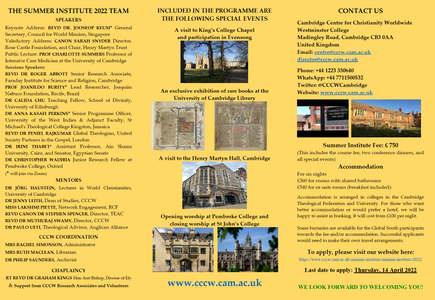
Inaugural World Christianity Summer Institute at CCCW, July 18-22, 2022
The Cambridge Centre for Christianity Worldwide is delighted to announce its first residential World Christianity Summer Institute on "Grief, Resilience, and Hope amid the Pandemic."