News
You’re Invited: What Mayors Need Now
 BU IN DC
You're Invited: What Mayors Need Now
Join the BU Initiative on Cities for the release of a survey on the transportation and mobility needs of the nation's mayors on January 21. RSVP today
 NOTABLE ALUMNI
Investigative Journalism in Today's Era
The BU Alumni Association invites you to a discussion with Kevin Merida (COM '79) of ESPN and Kimbriell Kelly (COM '98) of The Los Angeles Timesat National Public Radio headquarters on January 22. Join the discussion
 COMMUNITY RESOURCE
Helping High Schoolers Apply to College
With the College Advising Corps, recent BU graduates help first-generation applicants navigate the college application process.
See what they advise
IN CASE YOU MISSED IT...
Rebecca Ingber of the BU School of Law explains how Congress can stop war with Iran in The Atlantic... Marilyn Augustyn of the BU School of Medicine discusses new guidelines on diagnosing autism spectrum disorder with The New York Times... Rachel Nolan of the BU Pardee School of Global Studies describes the translation crisis at the U.S.-Mexico border in The New Yorker... BU political scientist Katherine Levine Einstein talks about how neighborhood meetings shape housing policy on Vox's The Weeds podcast... Rena Conti of the Questrom School of Business laments the amount of unused prescription drugs issued under Medicare in Axios.
Congressional Outlook For 2020
BU IN DC
Wheelock College of Education & Human Development Dean David Chard addressed the Annual Principal Investigators Meeting at the Institute of Education Sciences on January 9.
Andrew Bacevich of the Pardee School of Global Studies spoke about his new book at Politics and Prose Bookstore on January 8.
Ioannis Paschalidis of the College of Engineering and Daniel Fulford of Sargent College attended a National Science Foundation workshop on smart and connected health on January 6 and 7.
CONGRESSIONAL OUTLOOK FOR 2020
Congress returned to Washington this week with a short list of priorities to achieve before this fall's election season begins. The higher education community is anticipating action on the following items:
- Debate over the annual spending bills that determine federal agency budgets. The amount of money available for research and student aid is expected to be constrained by the spending caps set by last year's bipartisan budget deal.
- Updates to the laws that set policies for the National Science Foundation, the National Aeronautics and Space Administration, and research programs at the U.S. Department of Energy.
- Consideration of measures designed to protect research from inappropriate foreign interference, particularly as Congress works on the annual National Defense Authorization Act.
A possible Senate impeachment trial and the looming fall election will limit the number of legislative days available, so Congress may not make progress on all its pending agenda items.
BUZZ BITS...
- Steven Walker announced that he will step down as director of the Defense Advanced Research Projects Agency (DARPA), effective today. Deputy Director Peter Highnam will serve as acting director until a permanent replacement is named.
- The White House issued its final plan for implementing the federal data strategy. This is the first phase of a comprehensive, ten-year process to help federal agencies better utilize the valuable data they collect.
- The National Science Foundation (NSF) issued a Dear Colleague letter urging social, behavioral, and economic scientists to pursue NSF funding opportunities relevant to graduate education.
EVENTS NEWS YOU CAN USE
Come learn how to incorporate data analysis about books, articles, and other publications in your research at a SciVal bibliometrics database workhshop hosted by BU Research on January 22 from 3 to 5 pm. SciVal is one of the leading sources of bibliometric data for academic institutions, and is free for the BU community. This workshop will provide an overview of SciVal, its potential applications, and a practical understanding of how to use the database, including practice time to investigate your own topics and ask questions with an expert on hand.
Coming Soon: Research, Student Aid Increases
BU IN DC
Elaine Nsoesie of the School of Pubic Health gave a talk on using artificial intelligence to promote food safety at the U.S. Food & Drug Administration on December 13.
COMING SOON: RESEARCH, STUDENT AID INCREASES
This week, both chambers of Congress passed two spending bills which will fund the federal government for the remainder of fiscal year 2020, which began on October 1. Federal research agencies and student financial aid will see significant increases over this year, including:
- National Institutes of Health: $41.7 billion, a 6.6% increase
- National Science Foundation: $8.3 billion, a 2.5% increase
- NASA Science: $7.1 billion, a 3.4% increase
- Department of Energy Office of Science: $7 billion, a 6.3% increase
- Department of Defense Basic Research: $2.6 billion, a 2.9% increase
- National Endowment for the Humanities: $162.3 million, a 4.7% increase
- Institute of Education Sciences: $623.5 million, a 1.3% increase
- Pell Grants: $6,345 maximum award, a $150 increase
- Federal Work Study: $1.2 billion, a 4.4% increase
President Donald J. Trump plans to sign the measure into law today.
TRUMP ANNOUNCES CHOICE FOR NSF DIRECTOR
On Thursday, President Trump announced his intent to nominate Dr. Sethuraman "Panch" Panchanathan as the next director of the National Science Foundation (NSF). Dr. Panchanathan is currently the the executive vice president and chief research and innovation officer at Arizona State University. He is also a member of the National Science Board (NSB), having been appointed by former President Barack Obama. Panchanathan's nomination will need to be confirmed by the U.S. Senate in order for him to replace Dr. France Córdova, whose term expires in spring 2020.
BUZZ BITS...
- The President announced his intent to nominate Dr. Neil Jacobs to be the next administrator of the National Oceanic and Atmospheric Administration (NOAA). Dr. Jacobs joined NOAA as assistant secretary of commerce for environmental observation and prediction last year and has served as the agency's acting administrator for several months.
- Dr. Catherine Marsh has been named the director of Intelligence Advanced Research Projects Activity (IARPA), which oversees research programs for the national security community. Dr. Marsh has previously served in senior scientific roles at both the Central Intelligence Agency and IARPA.
- The National Aeronautics and Space Administration announced last week that Robert Pearce is the new associate administrator for the Aeronautics Research Mission Directorate. Mr. Pearce is an engineer who has worked at NASA since 1990.
A Note to Our Readers: Beltway BUzz will not publish during intersession. Happy Holidays and see you in the new decade!
12 Breakthroughs That Wowed Us in 2019
From climate science to fake news, these discoveries are sure to keep making waves in the next decade

2019 will go down in history as the year that an international team of researchers, including two BU astronomers, captured the first image of a black hole. Photo courtesy of Event Horizon Telescope.
Still looking for a New Year’s resolution to guide you into 2020? If so, here’s some food for thought: Earlier this year, Boston University clinical researchers found that optimism could boost people’s chances of reaching the age of 85 by over 50 percent. But that’s not the only discovery from 2019 that’s sure to keep making waves in 2020 and beyond. From memory manipulation, to plastic pollution, to a real-life mute button, and a portable device that can instantly diagnose Ebola, here are the top 12 breakthroughs that Boston University researchers made in 2019:
1. CTE Risk
For the first time, BU researchers can quantify just how damaging football play is to the brain. In a study of the brains of 266 deceased former amateur and professional football players, researchers at the BU Chronic Traumatic Encephalopathy (CTE) Center, led by Ann McKee, found that every year of playing American tackle football increases a person’s risk of developing CTE by 30 percent. For every 2.6 years of play, a person’s risk of developing CTE doubles. In a critical distinction between many previous CTE studies, the analysis included dozens of brains of former football players who did not have CTE.
Building a Carbon Free Boston
 ON THE CHARLES RIVER
Building a Carbon Free Boston
BU President Robert A. Brown and Boston Mayor Martin Walsh broke ground on the most energy efficient large building in the city's history. Learn how we did it
 COMMUNITY RESOURCE
BU Offers Discounted Tuition to Boston Public School Teachers
Boston Public School employees will receive scholarships equal to 33% of their tuition for graduate and certficate programs at the BU Wheelock College of Education & Human Development. Spread the word
 NOTABLE ALUMNI
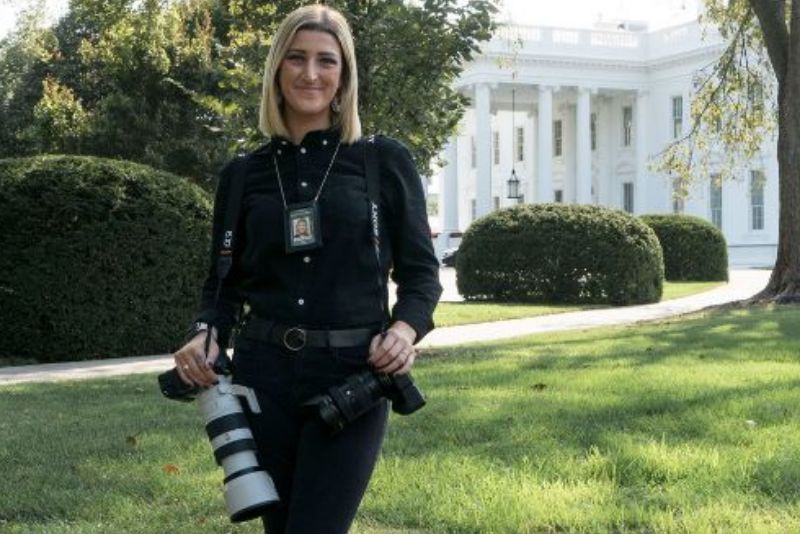
Photographing Trump's Washington
Sarah Silbiger (COM '18) has a front row seat to history as a member of the White House press pool. See what she sees
IN CASE YOU MISSED IT...
Join the BU Alumni Association on January 22nd for a panel discussion on investigative journalism at National Public Radio headquarters... Eugene Declercq of the BU School of Public Health says the Texas health care system harms pregnant women in Vox... Three BU School of Law alumni are tackling criminal justice reform at the American Civil Liberties Union... Paola Sebastiani of the BU School of Public Health discusses how protein in the blood may affect aging on National Public Radio... Sheila Cordiner of the BU College of General Studies explains why children need to read more diverse books in The Conversation.
Congress, NSF Act on Scientific Security
BU IN DC
James Bessen of the School of Law spoke about automation and the labor market at a Brookings Institution event on December 12.
Associate Provost for Computing and Data Sciences Azer Bestravos spoke at a meeting of the National Science Foundation Computing & Information Science & Engineering Advisory Committee on December 12.
CONGRESS, NSF ACT ON SCIENTIFIC SECURITY
On Wednesday, the U.S. House of Representatives passed a bill (S. 1790) that would create a federal task force to coordinate efforts to protect federally-funded research from foreign espionage. The U.S. Senate is expected to pass the measure quickly, and the President has indicated he will sign it. Separately, the National Science Foundation released the findings of a highly anticipated study on security threats in the federal research enterprise. The report found that open international collaborations are essential, and that most breaches in scientific integrity can be adequately addressed through existing research integrity frameworks. The Congressional and NSF actions are meant to assuage policymakers' concerns about inappropriate foreign interference in American science.
BUZZ BITS...
- On Tuesday, Congress passed the FUTURE Act (H.R. 5363), which allows the Internal Revenue Service to share student aid applicants' tax data with the U.S. Department of Education in order to simplify the federal student aid application. President Donald J. Trump is expected to sign the bill into law shortly.
- The President issued an executive order on Wednesday to require federal agencies to use the International Holocaust Remembrance Alliance definition of anti-Semitism when enforcing the Title VI anti-discrimination statute. The U.S. Department of Education is expected to use this change to intervene more frequently in cases alleging anti-Semitism on college campuses.
- Senators Chris Murphy (D-CT) and Mitt Romney (R-UT) have jointly formed a bipartisan Senate working group on student athlete compensation. Murphy said the working group will address "inequities in this broken [college athletics] system."
GRANTS NEWS YOU CAN USE
The U.S. Department of Energy's (DOE) Office of Science has released a $5 million opportunity in its biological and environmental research program for “Computational Tool Development for Integrative Systems Biology Data Analysis." The program aims to develop new computational approaches that can integrate large, disparate data types from multiple and heterogeneous sources generated by DOE’s systems biology research. The research will focus on data from plants and microbes relevant to DOE missions in energy and environment, including laying the scientific groundwork for cost-effective production of biofuels and bioproducts. Pre-applications are due by January 31.
Automation, Labor Market Institutions, and the Middle Class
BU Law Professor James Bessen speaks at the Brookings Institution on December 12, 2019.
How Recent BU Alums Are Helping High Schoolers Apply to College
College Advising Corps provides a “near-peer” experience for first-gen students sweating the process

Seniors Nedgyn Laloi (from left), Angy Bedoya, and Dariana Perez with their career and college advisor Miriam Alfaro (CAS’19) at English High School in Jamaica Plain.
When Miriam Alfaro graduated from BU in May, she went right to work—helping young people like herself get into college.
“It was great that I had just finished college and knew what that experience was like,” says Alfaro (CAS’19), who now spends her days at English High School in Jamaica Plain as one of the so-called near-peer counselors who are embedded in every Boston public high school by the College Advising Corps (CAC).
CAC, which is holding its national summit from Monday through Thursday this week at Boston Marriott Copley Place, is a nonprofit devoted to increasing the rates of college enrollment and completion among low-income and first-generation high school students and those from underrepresented communities. Although income is far from the only metric involved, a key stat is that 50 percent of students from high-income families earn a bachelor’s degree by age 25, while only 10 percent from low-income homes do.
Alfaro is one of many CAC advisors who fit the profile when they were applying to college. She was the first in her family to go to college. Her parents came here from El Salvador as teenagers, escaping that country’s 1980s civil war. They encouraged her to go to college, but couldn’t help her with the application process. “They didn’t realize it included the SAT and the essay and all the little things that go with it,” she says. Instead, her guidance counselor at Boston Community Leadership Academy helped her. Being valedictorian didn’t hurt, either.
“Coming to BU I received a Boston Community Service scholarship, and at the end of the program, my mentor told me about the job,” Alfaro says. “What really drew me to it was that I had been in a similar situation to the students. I was in their shoes, so I could relate to a lot of what they would be facing.”

The advisors provide practical support and inspiration as role models, says Katie Hill, director of CAC’s Boston operation, run in partnership with BU and AmeriCorps. “Being able to share their direct, lived experience is really important,” Hill says. “Some really see themselves in these students. Somebody helped them get to college, and they want to do that for somebody else.”
“I just put up my huge flag in my room so they know this is where I’m from and that I speak Spanish, and that is a huge opening,” Alfaro says, noting that English High has a large contingent of students from Central America. “I tell them my parents came here when they were really young, and that I’m the first generation to go to college, and I feel like they open up to me more, because they’re in the same situation.”
Her age also helps the students relate to her.
“You feel like you’re talking to someone who knows what you are going through,” says English High senior Nedgyn Laloi.
Writing that college essay and working through the application process can be scary even without cultural differences, says senior Angy Bedoya. “There’s a lot of things that if I was applying by myself I would have just said yes, but when she explained it to me, I was like, ‘Oh, no, no, no!’ Like early decision—I thought it just meant applying early, but it means you have to go.”
“If I didn’t have her, I was never going to do my applications, to be honest,” says senior Dariana Perez. “I was so confused, I didn’t even know what colleges I wanted to apply to.”
BU hosts CAC’s Boston program in an office at 100 Bay State Road. Advisors fan out to 30 Boston public high schools as well as a handful in adjacent communities, working alongside guidance counselors who often don’t have the time that a first-generation-to-college high school student needs during the process.
The CAC advisors work with students from all grades to get them thinking about their future, but especially with juniors and seniors, helping them work through the complex process of applying to institutions from community college or technical school to private four-year institutions like BU.
“Something that happens a lot with our student population is that they see a college like BU that’s competitive and prestigious and say, ‘I don’t know that I belong there,’” Hill says. “Our goal is to make sure each student has a pathway that’s a good fit for them.”
They’re going into or back into these communities and saying in powerful ways, ‘Look, if I can do it, you can too.’
There are 36 advisors in the Boston cohort, 10 of them BU alumni. Most of the others are from other area colleges and universities. Many identify as first-generation college students, people of color, Pell Grant–eligible, or some combination of the three. Many, like Alfaro, attended a Boston-area high school. They’re paid nearly $27,000 and receive BU employee benefits, including tuition remission if they want to work on a graduate degree. Most stay with CAC for a full two-year stint. Nearly a dozen of the advisors have hired on at BU when their two years were up, leveraging their CAC experience with positions in admissions, financial aid, or advising.
Hill launched the program in Boston more than a year before the BU partnership began in September 2015.
Madison Crosby (CAS’19), a CAC advisor embedded at Charlestown High School, discovered CAC at a social-impact career fair at BU. “I’ve kind of been in a bubble through my high school and college,” she says. “I went to a very affluent, elite high school, and I went to an elite university. I say that I’m from Boston, but I felt on graduating that I didn’t really know Boston. I wanted to stay in Boston and try to make a difference in this community.”
Emily Thoman (CAS’18, MET’20), in her second year in Charlestown, first heard about CAC from a BU career coach. “The more I learned about the program, the more it sounded like something I really wanted to do,” she says.
“CAC’s mission to increase college access aligns well with BU’s desire to provide more low-income and first-generation college students with access to a quality education,” says Kelly A. Walter (Wheelock’81), the University’s associate vice president for enrollment and dean of admissions. “Given BU’s long and rich history of giving back to the city of Boston, we saw this partnership as an opportunity to expand and strengthen our impact on students attending Boston Public Schools.”
English High student development counselor Christina Calderon—one of the school’s two guidance counselors—says CAC has been a major asset in getting some of the 140 members of the senior class to college.
“When CAC came into our building almost five years ago, it was a huge burden lifted off our shoulders,” Calderon says. Guidance counselors serve the whole student body as mentors, teachers, and substitute parents, while the CAC advisors can focus just on the complex college application process. The near-peer angle is key to their success, she says: when students feel comfortable sharing about their lives and family situations, then they’re more willing to do the things their CAC advisor may recommend, such as applying to a broader spectrum of schools.
They think, “‘OK, I’m going to try XYZ, because you understand where I’m coming from, because you were me,’” Calderon says.
Working in 782 high schools in 17 states, CAC has 829 advisors, more than 100 of them served by the program when they were in high school, according to founder and CEO Nicole Hurd. Roughly two-thirds are people of color, Pell-eligible, first generation to college, or a combination. And the organization has committed to a lot more with its goal to enroll a million students in college by 2025 who might otherwise never have even applied. They are almost halfway there.
“They’re going into or back into these communities,” Hurd says, “and saying in powerful ways, ‘Look, if I can do it, you can too.’”
Author, Joel Brown is a staff writer at BU Today and Bostonia magazine. He’s written more than 700 stories for the Boston Globe and has also written for the Boston Herald and the Greenfield Recorder. View his profile
Photojournalist, Cydney Scott has been a professional photographer since graduating from the Ohio University VisCom program in 1998. She spent 10 years shooting for newspapers, first in upstate New York, then Palm Beach County, Fla., before moving back to her home city of Boston and joining BU Photography. View her profile
BU Responds to House Climate Request
BU IN DC
Malika Jeffries-EL of the College of Arts & Sciences spoke at a November 20 colloquium celebrating 150 years of the Periodic Table of Elements sponsored by the American Chemical Society and the National Science Foundation.
School of Medicine Dean Karen Antman attended the Association of American Medical Colleges Council of Deans Administrative Board meeting on December 3.
Rena Conti of the Questrom School of Business spoke at an Alliance for Health Policy Capitol Hill briefing on cell and gene therapies on December 4.
Sarah Lattrell of the Global Development Policy Center met with global policy stakeholders from December 4 through 6.
BU RESPONDS TO HOUSE CLIMATE REQUEST
On November 22, the University responded to a request from the House Select Committee on the Climate Crisis to share input on policies and strategies to address climate change. Vice President and Associate Provost for Research Gloria Waters encouraged Congress to "significantly invest in the federal research agencies that fund innovative science and technology solutions and develop the next generation workforce needed to address the changing climate." She also highlighted research conducted by BU's scholars and described the steps the University is taking to achieve net zero emissions by 2040. The Committee plans to use the comments submitted by the public to formulate comprehensive climate change legislation.
BUZZ BITS...
- The National Institute of Mental Health (NIMH) is soliciting input on NIMH's draft 2020 strategic plan, with comments due by January 1. The plan identifies NIMH's goals for the next five years as: defining brain mechanisms, examining mental illness across the lifespan, aiming for prevention and cures, and strengthening public health impact.
- President Donald J. Trump appointed three new members to the National Board for Education Sciences. The Board provides guidance for the U.S. Department of Education's research arm, the Institute for Education Sciences.
- The U.S. Senate confirmed Dan Brouillette as the next U.S. Secretary for Energy. Mr. Brouillette replaces Rick Perry, who stepped down late last month.
EVENTS NEWS YOU CAN USE
The BU Office of Research and BU Technology Development will host four workshops this month on how to write successful business proposals. The seminars will take a close look at BU’s Ignition Award, which supports research projects with clear commercial potential, and offer tactics for preparing a winning proposal. They will also include tips on selling your idea to potential investors, customers, and collaborators.
The Science, Policy, and Potential of Cell and Gene Therapies
BU Professor Rena Conti spoke at Capitol Hill on December 4, 2019.