CPT Today
CPT Today is the blog of The Center for Practical Theology. Here you’ll find posts under the categories of Book Reviews, News and Events, Opportunities, Perspectives, Practical Theology Profiles, and Research Reflections. Interested in submitting? Please see our submission guidelines and feel free to be in touch with cpt@bu.edu with any questions!
Call for Submissions: Practical Matters

Issue 14: Exclusion, Belonging, and Becoming in Religious Communities
Call for Submissions: practicalmattersjournal.org/submissions
Deadline: October 1, 2020
Many religious traditions uphold values of justice, community, and belonging, yet many also occupy ambivalent positions vis-à-vis systems and acts of exclusionary violence. Sometimes religion is the target and other times the perpetrator. The study of religious practices has much to offer to conversations on the complex entanglement of religion and exclusion. Similarly, studying religious practices can help us understand how religious communities nurture belonging and work toward personal and collective becoming in more capacious ways. In this issue, we engage critical analysis of the role of exclusionary violence both within and against various religious communities. We also seek dialogue about how communities respond to and resist exclusion with creative processes of becoming and transformation.
Practical Matters is now accepting submissions on religious practices and practical theology for Issue 14. The journal will feature articles on the theme of “Exclusion, Belonging, and Becoming in Religious Communities.” Potential topics may include but are not limited to
- The role of religion in forms of cultural, structural, direct, and epistemic violence
- The response of religious institutions to global crises (e.g. the COVID-19 pandemic, the refugee crisis, the ongoing impact of colonialism, climate change, the prison-industrial complex, etc.)
- Cultivating a community of belonging in the context of COVID-19 and social distancing
- Religious practices created or practiced by marginalized individuals and communities
- Religion as a resource for resistance and social justice struggles
- How religious identity generates political stance and action
- Spirituality as a source of identity formation and development
- Understanding exclusion, belonging, and becoming in religious texts and practices
- The politics and practices of interfaith coalition-building and action
- Multiple-religious belonging and becoming across religious divides and boundaries
- Theological responses to specific forms of exclusions and belongings
- LGBTQ issues, identity politics, and religious institutions
- Religion’s undergirding of, and/or resistance to, white supremacy and coloniality
- The function of power and authority in religious communities
- The experience of symbolic and physical exclusion, as well as belonging
In all submissions, we are particularly interested in works that perform what they analyze—i.e. compelling use of theories, methods, and conversations that help flesh-out meta-commentary. We invite contributions on and from any religious or spiritual tradition as well as from any theoretical position or discipline. The journal includes both peer-reviewed articles (Features and Analyzing Matters) as well as non-peer reviewed content that presents the thoughtful reflections of teachers and practitioners (Practicing Matters and Teaching Matters). Practical Matters accepts submissions that incorporate a variety of media and genres.
Submissions are accepted and published on a rolling basis throughout the year. For more information, see http://practicalmattersjounral.org/submissions or contact the issue editor at pm.issue.editor@emory.edu. Submissions must be received by October 1, 2020 for consideration in Issue 14: Exclusion, Belonging, and Becoming in Religious Communities.
Creative Callings Innovation Hub Gathering at Boston University School of Theology
A Note from the Editor: Upon careful deliberation, we have decided to continue to share CPT Today content in the coming months, as we work remotely from our homes. While we have needed to postpone some of our scheduled content, we hope to continue to highlight the work of theologians and practitioners as we face this time of great uncertainty. The following piece features updates from Creative Callings, and shares a report about an event which took place prior to the mass outbreak of Coronavirus in the United States.
On February 1, 2020, twelve congregational teams with the Creative Calling’s Innovation Hub gathered in the BU School of Theology’s Community Center to continue to explore the images of calling enlivening their congregations and to support one another in implementing creative programing around calling and the arts, restorative justice, resourcing communities, and discernment/discipleship. Each congregation team is in their first year of grant funding through the Creative Callings project, and the Creative Callings leadership team is excited to learn alongside these congregations during this program year and beyond.
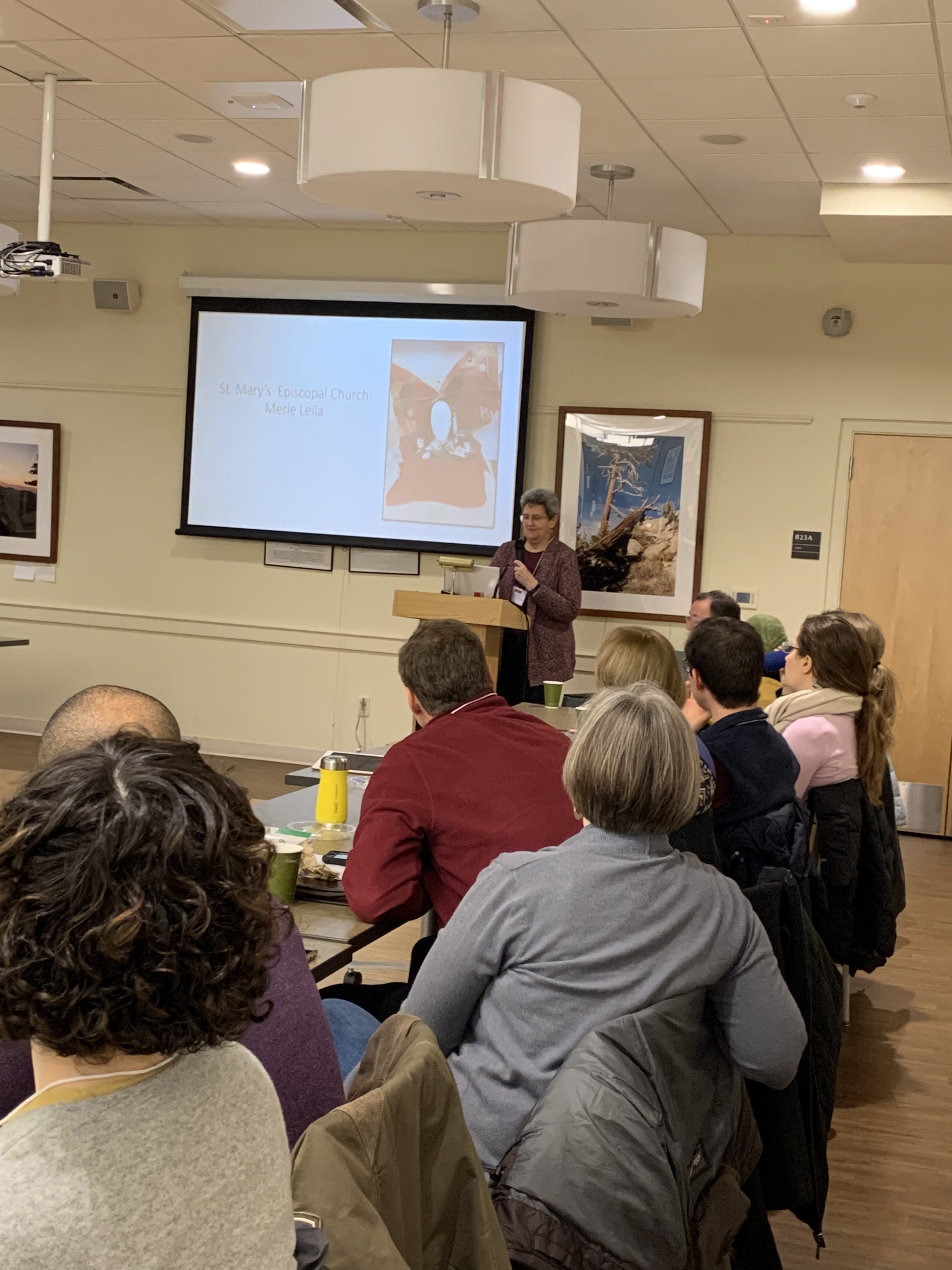
Creative Callings Project Director, Dr. Claire Wolfteich, and Associate Project Director, Dr. Wanda Stahl began the morning with a presentation on “Lived Theologies of Vocation.” Through exploring images already present in the twelve congregation with this presentation, teams members shared strategies for centering joy in their work, capacity building, and teambuilding.
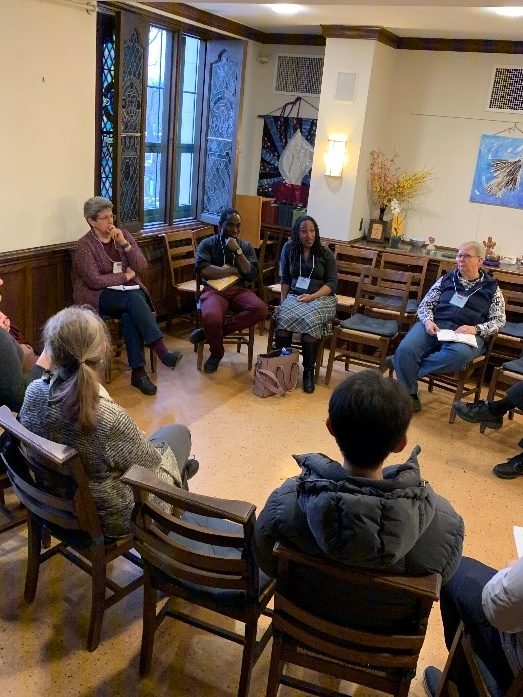
In the afternoon, the team members broke into small groups to discuss important challenges in project implementation, such as the role of clergy/lay leadership, congregational conflict, rest and joy, and linguistic challenges. Through culling the wisdom of the group, the teams were able to help each other think more expansively and to develop relationships across congregations.
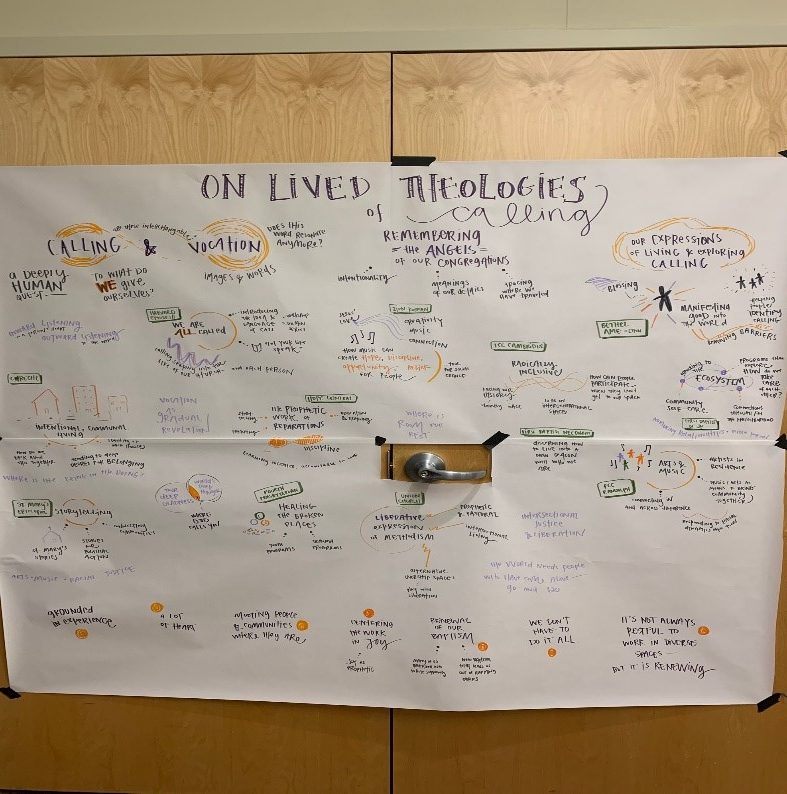
BU STH MDiv student Cate Nelson provided interactive scribing throughout the day and we hope you enjoy the glimpse into our day through her notes, which are below.

Interdisciplinary Methods: A Conversation with PhD Student Scott Donahue-Martens
One of the defining features of the field of practical theology is its commitment to interdisciplinary methods of inquiry. While practical theologians do not always agree upon the nature of interdisciplinary research, or the viability of certain interdisciplinary paradigms, most practical theologians do affirm the importance of interdisciplinary dialogue. This semester, first and second year PhD students in Practical Theology at the School of Theology received the opportunity to take a course called Interdisciplinary Methods instead of the usual required course, Advanced Research in Practical Theology. The course on interdisciplinary methods is taught by constructive theologian, Dr. Shelly Rambo, whose own work has featured a commitment to interdisciplinarity. The class consists of Track 3 (Practical Theology) students, as well as Track 2 (Theology, Ethics, and Philosophy) students, who work together to evaluate various methods and paradigms featured across course readings. 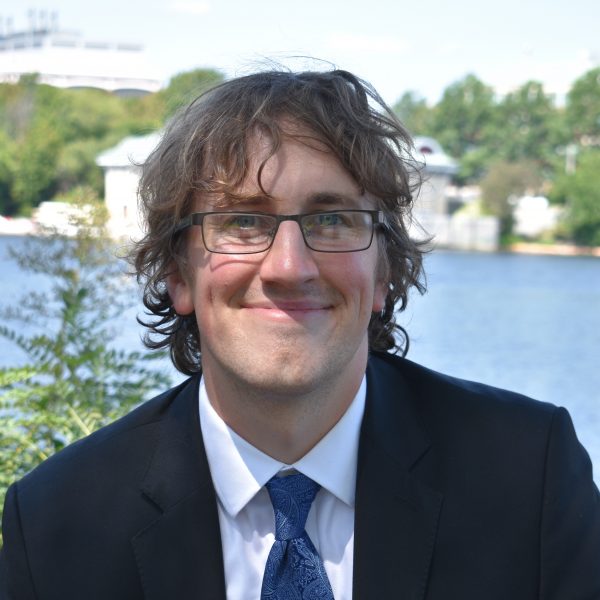
Last week, Amy McLaughlin-Sheasby, CPT Today Editor, sat down with current Interdisciplinary Methods student, Scott Donahue-Martens (second year PhD student in Practical Theology), to discuss how the course is shaping his work as a practical theologian.
Amy: As I understand, Interdisciplinary Methods was offered this semester instead of Advanced Research in Practical Theology. Can you tell me a little bit about your experience of the course so far, and what this course is offering to you as a practical theologian?
Scott: A lot of the readings so far are readings from disparate fields and different approaches to theology. But a lot of what we are doing is actually reading the books for their interdisciplinary approaches, rather than just for the content itself. So, in some ways, we have had to learn a new evaluative skillset, where we are not just looking for the point the author is trying to make, but how they are making their point. We ask what sources they are drawing from, whether or not they are doing it responsibly, and how they are engaging scholars in other fields.
Amy: What is it like to have Dr. Rambo, a constructive theologian, guide you, a practical theologian, into analysis of interdisciplinary methods? Is it helpful to have someone outside of your field teaching interdisciplinary methods?
Scott: Yes, I think so. One of the things Dr. Rambo has us do is write analytical papers for most of the sessions, so we all form our own opinions and ideas. Throughout the papers we have to talk about the interdisciplinary methods. The reality is that each of us ends up talking a little bit from our own field and our own perspective. Then Dr. Rambo goes around the table, and has each person one at a time give some sort of insight from the work or method being discussed. Usually she asks a particular question that allows us to explore some facet of the reading. But the interesting thing about that approach is that it allows each of us to experience each other’s voices and their connection to our respective fields. There are definitely some similarities between the things the practical theologians share, and it is interesting to see how practical theologians tend to gravitate toward certain texts, but not other ones. Sometimes the people in the other disciplines may not like some of the texts that are more natural for practical theology, for example, texts that afford a larger role for experience, or demonstrate how practices shape theory, rather than just theory shaping practice.
Scott went on to share about how Dr. Rambo and the students from Track 2 have helped him to assess his own operative paradigms. Scott is a homiletician who works closely with the field of hermeneutics. He is particularly interested in the work of Paul Ricoeur, and is eager to explore how Paul Ricoeur’s hermeneutics will contribute to his burgeoning research questions. Scott notes that homiletics as a field has not always promoted responsible interdisciplinary methods. Many homileticians have normalized appropriation, or to use Scott’s more indicting word, raiding of other disciplines without careful consideration for what is lost or compromised in the process. Scott is hopeful that this course will help him resist such tendencies in his own work. My last question for Scott was, “What do you think is the promise of interdisciplinary methods for academia as a whole?” Scott responded, “I think part of the promise is honesty—honesty about the fact that we don’t ever interpret purely from one position, and honesty about the limitations that come with specialization. Also, interdisciplinarity helps us to be honest about the limitations of our own fields for discerning truth and constructing meaning.”
Center for Practical Theology at AAR

As the American Academy of Religion (AAR) Annual Meeting in San Diego, CA, Nov 23-26, approaches, plan ahead to attend the sessions with Center for Practical Theology affiliates!

CPT Co-Director Theodore Hickman-Maynard presides at the Ethnography and Theology Workshop. The theme is “Representation and Normativity: Crises and Possibilities. Additionally, Dean Teddy presides at the Ecclesial Practices Unit session. The theme is “Ethnography, Theology, and Intersectionality.”
 PhD in Practice Theology graduate Yara Gonzalez-Justiniano presides at the Association for Practical Theology’s panel. The theme is “Apprenticing into Practical Theology: Emerging Epistemologies, Methodologies, Collaborative Inquiries.”

Current PhD student in Practical Theology, Jasmin Figueroa is a panelist at the Association for Practical Theology’s panel. The theme is“ Apprenticing into Practical Theology: Emerging Epistemologies, Methodologies, Collaborative Inquiries.”
 Current PhD student in Practical Theology, Daniel Huage presents “The Comforts of “Home”: White Comfort as Boundary Marker” at the Liberation Theologies Unit session. The theme is “Landscapes of Liberation: Building New Horizons of Bodies, Borders, and Belonging.”
Congratulations all!
More information about the sessions, including time and location, can be found here.
The Center for Practical Theology’s Twelfth Annual Lecture with Dr. David Jacobsen
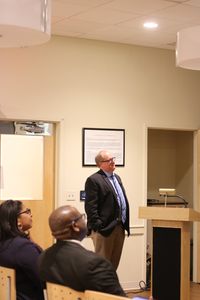
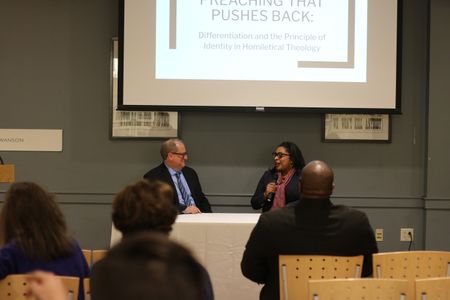
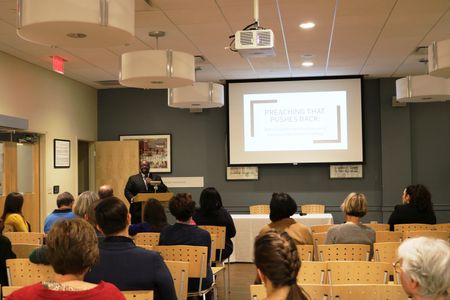
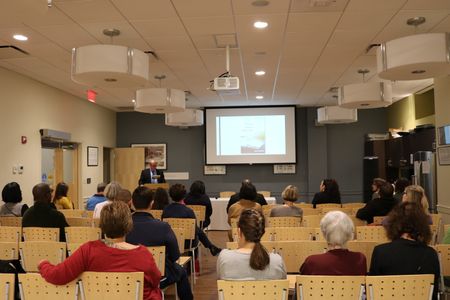
We were thrilled to welcome Boston University School of Theology's own Dr. David Schnasa Jacobsen to give the Center for Practical Theology’s Twelfth Annual Lecture on October 23, 2019. Dr. Jacobsen presented “Preaching that Pushing Back: Differentiation and the Principle of Identity in Homiletical Theology," and Boston University School of Theology's Assistant Professor of New Testament Dr. Shively Smith responded to the lecture.
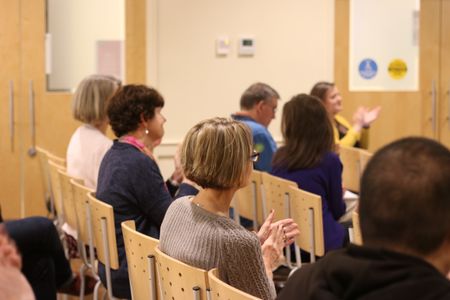
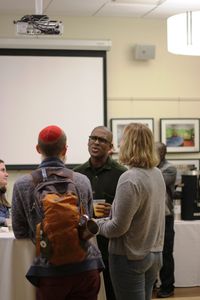
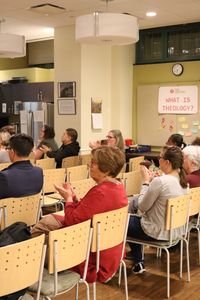
We were pleased to welcome our colleagues from BU School of Theology, Boston Theological Institute schools, and from the greater Boston community. A YouTube video of the lecture is available here. We are so grateful to Dr. Jacobsen for sharing his insights with us.
Below, PhD Student in Practical Theology, Amy McLaughlin- Sheasby, responds to Dr. Jacobsen's lecture.
by Amy McLaughlin-Sheasby
 On the evening of October 23, 2019, students and faculty gathered together for the CPT’s 12th annual lecture, given this year by the School of Theology’s own Dr. David Schnasa Jacobsen. Dr. Jacobsen is the professor of the Practice of Homiletics, and was recently installed as the Bishops Scholar of Homiletics and Preaching earlier this month. In his lecture titled “Preaching That Pushes Back: Differentiation and the Principle of Identity in Homiletical Theology” Dr. Jacobsen invited us to consider how social difference and identity negotiation require a reconsideration of the tasks of interpretation and preaching. He proposed that faithful tending to social difference sometimes requires the preacher to preach against the text. To preach against a text is not to forsake the importance of careful study and exegesis, nor to abandon reverence for scripture, but rather to seek greater awareness of how social difference may impact the reception of scripture. Videos of sermons from Barbara Brown Taylor and Lisa Thompson helped to demonstrate how a preacher might push back against a difficult text in order to proclaim a truly liberating, gospel word.
The thesis of this lecture was eagerly anticipated by students and faculty who share a vested interest in conversations around identity, power, and theology. Following the lecture, Dr. Jacobsen was joined by New Testament professor, Dr. Shively Smith, to discuss various interpretive approaches to biblical texts. Questions and comments from Hebrew Bible professor Dr. Katheryn Darr, as well as New Testament professor Dr. Luis Menéndez-Antuña, helped to round out an important interdisciplinary conversation on biblical interpretation.
Ultimately, this year’s lecture provided a platform from which Dr. Jacobsen could highlight the great promise of homiletical theology for the field of practical theology. Few other practical theological areas are so deeply concerned with examining the relationship between communities of faith and their scriptures. While many practical theologians must contend with questions concerning theological norms and sources of authority, homiletics offers a distinct avenue for these conversations. Homileticians presuppose the community’s engagement with sources of authority—such as scripture—and thus seek to shape the process of interpretation and proclamation. Dr. Jacobsen’s lecture reminded us that a homiletical theology which carefully tends to issues of power and identity may also clear paths for liberative theologies in communities of faith. Preaching that pushes back offers a plenitude of paths forward for communities of difference that are bound together by a shared faith.
Amy McLaughlin-Sheasby is a PhD Student in Practical Theology with a Concentration in Homiletics at the Boston University School of Theology. Her research interests include trauma-informed homiletical theology, trauma theory, homiletical pedagogy, feminist hermeneutics, wisdom literature and wisdom traditions, and preaching and the Hebrew Bible. Dr. David Schnasa Jacobsen is her advisor.


Call for Proposals: Association of Practical Theology Biennial 2020

“This is my body”: The Human Body as Site for Intersectional Discourse on Practical Theology and Bioethics
Call for Proposals
You are invited to submit proposals for individual papers or panels on the 2020 APT Biennial Conference theme, “This is my body”: The Human Body as Site for Intersectional Discourse on Practical Theology and Bioethics. The call seeks proposals that consider the human body at the intersection of Practical Theology and Healthcare/Biomedical sciences, two aspects of Bioethics. Central to the intersectional discourse that we seek is critical theological reflection about embodied practices and related concerns about human well-being physiologically, psychologically, and spiritually.
Electronic submission of proposals are due Friday, 1 November 2019. Upon determining the idea for your topic write a 130 word abstract followed by an additional 750 words (per person, if a panel) that make the case for your proposed presentation. This additional material should include reference to your methodology, your key conversation partners in scholarly literature, and your primary intended audience. Please limit proposals to two-single-spaced pages (per presenter). All proposals must be submitted through the APT website submission form. A select number of proposals whose topics do not relate directly to the conference theme may be accepted in light of their scholarly quality, creativity, and emphasis on current sociohistorical events. Proposals sent by other means may not be considered.
Notification of your proposal’s acceptance status to the 2020 APT Biennial Meeting will be sent by Monday, 16 December 2019.
You do not have to be a member of APT to submit a proposal. However, if selected to present, presenters must hold a membership and be registered for the conference by February 15, 2020.
Call for Submissions: Practical Matters Journal

Call for Submissions to Practical Matters
Issue 13 Call for Submissions
Love
Deadline: December 1, 2019
practicalmattersjournal.org/submissions
Love is constantly being redefined by both scholars and people across a range of disciplines, theoretical approaches, and cultural contexts. Conceptions of love range from John Donne’s literary pursuit of love, both sacred and profane, to Alain Badiou’s philosophy of love as an existential quest for the truth. Religious communities also continue to pay close attention to love as a virtue, ideal, and practice adding to these ever-evolving conceptions. How do religion and faith then shape our ideas about love in this changing world? What are the various kinds of love that exist in religious theology and practice, and in what ways do they influence the discipline of religion, the practices, and the ideologies of religious groups and movements?
Practical Matters is now accepting submissions on religious practices and practical theology for Issue 13. The journal will feature articles on the theme of “Love.” Potential topics may include but are not limited to:
- Love in sacred texts
- The role of love in religious service and charity
- Marriage, divorce, sex, sex education, purity, (in)fertility, and family
- The body as sacred
- LGBTQ issues, identity politics, and religious institutions
- Love as a way of living or serving God, e.g. Sufism or Monasticism
- Romantic attachments to deities or Dating God
- Love and the ethics of care
- Love across religious divides, e.g. Inter-faith relationships or Love Jihad
We invite contributions from any religious or spiritual tradition, as well as from any theoretical position or discipline. The journal includes both peer-reviewed articles (Features and Analyzing Matters) as well as non-peer reviewed content that presents the thoughtful reflections of teachers and practitioners (Practicing Matters and Teaching Matters). Practical Matters accepts submissions that incorporate a variety of media and genres.
Submissions are accepted and published on a rolling basis throughout the year. For considerations in Issue 13, submissions must be received by December 1, 2019. For more information, please see www.practicalmattersjournal.org/submissions or email pm.issue.editor@emory.edu.
12th Annual Lecture for The Center for Practical Theology Announced
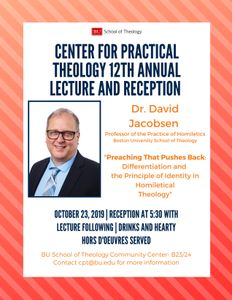
You are warmly invited to The Center for Practical Theology’s Twelfth Annual Lecture and Reception on Wednesday, October 23, 2019. Boston University School of Theology’s own Dr. David Jacobsen, Professor of the Practice of Homiletics, Director of the Homiletical Theology Project, and Co-Director of the Center for Practical Theology, will present on “Preaching That Pushes Back: Differentiation and the Principle of Identity in Homiletical Theology.” The reception begins at 5:30pm with the lecture following. For those of you who cannot attend, we hope you’ll be present in spirit via the Livestream. We hope to see you in October!
Job Posting: Assistant Professor of Pastoral Care (Tenure-Track), Union Presbyterian Seminary, Richmond, VA

Union Presbyterian Seminary invites applications and nominations for the position of Assistant Professor of Pastoral Care (tenure-track), to serve primarily on our Richmond, Virginia campus. The successful candidate holds a Ph.D. in pastoral care, pastoral theology, or psychology of religion, is committed to excellence in both teaching and scholarship,and also has an interest in the constructive interpretation of Christian faith and life in conversation with other disciplines. The candidate should be competent in contemporary theories and practices of pastoral theology and counseling and would teach regularly in introductory and elective courses for Master’s level students. In addition, the candidate would be expected to offer electives in all degree programs and platforms and occasionally lead seminars appropriate for the Th.M. and D.Min. degrees. While the area of specialization is open, special consideration will be given to those whose expertise complements our existing faculty, who have professional training and experience, and who exhibit intercultural competencies.
Since Union’s formation in 1812, it has sustained the intention of its founders to provide education for Christian ministry that is scholarly, pastoral, and engaged with contemporary life. As a free-standing, denominational seminary, we value the active participation of our faculty in the worship and community life of our campus and their provision of resources for regional churches and communities. The successful candidate will give evidence of such engagements in their current context, and will be prepared and eager to engage the church through varied forms of service.
Union Presbyterian Seminary is a graduate educational institution of the Presbyterian Church (USA) and an EO/AA employer committed to increasing the gender, racial-ethnic, and international and cultural diversity in its faculty and student body. Candidates from underrepresented groups are especially encouraged to apply.
Letters of application, including a curriculum vitae and the names and contact information of three references, should be addressed to Ken McFayden, Vice President for Academic Affairs and Academic Dean, Union Presbyterian Seminary, 3401 Brook Road, Richmond, Virginia 23227, eelliott@upsem.edu. Review of applications will begin on October 1, 2019.
Dr. Courtney Goto delivers keynote at the 25th Anniversary 2019 Conference of the British and Irish Association of Practical Theology
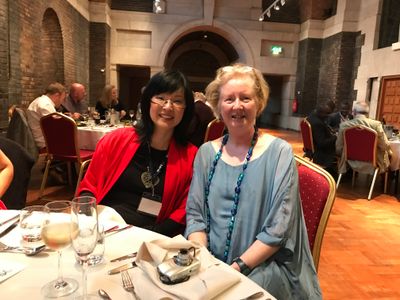
Congratulations to Dr. Courtney Goto for presenting a keynote address at the British and Irish Association of Practical Theology Conference in Liverpool, England on July 10th. Her speech, “The Ubiquity of Ignorance: A Practical Theological Challenge of our Time,” addressed questions about ignorance amplified by Brexit, xenophobia, and rising populism in Britain and Ireland. Her keynote will be published in an upcoming issue of Practical Theology and its abstract is posted below.
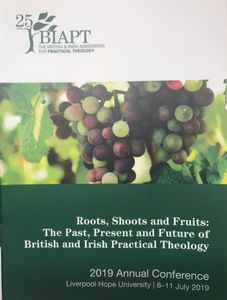
Find more information about the British and Irish Association of Practical Theology and the 25th Anniversary 2019 Conference at https://www.biapt.org/events/conference-2019/.
“Although academics are dedicated to the pursuit of knowledge, few realize that as we construct knowledge, we simultaneously produce ignorance by habitually ignoring what we tend to ignore. When we do reflect on ignorance, we are more inclined to focus on other people’s ignorance than our own. In this paper, I take the case of Brexit as the “perfect storm” of ignorance to re-examine how practical theologians in the UK (and beyond) approach research. I explore the practice of demonization in caricatures from both sides of the referendum, using the work of Elaine Pagels. I then open up the practice by identifying related habits of ignorance, drawing on the theories of John Dewey. I challenge practical theologians not to leave ourselves to our own research devices intended to mitigate our ignorance, but rather to consider that our own fallibility requires methods that cultivate dependency on others not like us, so that we might help one another know what we would otherwise ignore.”