CPT Today
CPT Today is the blog of The Center for Practical Theology. Here you’ll find posts under the categories of Book Reviews, News and Events, Opportunities, Perspectives, Practical Theology Profiles, and Research Reflections. Interested in submitting? Please see our submission guidelines and feel free to be in touch with cpt@bu.edu with any questions!
Church Planting in Post-Christian Soil: Theology and Practice – A Lecture by STH Alumnus Dr. Christopher James
 The Center for Practical Theology is pleased to announce Dr. Christopher James (STH Practical Theology '16)'s upcoming lecture. Dr. James will present "Church Planting in Post-Christian Soil: Theology and Practice," on Monday, November 20, 17 at 5:30pm. The lecture will be held in Room 325 at BU School of Theology, 745 Commonwealth Ave., Boston. The lecture is sponsored by the Center for Global Christianity and Mission.
We are also thrilled to share that Dr. James's new book, Church Planting in Post-Christian Soil: Theology & Practice, is now available for sale. Church Planting in Post-Christian Soil: Theology & Practice is a scholarly study of new churches in Seattle, WA. James combines original research with sociological and theological methods to develop the four dominant models of church plants and to draw practical wisdom for those who are interested in finding faithful ways of embodying the gospel in Christian communities that are an asset to the common good. The book is already garnering great reviews. For a limited time, you can receive 40% off with free shipping when you use PROMO code FRIENDS2017 here. Congratulations to Dr. James, and we hope to see many of you on Monday, November 20!
Human and Divine Being: A Study on the Theological Anthropology of Edith Stein (AAR Reading Religion Book Review)
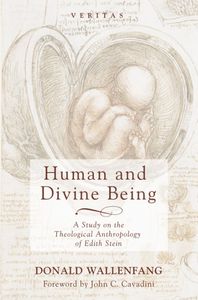 Sang-il Kim, a doctoral candidate in Practical Theology at BUSTH, recently reviewed Human and Divine Being: A Study on the Theological Anthropology of Edith Stein, by Donald Wallenfang. Please see the beginning of Kim's review below and visit the Reading Religion website for the full review.
Reading Religion (RR) is an open book review website published by the American Academy of Religion (AAR). The site provides up-to-date coverage of scholarly publishing in religious studies, reviewed by scholars with special interest and/or expertise in the relevant subfields.
Human and Divine Being: A Study on the Theological Anthropology of Edith Stein, by Donald Wallenfang, Eugene, OR: Cascade Books , April 2017. 274 pages.
$33.00. Paperback. ISBN 9781498293365. For other formats: See Cascade Books.
Dr. Michael Balboni publishes Spirituality and Religion Within the Culture of Medicine: From Evidence to Practice
 Congratulations to Dr. Michael Balboni (STH Practical Theology '11) on publishing Spirituality and Religion Within the Culture of Medicine: From Evidence to Practice! Co-edited with Dr. John Peteet, Spirituality and Religion Within the Culture of Medicine is a multi-disciplinary approach evaluating the relationship between spirituality, religion, and medicine. With contributions from leading clinician researchers from several fields, as well as scholars from humanities and social-scientific disciplines, this comprehensive volume is a critical resource for scholars, researchers, clinicians, practitioners, and students across a variety of disciplines. More on the volume is available at this link.
APT 32nd Biennial Conference Call for Papers
APT 32nd Biennial Conference
Call for Papers
MAKING JUSTICE:
PRACTICAL THEOLOGY, THE ARTS, AND TRANSFORMATION
The Association of Practical Theology
Biennial Conference, April 13-15, 2018
Yale University Divinity School, New Haven, CT
APTNH2018@gmail.com
Call for Papers
Proposals will be accepted through 10 December 2017.
All notifications to presenters will be made by 19 January 2018.
Theme Description
The arts have the power to change the way we view reality. The noted philosopher of education, Maxine Greene, considered art an act of “social imagination” that awakens social consciousness by allowing people to “see things as if they could be otherwise.” How are practical theologians engaging the arts, particularly in relation to the work of challenging injustice and envisioning social transformation? What other kinds of change can practical theological engagement with arts generate? The theme for the 2018 Association of Practical Theology’s Biennial Meeting, Making Justice: Practical Theology, the Arts, and Transformation, invites explorations of practical theological aesthetics and the work of performing justice through practical theology’s engagement with the arts, including explorations of the role that justice invites and demands in such engagements.
Recent scenes of public protest in the US, from Ferguson (Missouri), to Standing Rock (North Dakota), to Charlottesville (Virginia), have reawakened the performance of protest art and the use of the arts to challenge oppressive systems. For instance, the events of Ferguson gave rise to powerful creative responses from such groups as Artivists STL and the documentary film Whose Streets? (http://www.whosestreets.com/). Scholars of music, long recognizing music’s crucial role in the Civil Rights Movement of the 20th century, lift up contemporary rappers and spoken word artists as similarly giving voice to 21st century movements toward racial justice. Drama and dance based groups create opportunities for personal transformation as well as working for social justice, in forms such as Theatre of the Oppressed and InterPlay. Music, performance arts, poetics, and material art forms all can give expression to what is otherwise ineffable, offering alternative languages for meanings that refuse more typical forms of narrativity.
The intersections between art and practical theology show up in spaces such as the relatively new discourse on “theopoetics,” and in academic spaces such as religion and literature programs. Recent practical theological writings also give renewed attention to the arts in intersection with practical theology. Illman and Smith (2013) speak of the arts as having a particular kind of wisdom, offering examples of communities’ arts-based practices of as key sites where practical theology is enacted. Graham and Poling (2000) name art as “resistance to evil.”
In this biennial conference, we invite exploration of the intersections between practical theological reflection and art in its varied forms—music, film, poetics, performance arts such as dance and theater, material art forms such as painting, murals, sculpture, and art installations. In what sense might practical theology itself be art that includes performance, rhetoric, and aesthetics? Topics might include practical theological engagement with the following: the arts and anti-racism; populist art forms (graffiti, “street theater,” spoken word) as practical theology; contemporary sound tracks of justice movements; art, worship, and justice; the poetics of protest; the politics of art in urban public spaces; practical theology at the cinema; music in contemporary “worship wars”; photographing/ sculpting/ painting transformation; religious art in new faith communities; practical theology as art; the arts transforming practical theology.
Call for Proposals
We invite proposals for presentations that engage any dimension of the conference theme as described above. We welcome proposals that not only advance the research and discourse on practical theology and the arts, but also attend to presentational modalities that highlight the role that the arts play in practical theological construction. We encourage researchers/presenters to imagine creative modes of interweaving art forms into their presentations.
There are three possible types of presentation for this biennial conference:
Research Paper: A finished paper (5,000-7,000 words) that will be uploaded, read, and discussed among participants in an assigned breakout session. Accepted papers will be paired with one or two others to form a breakout session (1.5-to-3-hrs). Authors of accepted papers will be prepared to facilitate conversation among session participants. We strongly encourage utilization of the creative arts in the paper presentation and discussion.
Original Collaborative Production or Performance: An artistic production or performance that represents dynamic collaboration between scholars and artists who seek to advance practical theological reflection and the arts in their varied forms. The production/performance may take different forms (e.g., original film, live performance, visual installation), but must be accompanied by a written interpretive analysis (2,000-3,000 words). Accepted productions/performances (with audience discussion) will be assigned to 1.5-hr sessions.
Exhibit/Poster: A print or digital media presentation, or artistic exhibit, which represent emerging or on-going advancement of themes related to practical theological aesthetics. Selected poster presentations/exhibits will be on display during the conference in designated areas. There will be designated times for presenters to engage informally in Q&A with conference participants. (The standard size for print posters is 36in x 48 in, or 3ft x 4 ft. You may request for alternative specifics in the proposal, as needed.)
Proposal Guidelines
To submit a proposal for your presentation, please use the following Google Form ( https://goo.gl/forms/pVMJLGLceSjMQ5aU2). You will be prompted to provide the following information:
Author/Presenter information (name, institution, contact information).
Proposal information:
Title of proposal.
Type of proposal.
Abstract for proposal (no more than 50 words).
Narrative of no more than 500 words (excluding. bibliography) that explains the content and format of your intended presentation. Proposals will be selected by a blind peer review process. Therefore, please do not include information that would identify the author/presenter in this narrative.
Brief bibliography to situate your proposed topic within relevant research.
Specifications about audiovisual equipment and/or space desired for your presentation. We cannot guarantee that all requests will be met, but will do our best to explore options at the venue on your behalf. You will be notified in advance whether your request can be accommodated.
Proposals will be selected by a blind peer review process.
It is not necessary to be a member of the APT to submit a proposal; however, if selected to present, presenters must join membership and register for the conference.
Selected presentations must be given in person by those named in the proposal. No presentations can be made by proxy.
Proposals will be accepted through 10 December 2017.
All notifications to presenters will be made by 19 January 2018.
Research papers must be submitted electronically (in Word format, emailed to APTNH2018@gmail.com) by no later than 2 April 2018 so that they can be uploaded for prior reading by conference participants.
Faith in Action: Poverty and the Racialization of Economy
Faith in Action:
Poverty and the Racialization of Economy
Featuring Drs. Cornel West, Pamela Lightsey, Peter Paris, and Nimi Wariboko

October 19, 2017, 6:30-9:00 pm
Boston University George Sherman Union
Sherman Auditorium, 2nd floor
775 Commonwealth Ave.
The Poverty Consortium invites you to "Faith in Action: Poverty and the Racialization of Economy," a panel featuring Drs. Pamela Lightsey, Peter Paris, Nimi Wariboko and Cornel West. The event will be held October 19, 2017, 6:30-9:00 in the George Sherman Auditorium (second floor, George Sherman Union) at Boston University, 775 Commonwealth Ave.
A live stream of the event is available at this link. Light hors d'oeuvres and opportunity for conversation to follow. The event is sponsored by Boston University School of Theology, the Association of Black Seminarians at BU School of Theology, and The Poverty Consortium. All are welcome. Questions? Please contact Dr. Diana Swancutt at swancutt@bu.edu.
10th Annual Lecture for The Center for Practical Theology Announced
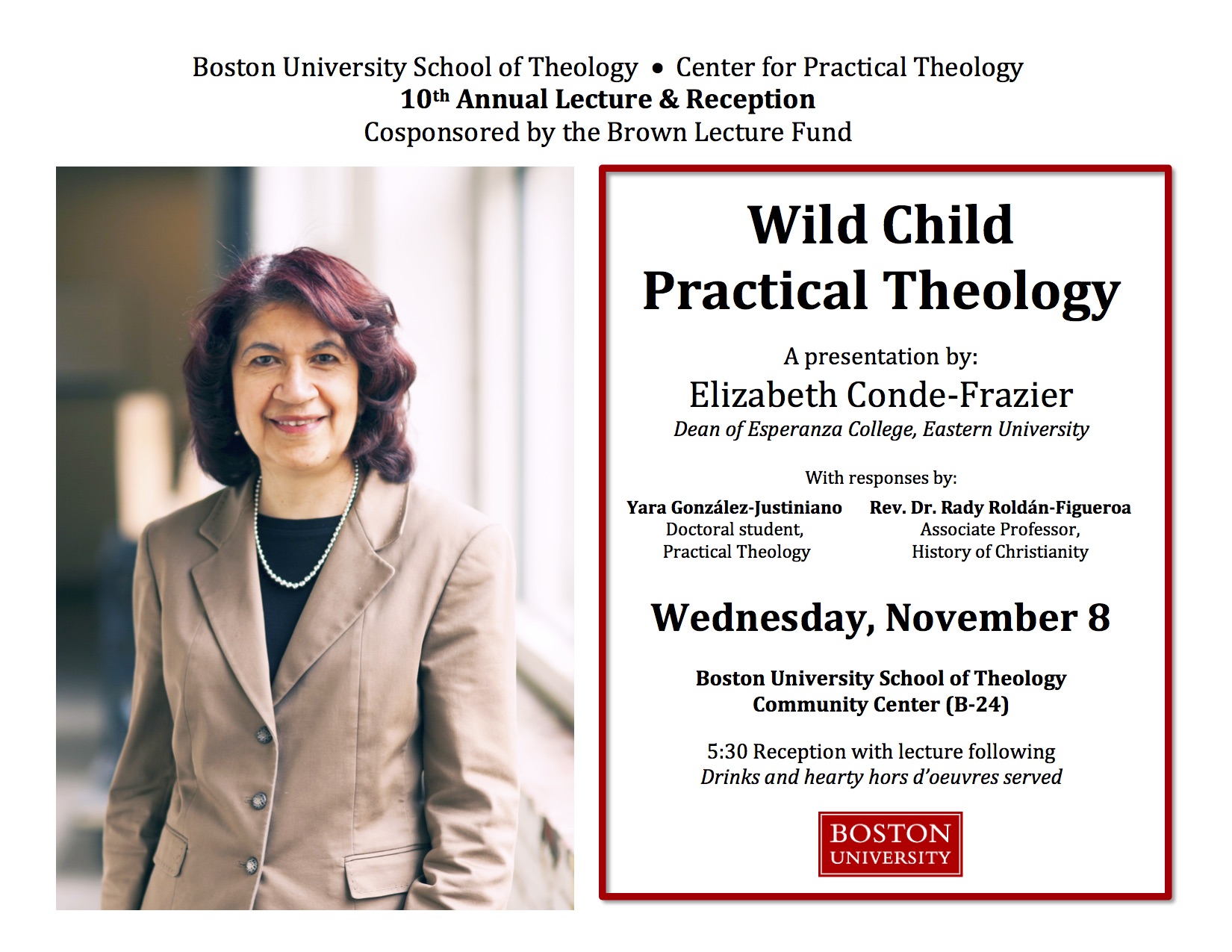
You are warmly invited to the 10th Annual Lecture of The Center for Practical Theology on Wednesday, November 8, 2017. Dr. Elizabeth Conde-Frazier will present on "Wild Child Practical Theology," with Yara González-Justiniano, PhD student in Practical Theology at STH, and Dr. Rady Roldán-Figueroa, STH Associate Professor of the History of Christianity, responding to Dr. Conde-Frazier's presentation. The reception begins at 5:30 with the lecture following. For those who cannot attend, we hope you'll be present in spirit via the Livestream at this link. Thank you to the Brown Lecture fund for their generous support of this event. We hope to see you in November!
Lived Theology: New Perspectives on Method, Style, and Pedagogy (AAR Reading Religion Book Review)
 Matthew Beal, doctoral student in Practical Theology at BUSTH, recently reviewed Lived Theology: New Perspectives on Method, Style, and Pedagogy, edited by Charles Marsh, Peter Slade, and Sarah Azaransky. Please see the beginning of Beal's review below and visit the Reading Religion website for the full review.
Reading Religion (RR) is an open book review website published by the American Academy of Religion (AAR). The site provides up-to-date coverage of scholarly publishing in religious studies, reviewed by scholars with special interest and/or expertise in the relevant subfields.
Lived Theology: New Perspectives on Method, Style, and Pedagogy, edited by Charles Marsh, Peter Slade, and Sarah Azaransky
Lived Theology: New Perspectives on Method, Style, and Pedagogy is the fruit of a two-year collaboration of the Project on Lived Theology [PLT], exploring issues related to two governing questions: the first asks “how might theologians engage the lived experience of Christian persons and communities with the same care and precision given to reading and interpreting texts?” and the second asks, “How might storied accounts of life with God inform the methodology, style, and teaching of Christian theology, and in turn illuminate a new model for bridging the widely lamented and discussed division between the academy and the congregations?” (vii). Charles Marsh’s Introduction then orients the reader to the idea of “lived theology.” It is a path of inquiry that addresses the disconnect between the academic study of theology and the ambiguous and chaotic world of lived experience—the theory-practice gap. Lived theology views practices as communicative, meaning that they permit discernment of theological truth concerning God’s presence and activity (6-7). Follow this link to read more of Beal’s review of Lived Theology.
Call for Submissions to Practical Matters

Call for Submissions to Practical Matters
Issue 11: Migrations
Deadline: October 1, 2017
Practical Matters is now accepting submissions on religious practices and practical theology for Issue 11. The journal will feature articles on the theme of “Migrations.” You can follow this link for the Call for Papers. Founded in 2007, Practical Matters is a cutting edge project in digital publishing funded by the Lilly Endowment and sponsored by the Initiative in Religious Practices and Practical Theology at Emory University.
In the last thirty years, theoretical frameworks across disciplines have emphasized mobility over more static conceptions of place. New metaphors of displacement, border crossings, nomads, transculturalism, diaspora, and migration reflect a world in motion. People are moving across distances both great and small as immigrants, political or economic refugees, and seasonal or temporary laborers. These individuals migrate with objects, practices, beliefs, theories, and cultures. In the midst of this motion, religion shapes and is shaped by these migrants, the places they have left behind, and the ones they enter into.
Potential topics may include but are not limited to: religious practices created or used by migrating individuals and communities, the movement of religious practices themselves, the role of religion in local as well as global migrations, religious practices across local, national, and religious borders, and the work of religious institutions in the refugee crisis religion as a source of agency for migrants.
Practical Matters continues to seek submissions that promote the dialogue between religious studies and practical theology through scholarship on religious traditions as embodied in religious practices, methods for engaging research questions that emerge in and about religious communities, theories of practice and praxis, and structures of scholarship that allow for more robust interactions between academic institutions and religious practitioners. We invite contributions on or from any religious or spiritual tradition as well as from any theoretical position or discipline. The journal includes both peer-reviewed articles (Features and Analyzing Matters) as well as non-peer reviewed content that presents the thoughtful reflections of teachers and practitioners (Practicing Matters and Teaching Matters). Practical Matters accepts submissions that incorporate a variety of media and genres.
For any additional information, please contact with the Issue Editor Eunil David Cho at pm.issue.editor@emory.edu.
Practical Matters Journal Website: http://practicalmattersjournal.org/
Dr. Stephanie Arel publishes Affect Theory, Shame, and Christian Formation
 We are excited to announce that Dr. Stephanie Arel (STH Practical Theology '14) has been named as an Andrew W. Mellon Postdoctoral Fellow at The National September 11 Memorial & Museum and Visiting Scholar at New York University. Dr. Arel is the co-editor, along with Dr. Shelly Rambo, of Post-Traumatic Public Theology, and she has recently published Affect Theory, Shame, and Christian Formation. Here, she shares more about her research, including what influences her interdisciplinary approach and why embodiment matters in practical theology.
1.What inspired you to engage Christian tradition and practice through the affect of shame?
In March of 2011, at a symposium on trauma, healing, and spirituality in Belfast, Ireland, I spoke about shame in the context of war, addressing the experiences of women survivors of rape during the Rwandan genocide, US soldiers returning from war with PTSD symptoms, and cultures, like those in Belfast and Bosnia, steeped in war and violence. The presentation asserted that theology has a responsibility to examine how the church talks about shame, guilt, and sin to help survivors of war trauma attend to their wounds. Afterwards, questions and stories about guilt, shame, and the role of theology in war proliferated. Two priests from Belfast and a therapist of African victims of torture shared about deep wounds suffered in war, urging me to continue to explore the affective impact of shame. They pressed the need for shame to be discussed more openly in theological circles, especially those that employ practices of care.
-
Your work is very interdisciplinary, drawing from psychology, literary theory, trauma studies and affect theory. How do you understand this interdisciplinary approach to enhance your practical theological perspective?
If we assume that practical theology constructs a bridge between theological learning and reflection on the one hand and the actual experiences or practices of Christian communities on the other, then we need tools to build, change, or improve that bridge. I see other disciplines as tools that offer methodological variety with which to approach reflection on religious practice thereby enhancing the depth of interpretation related to how praxis reflects particular theologies. Construction of new ideas through insights from other disciplines occurs alongside integration of academic schools of thought in the pursuit of a common goal. In my research, I combine the perspectives of two or more fields to enrich my understanding of religious practice while highlighting how religion undulates in modern thought and behavior.
-
You write that a focus on affect engenders “shame’s impact on the Christian self as fully embodied” and that the body is the “affective center of life” (24). This turn to the materiality and experience of the body is crucial for practical theologians. What possibilities do you see for exploring the impacts of other affects on the full embodied Christian self?
Affects are fractious, and they lie at the root of human experience – they show up first on the face, but they have a profound ability to direct human behavior. In the book, I focus primarily on shame and interest/excitement which technically is necessarily present when shame shows up. I appreciate Tomkins’s recognition of nine basic affect – distress-anguish, enjoyment-joy, interest-excitement, fear-terror, anger-rage, surprise-startle, shame-humiliation, dismell, disgust. The dashes between the affect pairs indicate a range of intensities. I could see fruitful work emerging from the study of any of these. A question that would be interesting to me might relate to how the affects of joy, fear, and anger facilitate or impede Christian formation. Off the cuff, I think that exploring these affects might reveal people’s images of God, how they respond to this image, and how that image effects how they relate in the world on an affective level. I am also interested in how practices and the spaces in which they are performed trigger particular affects.
-
You offer rich readings of Augustine’s City of God and Niebuhr’s Nature and Destiny of Man, particularly on these theologians’ interpretations of original sin. How does your work with these theologians expand past approaches to their work?
I think what interested me most about Augustine and Niebuhr, besides their position as placeholders in the Christian intellectual tradition, is that they are both diagnosticians of the human self or soul. And although, as my work tries to illustrate, they misunderstand affective phenomena, calling guilt shame for instance (although Augustine I think does a better job at understanding shame than Niebuhr), they are both committed to understanding the mechanisms at place that lead to human dis-ease in their particular contexts. Neither had access to the research we have today, in affect theory for instance. I approach their work with an epistemological advantage, also having at hand the work of other theorists (especially feminists). Uncovering where shame lies in their highly significant works is important for rethinking the theological meaning of shame in the current context.
-
You explore the imposition of ashes on Ash Wednesday as one Christian practice where touch has the potential to disinter shame. How do you see the possibility for other Christian practices?
As I discuss in the book, touch has potential not only to have a negative effect but also a positive one. Two productive consequences of touch include acknowledging another’s presence and triggering positive affects. As a result, any Christian practice that includes touch has the potential to recognize a person’s being in the world (therefore affirming their worth) and the potential to ameliorate negative affect – shame being one of these. The laying on of hands, baptism, touch in exchange during communion – anything where flesh makes contact – can be beneficial. Even though neurologically one does not need to be aware that touch makes a positive impact, I think practitioners that utilize touch can enhance their effectiveness by being aware of touch’s affective consequences.
-
You write beautifully in Chapter 5, “An affectively attuned theology understands that human life is made up of fractious affects, and that practice offers hope for renewal and conversion, not in order to purify and cleanse, but in order to become fully participating members of the Christian community who all bear shame.” Are there any practices or contexts where you think an affectively attuned theology is pressing in our world today?
First of all, I think that paying attention to affect happens when people talk about how affects operate in their bodies, identifying these. I also think that some people – those who are very empathic – can identify affect and the ability to influence someone affectively intuitively. When a person has experienced trauma, any triggering of the trauma (regardless of its perceived intensity) impedes the ability to regulate affect. The demand then is for self-soothing but also for contact with others that can foster healthy connections – or as I put it – attachment. This can happen in community – but it is very difficult even as it is very necessary for personal and communal health.
-
How do you hope practical theologians will engage your work?
I hope many things, but if I can focus on just two. First, I envision this book opening up an intellectual place of engagement with classical theology as it has the capacity to be interpreted and reinterpreted. Other, especially feminist theologians, have paved the way for scholars of my generation to do this effectively. For instance, I could not have uncovered in Augustine the shame I recognize without the work of Mark D. Jordan, Karmen MacKendrick, and Virginia Burrus. Secondly, I hope that the project propels theological reflection concerning how theory and practice make an indelible impact on affect, an impact that can either perpetuate shame and trauma or ameliorate their effects.
Lecturer in Practical Theology position posted at University of Aberdeen

Lecturer in Practical Theology
University of Aberdeen
School of Divinity, History & Philosophy
| Location: | Aberdeen |
| Salary: | £39,324 to £46,924 per annum |
| Hours: | Full Time |
| Contract Type: | Permanent |
| Placed on: | 4th August 2017 |
| Closes: | 7th September 2017 |
| Job Ref: | DHP058AX |
Salary will be at the appropriate point on the Grade 7 scale (£39,324-£46,924 per annum), with placement according to qualifications and experience.
Should you wish to make an informal enquiry please contact:
Professor Paul T Nimmo, Head of Divinity and Religious Studies (telephone: 01224 273120, email: paul.nimmo@abdn.ac.uk).
Should you require a visa to undertake paid employment in the UK you will be required to fulfil the minimum points criteria to be granted a Certificate of Sponsorship and Tier 2 visa. As appropriate, at the time an offer of appointment is made you will be asked to demonstrate that you fulfil the criteria in respect of financial maintenance and competency in English. Please do not hesitate to contact Dora Golaszewska (dora.golaszewska@abdn.ac.uk) for further information.
To apply online for this position visit www.abdn.ac.uk/jobs.
Job Reference Number: DHP058AX
The closing date for the receipt of applications is 7 September 2017.
Promoting Diversity and Equal Opportunities throughout the University.