

The Newsroom
The journalism department’s capstone course is giving student reporters coveted clips and landing them jobs when they graduate. It might even help save community news.
When he saw the news tip in his inbox, Charlie Johnson figured it would be a pretty straightforward local story. It ended up being anything but.
Johnson (’25) had been writing for Brookline.News all semester, and the email was from the nonprofit news organization’s editor, Sam Mintz: An area homeowner had reached out with questions about the sudden demolition of a house in her neighborhood.
Johnson, who was assigned the story as part of The Newsroom (JO 400), a capstone course in his journalism major, first spoke with the woman who’d made the complaint, as well as another neighbor. It wasn’t until he talked to the contractor who brought down the house in February 2025 that he knew he had more than just a slice-of-life reaction story. “It kind of spiraled,” he says, “and I realized there was more involved than just writing this quick update.”
| Students | News Outlets | Published Stories | |
| Spring & Summer 2025 | 33 | 15+ | 193 |
| Fall 2025 | 64 | 31 | 316 |
A Jamaica Plain couple had purchased the 1950s two-story in 2023. They had intended to renovate it, but after running into difficulties, they decided to tear it down in order to build a modern, energy-efficient home in its place. Johnson pored over Brookline permitting records and contacted the local building commissioner. He discovered that the contractor had not procured the proper permits before demolishing the home. Utilities providers told Johnson that electrical and gas were shut off only after the walls had come down. The demolition site, which remained a mess for weeks, was full of asbestos, according to the building commissioner’s report.
“His detailed, tantalizing story became one of our most-read of all time,” Mintz says. “And in addition to the sense of scandal that helped elevate it to a townwide ‘talker,’ it also raised interesting policy questions about the town building department’s role in policing bad actors.”
Johnson’s deep reporting wouldn’t have been possible for the Brookline.News staff of two, Mintz says.
Johnson credits the direction and editing he received from the course instructors, former Boston Globe editors Brian McGrory and Steve Greenlee. At the end of the course, he had amassed eight story clips at Brookline.News that he is using to apply for positions at community newspapers across the country, where he is interested in the kind of accountability reporting that helped him break the story about the unpermitted demolition in Brookline.
It was precisely how McGrory, chair of the journalism department (currently on leave), had drawn up The Newsroom course shortly after arriving at COM in 2023: Small, independent publications across eastern Massachusetts would receive professionally edited, student-written stories about their communities; students would gain invaluable experience, immersing themselves in the work of community journalism. The first two sections—spring and summer 2025—were an out-and-out success, with 33 students publishing 193 stories in more than 15 small news outlets.
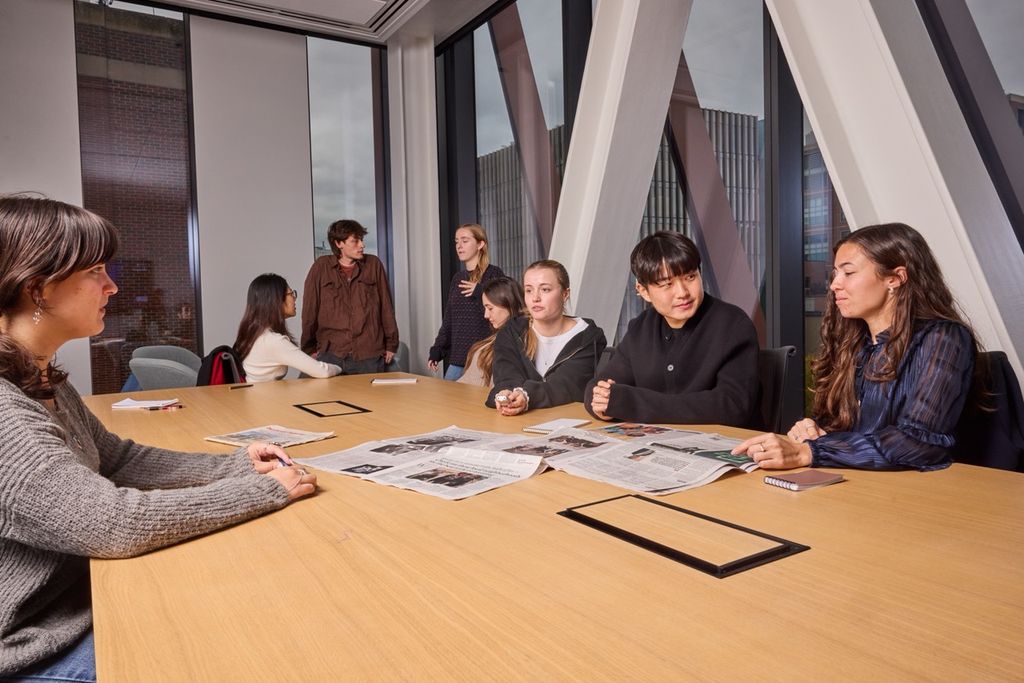
In fall 2025, COM expanded the model across five courses, with 64 student journalists and 31 community news partners—and eclipsed 300 published stories. “We want to make it the cornerstone of the journalism program at Boston University,” he says.
“A win-win-win”
In his 34 years as a Boston Globe journalist—including a decade as editor-in-chief—McGrory witnessed the glory days of the newspaper industry, and then its gradual decline. Local news outlets have long been losing the attention race to smartphones, and their advertising revenue has migrated to social media sites.

But McGrory knew of upstarts trying to buck the trend. “I kept hearing from people who are out in their communities launching their own nonprofit news organizations, mostly online news sites, and they were bootstrapping it,” he says. “They had very limited resources.”
At the same time, breaking into the industry can be challenging for young reporters. Students told McGrory they were having trouble building the kind of professional writing portfolios they would need to land an internship, let alone an industry job when they graduated. He imagined a partnership that could help the journalists in his program and offer vital reporting and editing to those bootstrapping community news organizations. With the support of Dean Mariette DiChristina (’86), McGrory redesigned JO 400—previously a course in which students wrote stories that would likely never be published—to be a functioning newsroom, with students reporting for local outlets.
The model isn’t new for COM—individual classes have long partnered with local outlets, and the college’s Statehouse Program provides students with experience reporting from Massachusetts’ political power center. The key to scaling up this work, McGrory knew, would be ensuring that the student reporting was drum-tight and the copy was clean. He’d need an editor.
I kept hearing from people who are out in their communities launching their own nonprofit news organizations…and they were bootstrapping it. They had very limited resources.
—Brian McGrory
In mid-2024, COM hired Greenlee, an industry veteran and McGrory’s old Globe colleague, most recently the executive editor at the Portland Press Herald, to help him design and coteach The Newsroom course, and to edit the students’ stories. They’d also need a roster of independent publications willing to work with COM students. Greenlee, a professor of the practice of journalism, found that there was no convincing needed: Mintz, of Brookline.News, was among 15 editors to jump at the opportunity ahead of the spring 2025 semester.
“We saw the partnership with The Newsroom class as a win-win-win,” says Mintz. “For us, it was a chance to receive and publish professionally edited stories from enthusiastic students. For the students, it was an opportunity to develop clips, learn about the standards, expectations and rhythm of a real-world newsroom, and make connections with local editors. And for BU, it helped bolster the already stellar reputation of the journalism department.”
Repetitions in the Field
By spring 2025, McGrory and Greenlee had selected 18 student journalists, most of whom were in their final semester, to participate in the first section of the course. The instructors knew that students’ skills would only get stronger with each cycle of reporting and filing a story, then being edited at a professional level.
I knew we were going to give them much more rigorous feedback and editing than they’ve ever had.… And we saw every student in our class get better and better over the course of the semester.
—Steve Greenlee
Each student was paired with an outlet and, at first, story ideas originated from the partner publications. By the end of the semester, students had formed reporting beats in the communities they covered and were pitching potential stories as they found them.

Chloe Jad (’25) pitched and wrote a piece for WBUR about an amateur Portuguese club soccer team in Cambridge ahead of its first trip to the U.S. Open Cup tournament. Jad embedded herself with the team and submitted a story that Greenlee edited as though she were a Globe or Press Herald reporter. “Steve was very frank about ‘You wrote too much here, this is too confusing here,’” Jad says. McGrory used the story to nominate Jad for COM’s $5,000 Jerome A. Nachman Writing Award, which she won. “That was the first story where I really got out there, met with the people in person, saw the environment, was able to write about details only I could know about because I was there talking to people,” she says. “And Steve edited the hell out of it with me.”
Rayea Jain (’26) took The Newsroom as a summer course, which she says gave her the freedom to spend most days in cafés around Newton scouting potential stories for The Newton Beacon. She noticed the community lacked arts coverage, so she pitched a story about a Scandinavian Viking Festival. Flanked by a student photographer from a photojournalism course that partnered with The Newsroom, she covered the eclectic event. “It’s something that maybe they wouldn’t report on, because it doesn’t seem as newsworthy,” Jain says. “But it’s equally important to the community to learn about where you’re living, the people there, the things going on for your family.”

Through the summer section of The Newsroom, the publications had accepted 100 percent of the student-reported stories, an unheard-of figure in journalism classes, McGrory says. Because they effectively doubled the number of partner publications for fall 2025, McGrory and Greenlee added a deputy editor—Pulitzer Prize finalist Scott Farwell, a master lecturer in journalism—to help manage the story load.
“I wasn’t sure what to expect this first semester of working with students, because Brian and I knew we were going to give them much more rigorous feedback and editing than they’ve ever had,” Greenlee says. “They were so happy to get feedback that helped them improve, and we saw every student in our class get better and better over the course of the semester.”
Jad walked away from The Newsroom with nine WBUR news clips. She had been planning to stick around Boston and work as a freelance reporter, but McGrory sent her a posting for a position at the Pittsburgh Post-Gazette and encouraged her to apply. Jad was hired as the Post-Gazette’s technology reporter in June. It was the only job she applied for.
“I genuinely think that it was the BU clips that got me the job,” she says. “This is a completely radical-approach class. I was able to point to something and say, ‘Here’s what I learned, here’s what I was able to do with what I learned.’ There it is—it’s online.”
FALL 2025 OUTLETS
- Allstonia
- Cambridge Day
- Beacon Hill Times
- Belmont Voice
- Berkshire Eagle
- Boston Business Journal
- Boston Sun
- Brookline.News
- Daily Hampshire Gazette
- The Dorchester Reporter
- Fig City News
- Gotta Know Medford
- Jamaica Plain Gazette
- Lexington Observer
- MetroWest Daily News
- Mission Hill Gazette
- The Natick Report
- Needham Observer
- New Bedford Light
- Newton Beacon
- North End Regional Review
- Plymouth Independent
- Saugus Advocate
- The Swellesley Report
- Waltham Times
- WBUR
- Weston Observer
- Winchester News
- Worcester Guardian
- Your Arlington


