Exploring the Intersection of Art as a Social Science at BU: Meet Thurman Center’s Nick Bates
This article was written by Shayla Brown (CAS’26) and Xiaowei “Kiwi” Yang (CAS’27), interns in the Summer Writing Internship Program focused on social science writing.
The Center for Innovation in Social Sciences (CISS) is committed to highlighting the meaningful and impactful work being done across Boston University by social scientists. In summer 2025, SWIP (Social Science Summer Writing Internship Program) interns Shayla Brown (CAS ‘26; Anthropology) and Kiwi Yang (CAS ‘27; Sociology) are turning their attentions to an especially rich and evolving area: the intersection of the arts and the social sciences.
These two fields, often seen as distinct, are deeply interconnected. Artistic expression provides a powerful medium for communicating complex social realities, whereas the social sciences offer frameworks for understanding and interpreting the cultural, historical, and political contexts that shape art. Together, they create new pathways for empathy, awareness, and—most importantly—social change. Research continues to show that integrating creative practices with social inquiry can deepen understanding, foster connection, and inspire action.
 At BU, this intersection comes alive in many ways—one exemplar being the Howard Thurman Center for Common Ground (HTC), often described as BU’s cultural hub. The HTC is a space built on values of inclusion, connection, and dialogue. Among its many offerings are rotating art exhibits that reflect themes of identity, community, and justice. These exhibits are carefully curated by HTC Director Nick Bates (Howard Thurman Center/Director), who draws on the legacy of Howard Thurman to guide his vision for the center. Howard Thurman was an influential theologian, author, civil rights leader, and dean of BU’s Marsh chapel from 1953-65.
CISS summer writing intern Shayla Brown had the opportunity to sit down with Nick and hear his reflections on how art and the social sciences work together to foster meaningful dialogue and drive social transformation.
What led you to this work?
Nick’s path to directing the HTC is grounded in generational community activism. His grandmother advocated for homeowners’ rights and was involved in protests to hire a Black president for Chicago City University.
These experiences shaped his foundation in community justice. He describes his philosophical approach as evolving from early community activism to exploring “interpretive life”—the ways we understand community and identity. He was drawn to BU by Howard Thurman’s writings and Toni Morrison’s The Practice of Freedom—seeing in them a model for “engaged pluralism,” where diverse identities are nurtured in shared spaces.
How are HTC art exhibits and programs curated?
Nick explains,“Our process [is]… based on Thurman’s book Disciplines of the Spirit… reconciliation, prayer, suffering… we use that as our foundation… looking at art through that lens.”
He notes he curated exhibits highlighting themes—initially showing printmaking that spoke to reconciliation, prayer, and social justice. Thurman’s own integration of artistic expression into spiritual life (e.g. interpretive dance in sermons about the Black Madonna) serves as inspiration for connecting art with social meaning.
How do art and social science complement each other in driving change?
Nick explains how quantitative and qualitative research inform one another and “art is a direct reflection of what the social sciences are doing..they just look different in what they want to say.”
Art interprets lived experiences, emotions, and contexts—in a way that parallels how social science seeks to understand communities. They shape meaning differently but serve a shared goal: deeper insight into the human condition.
Is there a project that embodies Thurman’s vision?
He highlights Charcoal Magazine, a student-run multimedia initiative that began in 2018 with 20 students and has since expanded to 172, “… it was a photo‑based magazine, art, spoken word, journal articles…you would see a range of identities and expressions that loved it. It was exactly what Howard Thurman was talking about [in terms of creative shared experiences]. I saw a group of young people that represented everything you could think of, coming together to produce art. There is no better example of what Howard Thurman speaks to than that project.”
Although the publication eventually ended, Nick recognizes its value. “Endings are amazing… sometimes this iteration is done… it continues to inspire.” Charcoal Magazine continues to serve as a benchmark for inclusion and creative pluralism in community spaces.
How does Nick’s equity and inclusion work shape arts programming at HTC?
He reflects on how “Art is expression and interpretation… when we’re doing identity and equity work, we’re trying to make space for interpretations… it could be how you feel and present in the world… or how the world receives you.”
He highlights the importance of the role of art in scholarship. “Just as much as I’m pulling from noted equity scholars, I’m also pulling from artists.” For example, he designed an orientation workshop combining Howard Thurman’s sermon cadence with the music of Nas (“Illmatic”), blending Jesuit reflection, rap, art, and identity to foster rich dialogue.
He reiterates that “Art inspires creativity for things we may think are mundane problems…art inspires me the same way an equity scholar would inspire me, there’s no difference to me. Art generates creative bursts and often leads back to scholarship.”
Nick Bates’ leadership of the Howard Thurman Center reveals how art and social-science scholarship are mutually reinforcing, each facilitating community transformation. As he emphasizes: whenever people say “it’s just art,” consider how art has historically shaped social movements—from Martin Luther King Jr.’s rhetoric to the Black Arts Movement. Creative expression is not secondary. It is central to shaping meaning, identity, and justice.
 Shayla also had the chance to sit down with rising senior Sofia Sanchez,(CAS/’26), a student majoring in Environmental Archaeology through the College of Arts & Sciences (CAS ‘26), with a minor in Theatre Arts in the College of Fine Arts (CFA). Sofia’s lifelong love of both the humanities and the arts gives her a unique perspective on how literary social sciences and visual/performance arts inform one another.
Why made you pursue a minor in CFA alongside your CAS degree?
Sofia explains how her academic journey took shape. “I started in environmental analysis… because it was something I was interested in… but I did find that it was not exactly what I wanted to do. I wanted to do more in the humanities. Also I’ve just loved the humanities and the arts for a very long time, and I wanted to kind of incorporate that more into what I studied.”
She then refined her major to archaeological and environmental sciences, a discipline that blends material culture with environmental understanding—shifting toward the social sciences rather than policy or strict science. She explains how adding the theatre minor offered new creative outlets: “I did theater my whole life, and I’ve loved it, but it was interesting to see… ways in which I can include what I learned in my screenwriting classes or directing classes or acting classes… towards what I was studying in class [CAS courses].”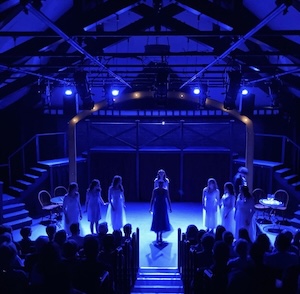
Has there been a moment where your CFA and CAS studies felt directly connected?
Sofia explains that the connection often comes up in conversations with artists in CFA “specifically playwriting… you have the freedom to write about whatever interests you… a lot of that has to do with different kinds of advocacy…personal lived experience or something you research externally and want to make accessible in a story.”
Her engagement in theatre doesn’t just enhance her creative expression—it also enriches her perspective on social impact and advocacy within archaeological studies.
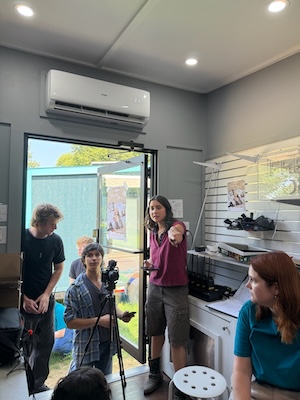 How does art inspire your work and ambitions in archaeological environmental science?
Sofia envisions a future career that blends both disciplines which “…kind of opens up what I’m looking into, postgrad… I do want it to be more in the arts, but with this background, I’m able to come in with a unique perspective and bring my education in material culture, and the environment into whatever story I will tell.”
Her ideas suggest that there is value in advocacy and education through art, and that she hopes to be able to tell these stories in the future in a way that inspires.
How do art and literary social sciences complement each other and drive social change?
Sofia shares a nuanced understanding of both disciplines. In environmental archeology she learned,“You have to go into it… wanting to understand a community or a new group of people in their history… when you go into a space… you have to understand history and the people… what is tangibly important to them.” Whereas in theatre, “You build a space… everything is intentional… learning about the characters… is how you learn about the people.”
Here, she draws a clear parallel: whether conducting archaeological fieldwork or constructing a theatrical environment, both demand empathy, contextual awareness, and deep listening. The methods of social science—research and interpretation—are complemented by the artistic process of expressing emotion and giving form to human experience.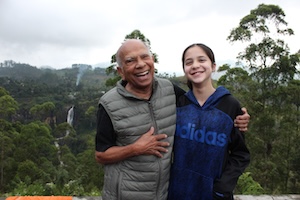
We also learned about her current interdisciplinary work:
Sofia is deeply involved in a personal project this summer that ties to her major. She is “Looking into postwar cultural preservation for Sri Lankan Tamils… [and] the impact of the environment and material culture… through poetry, literature, art… alongside my artistic interest… photography and potentially documentary‑style narrative to look into the role of women’s narratives.”
This active blend of archaeological/environmental sciences research and creative media illustrates how she uses academic rigor as a foundation for storytelling that is both accessible and effective.
 In what ways can art reach people and change perspectives in ways that maybe academic writing sometimes can’t?
She explains that “Art is really special in that way… you can personalize it…and it’s automatically more accessible because it’s about expression… that connects with people more easily rather than telling them about a topic just at face value.”
Her insight captures how performative and visual arts can bridge the gap between research and human connection—translating dense environmental, cultural, or archaeological content into emotionally relatable narratives.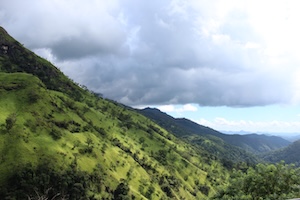
Sofia’s experience reminds us that cultural preservation, environmental study, and artistic expression can—and should—inform one another. Boston University’s academic offerings provide opportunity for this interdisciplinary growth, but student initiative remains key to weaving a personalized path. Sofia’s curriculum, summer work, and thoughtful synthesis offer a powerful blueprint for how future scholars might blend literary social science and visual/performance arts into a cohesive, socially meaningful practice.