African Initiatives
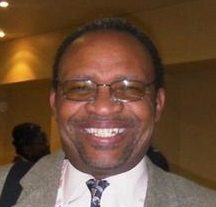
Boston University hosts the second oldest African Studies Center in the United States, and is recognized by the federal government for its excellence in the study of African languages and cultures. The School of Theology is a vital component of African Studies at Boston University, beginning with the sending of graduates to Africa as missionaries over a century ago. Important African alumni include Bishop Josiah Kibira (1964 graduate), the first African head of the Lutheran World Federation; Dr. Kenaleone Ketshabile, Head of the Mission Desk, Methodist Church of Southern Africa; Yusufu Turaki, Professor and former General Secretary of the Evangelical Church of West Africa; and Professor Emmanuel Anyambod, Rector of the Protestant University of Central Africa.
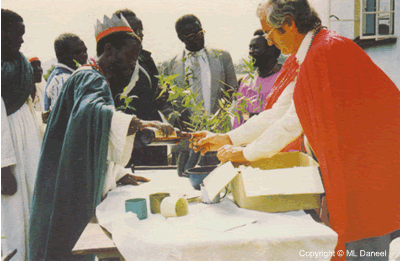
Africa research in the CGCM grows from the work of retired Professor M.L. “Inus” Daneel. His over forty-year presence among African Initiated Churches in Zimbabwe culminated in the 1990s with the largest tree-planting movement in southern Africa, and a program in Theological Education by Extension. The son of missionary parents, Daneel served as a missionary of the Dutch Mission Councils, and then as professor of African theology and missiology at the University of South Africa. He and Professor Robert co-edit the African Initiatives in Christian Mission Series, published by the University of South Africa Press. The goal of the series is to reflect upon contemporary African Christianity, and to document its expansion. Other Africa projects include the digitization of Daneel’s photography and publications on the multimedia site Old & New In Shona Religion, and ongoing research into southern African traditions of earth-care.
See also the Dictionary of African Christian Biography (DACB) listed under Digital Projects.
Dr. Marthinus Daneel, Africa Research Director
Expressions & Encounters Exhibition
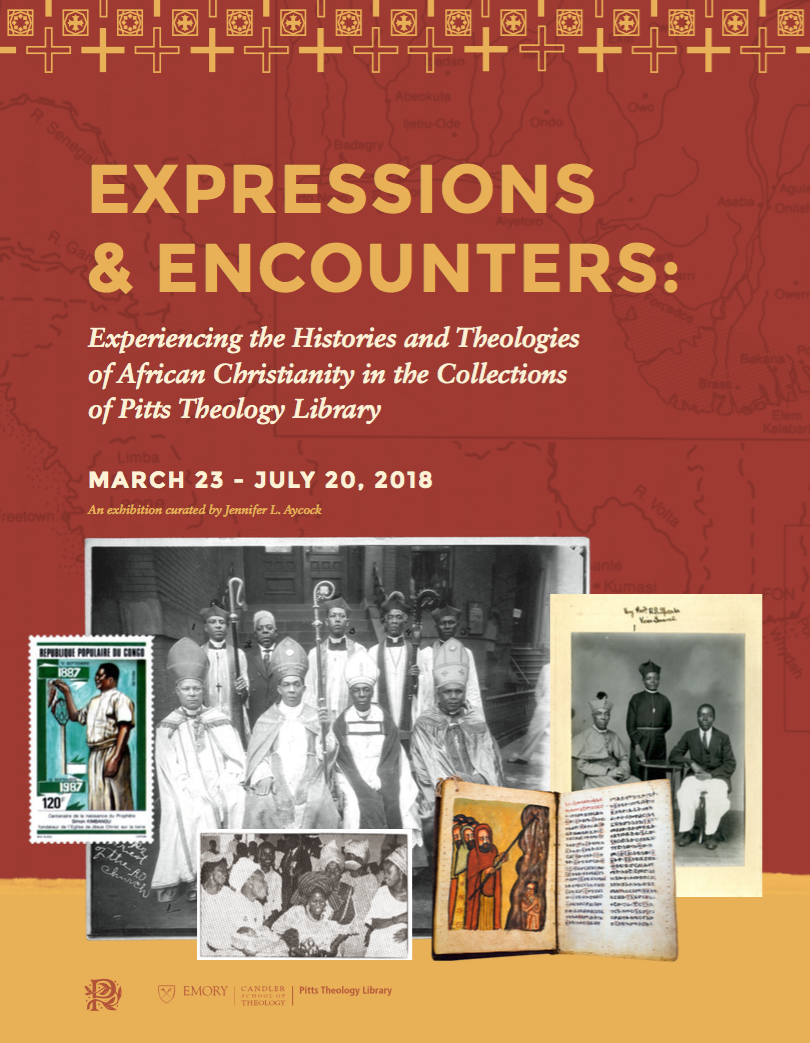
Mission and the Methodist Connexion in Southern Africa
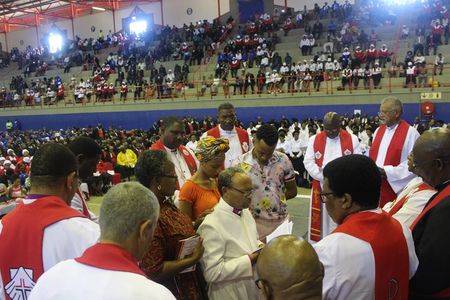 The Methodist Church of Southern Africa installed the leader of its Mission unit, Rev. Dr. Kenaleone Ketshabile ('12), as the new bishop of the Kimberly, Namibia, and Bloemfontein District. The District is mostly rural and rich in many languages including Afrikaans, English, Sesotho, Setswana, etc. Its vision and mission is aligned with the Connexional one – that Methodist people are called to proclaim the gospel of healing and transformation.
Sexual Politics and Christianity in Africa
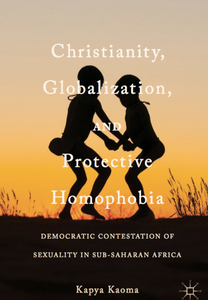 In his most recent book, Christianity, Globalization, and Protective Homophobia, Visiting Researcher Kapya Kaoma illuminates the complex and contested nature of sexual politics in sub-Saharan Africa. He examines the way competing understandings of sexuality collide and intermingle, and seeks a way beyond the impasse.
17th Century African Christian Queen Njinga
 European powers expanding into southwest Africa in the 17th century confronted a cunning and capable leader in Queen Njinga. Linda Heywood has been uncovering the story of this complex figure, teasing out how she ruled and what role her faith played in her kingdom. Most recently, she gave lectures on the subject in London and Bristol, England, as she draws closer to the publication of Njinga, History, Memory, and Politics and Culture: Angola and the African Diaspora. This fall, Haywood will lecture on Queen Njinga at the Library of Congress on November 9th (see flyer here) and again on December 14th at the Mariners' Museum. (the photo to the left is of Dr. Heywood at her recent lecture at the Library of Congress).
Call for Papers: Religion and the 21st Century City: Openings and Closures

DEPARTMENT FOR THE STUDY OF RELIGIONS
In Collaboration With
SCHOOL OF ARTS
Call for Papers for an International Conference on
RELIGION AND THE 21ST CENTURY CITY: OPENINGS AND CLOSURES
University of Ghana, 20th-22nd June, 2018
Background
Faith communities and religious institutions have been pivotal in the growth of cities and urban communities in the world, usually as cradles around which large cities emerge. While there are concerns about the impacts of the growth of cities on religious life in the post-modern secular society, we are convinced that the continuous urbanization of societies and growth of cities, however, offers both opportunities and challenges to religious life and commitments to the sacred. Particularly, the growth of cities and urban spaces as well as the dynamics of city and/or urban life have provided bothopenings and closures to faiths and religious life with regard to: (i) the conceptualization and definition of religion and religious space; (ii) organization and role of religion and religious institutions; (iii) religious affiliations and identities; and (iv) religious communication and the interpretations of symbols. Consequently, in communities where the sacred still remains central to the lives of people, the phenomenon of religion and the religiosity of individuals in contemporary secular cities are worth paying attention to in both academic and public discourse, not least as results of the continuing growth of urban conurbations. This is undergirded by the default assumption that conceptualizations of, and understanding the phenomenon known as religion, religious communities and institutions are not insulated from, but are impacted, usually negatively, by the myriad developments taking place in contemporary secular cities. However, those default assumptions overlook a salient fact that the growth and constitution of cities and urban polities also contribute to understanding notions and salience of religion and the role of faith communities in myriad ways. It also remains true that, especially in such societies where religious beliefs remain widespread and central to the population, religions and religiosity of groups also try to negotiate or even constraint city life with regard to the social, economic, moral and religious developments in the secular city.
With the understanding, therefore, that the conceptualization, definition and salience of religion and religious life in both public and academic discourse are contingent on how religion is faring within time and space, the dialectical and complex relationships between religious faiths and contemporary secular cities (urban space) and how both respond to the relationship, is worth examining and reflecting on in academic discourse. This is especially so with regard to the implications of this relationship to the understanding and salience of religious faith in contemporary cities. This emphasis is crucial, as the main aim of the conference is to offer research and reflections into how city dwellers understand and negotiate the idea/notion of the sacred in light of the prospects offered and challenges posed by the city or urban life – how cities influence religion. It also delves into how religion and religious aspirations contribute to or constrains conflicting interests that have converged within the city – government interests, corporate interests, interest of groups of people and civil societies, and individual interests – and which further shape the phenomenon, definition/conceptualization, re-organization and relevance of religion in the 21st century city.
Researchers, academics, religious practitioners, and students are hereby invited to submit abstracts/papers related to, but not limited to, any one of the following themes or topics:
- Urbanization, democracy and religion in the city – especially negotiating the conflicts between customary laws (traditional authority) and constitutionality
- Religious pluralism and religious life in the city
- Religion and the media in the city
- Urbanization, religious innovations and manifestations in the city
- Urbanization, cities and the construction of new religious identities
- Religion, morality and human rights in the modern city
- Faiths, urban ecology and environmental sustainability
- Religion, transportation and mobility in the city
- Religious history, monuments and the growth of cities
- The secular city, religious radicalization and resistance
- Cities, consumer societies and religious markets
- Urban space, new religious movements and proselytization
- Cities, sexuality, human rights and religious co-existence
- Dynamics of the city, religion and gender
- Youth, religion and the city
- Migration, migrants and religious communities
- The urban landscape, emerging markets and religious sensibilities
- Urbanization, configurations and of the sacred and new religious movements (NRMs)
- Religion, the urban space and the performing arts
- The urban space, language use and religious communication (political correctness)
Proposal Submissions:
Abstracts, including five key words, and not exceeding three hundred (300) words in Microsoft Word 98 or newer, must be sent to bwkgolo@ug.edu.ghand aatiemo@ug.edu.gh with the subject “Religion and the City Conference 2018”. Author’s contact details (name, department, email address and phone number) should be provided on a separate page.
Deadlines:
Deadlines for the submission of abstracts: January 31, 2018
Notification of acceptance: February 20, 2018
Submission of draft papers: June 1, 2018
Conference Fees:
Local participants: GHC 250
Local student participants: GHC 100
International participants: $ 200
Further information on payments and other practical matters will be communicated after the notification of acceptance of abstracts.
Important Notice:
Conference fees cover stationery, snacks and lunch only. Conference participants are responsible for their own arrangements for accommodation and transport.
However conference organizers recommend the Erata Hotel which is just a few minutes’ walk from the University. Also available is the University Guest House on the campus.