News of the extended network of faculty, alumni, students, visiting researchers, and mission partners is regularly updated, and some of the big ideas or major events in Global Christianity are covered in the CGCM News.
Call for Papers: Broadening Themes and Methodologies in Research and Writing of History and Christian Mission Theologies
This is a “Call for Papers” on behalf of the journal RELIGIONS, which is preparing a special issue entitled “Broadening Themes and Methodologies in the Research and Writing of History and Christian Mission Theologies.” We are looking for proposals that will address the following description:
This special issue seeks to explore the intersection between history, mission, and theology in the worldwide Christian movement. Essays are invited that identify and investigate new themes or methodologies in the research and writing of the history of Christianity and Christian mission theology. While recent scholarship has begun to diffuse the separation between the history of Christianity and the history of Christian mission, this special issue directly challenges the division between the history of Christianity, the history of Christian mission, and the history of theology. Rather than separate, the issue's focus argues that they are in constant conversation. Thus, the issue's central question might be framed as: How have Christian mission activity and theological constructs shaped, reordered, deconstructed, etc., each other in particular periods and contexts?
For more information, you can follow the link, https://www.mdpi.com/journal/religions/special_issues/Mission#editors
If you are interested in submitting a paper, please send (1) a tentative title and (2) an abstract of no more than 500 words by June 15, 2020. Please send it to the following email address, carlos_cardoza@baylor.edu
The second way is to submit an essay following the directions in the link provided above. Take note that given the current circumstances, RELIGION has extended the submission of manuscripts for 30 January 2021.
New Book: Handbook of African Social Ethics
 This handbook, edited by Nimi Wariboko and Toyin Falola, provides a robust collection of vibrant discourses on African social ethics and ethical practices. It focuses on how the ethical thoughts of Africans are forged within the context of everyday life, and how in turn ethical and philosophical thoughts inform day-to-day living. The essays frame ethics as a historical phenomenon best examined as a historical movement, the dynamic ethos of a people, rather than as a theoretical construct. It thereby offers a bold, incisive, and fresh interpretation of Africa’s ethical life and thought.
Call for Papers: Religion and Communal Interaction
Boston University’s Institute for Culture, Religion, and World Affairs (CURA) invites BU faculty and graduate students to apply to become fellows in the interdisciplinary Colloquium on Religion and World Affairs run in cooperation with the BU School of Theology. The CURA Colloquium involves bimonthly meetings throughout the academic year to discuss working papers on a chosen theme. The papers are prepared by both the BU fellows and invited scholars from outside BU. The colloquium sessions are open to the general public, with the expectation that all attendees read the papers in advance and that the sessions focus on providing feedback and suggestions to the authors. At the end of the colloquium, we hope to collect a coherent group of papers into an edited volume or a themed edition of a relevant journal.
The theme for this year’s Colloquium is religion and communal interaction. Religion plays an important role in how communities across the globe interact. Religion can play a role in peacemaking or can foster social divisions. Religion is a major aspect of identity, and conflict both between and within religious communities is an important aspect of world affairs. Religion plays an important part in debates of definitions of gender, sexuality, ethnicity, and race. In an election year, we are particularly aware of the role that religion can play in politics, as religious identity helps to shape various communities and how they interact with the political system. We invite proposals that explore various aspects of religion and the ways that it affects interactions between and within communities.
A committee of faculty will select the proposals from among those submitted, with the idea of accepting approximately 8-12 fellows. Those selected as CURA Fellows will be asked to prepare a working paper of 5,000-8,000 words that will be scheduled for presentation next year. Fellows will be expected to attend all sessions, read papers in advance, and provide feedback for other participants. Colloquium sessions will be held on Fridays, 12:00-1:30 (on weeks where STH does not have faculty meetings). Fellows will receive a $1,000 stipend for successful participation in the colloquium.
To Apply: Send your resume and a paragraph about your paper topic to Arlene Brennan arleneb@bu.edu. The deadline for applications is Friday, April 17, 2020.
Call for Papers: COVID-19, Disease, and the World Church
In the midst of a pandemic that is shaking the globe we call for papers for a special issue of Studies in World Christianity that analyse immediate responses to COVID-19 and that give some historical perspective on pandemics or epidemics. We do this in order to resource further response to pandemic whose effects will be with us for some years to come.
The papers may interrogate worldwide Christian responses to the outbreak of COVID-19 around the world by examining how churches have responded theologically and practically as the disease continues to spread. How have Christians responded by offering hope, calling for lament, or proclaiming God’s judgment? What ethical questions about planetary health, palliative care etc. have emerged or been hightened? How has digital media been employed for online church practice or as a vehicle for evangelism and social engagement? How has social distancing shaped understandings of the church community, and in what ways has online church left behind certain sectors of society?
The papers may also provide insight into how the world church in the past understood wide spread disease. Plague and pestilence have regularly been given theological scrutiny in Christian history and have prompted discussions of evil. The 1918-19 Influenza Pandemic influenced Pentecostal growth across the globe, and was instrumental in creating Independent Churches in West Africa who turned to fervent prayer and criticised mission churches for a lack of confidence in God. Missionary photography of plague and leprosy have been used to invigorate support of Western churches and missionary societies. In more recent history, HIV/AIDS has been described by some as the result of sexual sin, whereas the Avian flu and SARS were seen by others as fulfilling end-times prophecy and Ebola has shaken customary palliative care and funeral rites.
It is not uncommon to find articles that address aspects of health and Christian healing. In this special issue we wish to examine worldwide Christian reactions to disease and its spread as a way of understanding and reflecting upon a common problem with different contextual outcomes that have distinct and shared responses across the globe.
Due to the timeliness of the subject, we invite indicative abstracts by 20 April 2020 and complete articles (5000–8000 words, footnotes inclusive) by 25 May 2020. Papers should be formatted based on our styl e guide https://www.euppublishing.com/pb-assets/SWC_May2017.pdf and emailed to swc-editor@ed.ac.uk.
New Book: A History of West Central Africa to 1850
 In his latest book, John Thorton has done substantial new research in primary sources and archives, to create an accessible interpretative history of West Central Africa from earliest times to 1852. He gives comprehensive and in-depth coverage of the region with equal focus given to both internal histories or inter-state interactions and external dynamics and relationships. This study represents an original approach to regional histories which goes beyond the existing scholarship on the area. By contextualising and expanding its range to include treatment of the Portuguese colony of Angola, John K. Thornton provides new understandings of significant events, people, and inter-regional interactions which aid the grounding of the history of West Central Africa within a broader context. A valuable resource to students and scholars of African history.
New Book: The Split Economy
 In his new book, The Split Economy, Nimi Wariboko looks closely at the ethical challenge of capitalism. Others have named injustice, inequality, repression, exploitative empires, and capitalism’s psychic hold over all of us, as the central problem. Nimi Wariboko instead argues that the core ethical problem of capitalism lies in the split nature of the modern economy, an economy divided against itself. Production is set against finance, consumption against saving, and the future against the present. As the rich enjoy their lifestyle, their fellow citizens live in servitude. The economy mimics the structure of our human subjectivity as Saint Paul theorizes in Romans 7: the law constitutes the subject as split, traversed by negativity. The economy is split, shot through with a fundamental antagonism. This fundamental negativity at the core of the economy disturbs its stability and identity, generating its destructive drive. The Split Economy develops a robust theoretical framework at the intersection of continental philosophy, psychoanalytic theory, theology, and political economy to reveal a fundamental dynamic at the heart of capitalism.
Award of Excellence
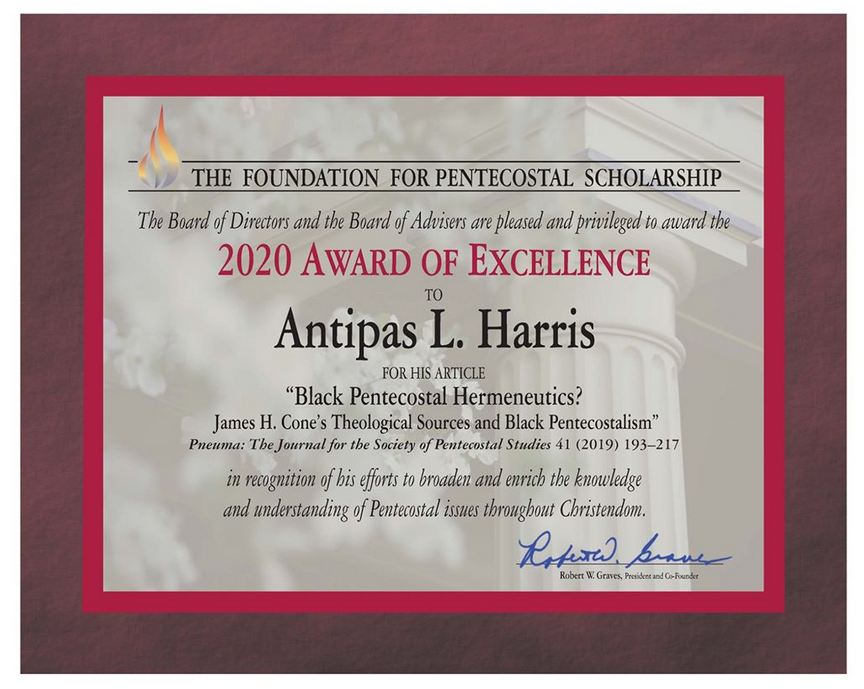
In a recent award-winning article in Pneuma, Antipas Harris ('08) advances hermeneutical insights for emerging black pentecostal scholars to consider. The salient question is, “What distinguishes black Pentecostalism?” This study revisits James H. Cone’s sources for black theology for insight into the role of blackness in shaping black Pentecostalism. On the one hand, the study dispels the myth that black Pentecostalism is inherently a spiritual alternative to the fight for social justice. On the other hand, it calls for critical dialogue between Cone’s sources for black theology and black Pentecostalism to advance scholarship on the formation of black pentecostal hermeneutics. This essay explains that blackness is more than a cultural and experiential reality. Blackness is a theological source that correlates with other sources in shaping black Pentecostalism. Blackness, moreover, legitimates black pentecostal proclivities for the integration of the faith, spirituality, and social advocacy. Theological blackness in Pentecostalism has historically distinguished black Pentecostalism from subsequent white Pentecostalism.
Remembering India’s Pioneering Missionary to Nepal
March 15, 2020 was Rev. C. K. Athialy's birth centenary day. He was the pioneering Indian missionary in Nepal. To honor his life, a thanksgiving meeting was planned in Nepal, but has been postponed due to the rapid spread of the coronavirus. Rev. C. K. Athialy's son, Jesudas Athyal, has been a Visiting Researcher at the CGCM and with his family produced a short documentary of his father's life. The video also features Bishop Abraham Mar Paulos, who earned his doctorate at the Boston University School of Theology in 1993.
Yale-Edinburgh Call for Papers
This year’s conference on World Christianity will take place at New College, University of Edinburgh, UK from 25 – 27 June 2020 on the theme “Oral, Print, and Digital Cultures in World Christianity and the History of Mission.”
Paper proposals with brief abstracts of 250-300 words should be submitted via email by March 6, 2020 to the Conference Administrator, Jessie Fubara-Manuel at cswc-events@ed.ac.uk. Please include your name, the name of your institution, and the title of your proposed paper at the top of the document. Description for the conference theme is available at http://divinity-adhoc.library.yale.edu/Yale-Edinburgh/2020theme.htmand papers should focus on the theme.
Registration for the conference and payment of the conference fee of £90.00 should be completed by March 30, 2020 through the ePay online portal at (http://bit.ly/YaleEd2020). Paper presenters are expected to complete the registration and payment process as a demonstration of their commitment to attend the conference. Details for accommodation are available on the ePay portal. Once you have registered, you will receive further communication.
Please note that space for the conference is limited to 90 participants. If you plan to attend, please register at your earliest convenience. Queries regarding conference registration and submission of abstracts should be sent to Jessie Fubara-Manuel at cswc-events@ed.ac.uk and to Jean Reynolds at J.Reynolds@ed.ac.uk for booking accommodation.
Human Rights, Nonviolence, and Conflict Transformation
In the summer of 2019, Colombia was a place of significant convergence for people of faith and people of conscience who are concerned about issues of human rights, nonviolence and conflict transformation. In early July, the Baptist Peace Fellowship held an international gathering in the Colombian city of Cali. In late July and early August, Bogota was the site for additional international gatherings. Chris Ney was privileged to attend the meetings in Bogota as part of his continuing education.
War Resisters’ International, a 98-year-old pacifist organization based in London, organized a conference called, “Antimilitarism in Movement.” From July 30-August 1, 300 peace workers gathered to share experiences, insights, and resources. While many of the participants came from Colombia and other Latin American nations, but representatives from places as diverse as West Papua, Ambizonia (a region in Cameroon), Palestine, Western Sahara, England, Holland, and more.
In addition to plenaries and workshops, conference participants interacted with each in working theme groups that gathered under the headings, “just peace,” “sustainable peace” and “diverse peace.” The three work groups examined and developed program ideas that relate to the intersection between peace and issues of human rights, the environment, and culture. Over the course of three days, we heard reports about the occupation of territories, the work of human rights workers, and the power of nonviolence to mobilize diverse communities.
Prior to the WRI meeting, a smaller, yet historic consultation took place. For the first time, two international nonviolence networks representing activists from the global south, met for the first time. The Latin American network, Servicio Paz y Justicia (Peace and Justice Service or SERPAJ), founded in 1974 by Argentine Adolfo Perez Esquivel met with the Pan African Nonviolence and Peace Building Network (PANPEN), a network of peacemakers representing thirty nations across the continent of Africa. It was an honor to hear stories of nonviolence from places that are often ignored.
An awareness of the situation in our host country, Colombia, ran through many of these international encounters. Colombia has been known as the site of the longest running civil war in the Western Hemisphere, and one of the most intractable conflicts in the world. But a peace treaty signed in January 2016 by the government and the largest rebel group created hope for an end to the violence.
One of the highlights of the trip to Colombia was the opportunity to learn about the work of JUSTAPZ, a faith-based organization dedicated to conflict transformation. Founded by the Mennonite Church of Colombia in 1990, JUSTAPAZ is a mission partner of the UCC. Their Executive Director, Martín Nates, spoke to the SERPAJ-PANPEN meeting, offering a critique of the implementation of the peace accords and expressing concern about the ongoing violence against leaders of community organizations. Later, I was invited to visit the JUSTAPAZ office to learn about their work with churches and rural communities—workshops on conflict transformation, documentation of human rights violations, and communication by print and radio to reach larger audiences.
On a personal level, these conferences gave me the opportunity to spend time with old friends in the peace movement and even to offer workshops on a Chilean human rights movement. I’m grateful to have had this opportunity.